

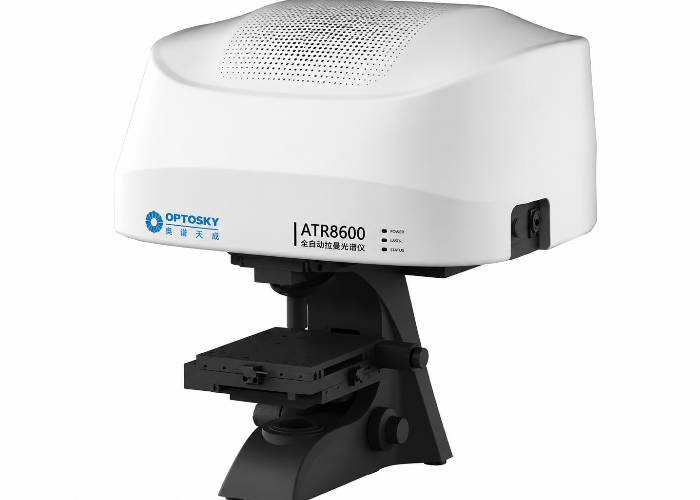
ATR8500 Series Automated Raman Imaging Systems
Automated multi-wavelength Raman microscopy with autofocus, mapping and large-area chemical imaging
Description
The ATR8500 Series is an automated Raman microscope designed for laboratories that need more than isolated point spectra. It combines microscope imaging, autofocus, motorised scanning and Raman mapping so chemical information can be collected systematically across larger sample areas. Single-, dual- and triple-excitation configurations allow the instrument to be adapted to samples with different fluorescence and Raman-response characteristics.
Product Overview
Manual micro-Raman measurements are effective when only a small number of known locations need to be analysed. They become inefficient when a researcher wants to map a large coating, tablet, mineral grain, semiconductor region or heterogeneous material.
ATR8500 automates several of these repetitive steps. The microscope identifies and images the sample region, autofocus establishes the measurement plane, and a motorised scanning platform collects Raman spectra across programmed coordinates.
The resulting spectra can be processed into Raman chemical maps that show where selected compounds, phases or spectral characteristics occur across the specimen.
How It Works
A laser is focused onto the sample through a microscope objective. Raman-scattered light is collected and transferred to the spectrometer, while a camera provides the corresponding microscopic view.
During mapping, the sample stage moves systematically. Each location is associated with a Raman spectrum, producing a three-dimensional dataset containing X position, Y position and spectral information.
Software can then display selected Raman-band intensity, peak position or other calculated results as pseudo-colour maps.
Excitation Configurations
Current documentation identifies:
Single wavelength
- 532 nm
- 633 nm
- 785 nm
- 830 nm
- 1064 nm
Dual wavelength examples
- 785 + 1064 nm
- 532 + 633 nm
- 532 + 1064 nm
- 532 + 785 nm
- 633 + 1064 nm
Triple wavelength examples
- 532 + 633 + 1064 nm
- 532 + 785 + 1064 nm
The exact available combination should be confirmed before purchase.
Key Features
- Fully automated Raman acquisition workflow.
- Autofocus and automatic scanning.
- Raman chemical mapping.
- Single-, dual- and triple-laser configurations.
- Documented mapping area up to 50 × 50 mm on current product information.
- Automatic image-stitching functionality.
- 5-megapixel microscope camera.
- SNR documented above 6000:1.
- USB computer connection.
- Long-integration capability on configured detector platform.
- Enclosed measurement architecture to reduce ambient-light interference.
Technical Specifications
| Parameter | Current documented value |
|---|---|
| SNR | >6000:1 |
| Raman range | 200–3700 cm⁻¹ on documented general configuration |
| Resolution | 3–12 cm⁻¹, configuration dependent |
| Mapping area | Up to 50 × 50 mm on current exact page |
| Microscope camera | 5 MP |
| Laser options | 532, 633, 785, 830, 1064 nm |
| Number of excitation wavelengths | Up to 3 in a configured system |
| Interface | USB 2.0 |
| Focus | Conjugate-focus / automated-focus platform |
| Laser stability | σ/µ <±0.2% documented |
Because wavelength, detector and optical configuration affect both Raman range and resolution, the values above should not be applied indiscriminately to every laser combination.
Applications
ATR8500 is particularly useful where spatial chemical information is important:
- active-component distribution in pharmaceutical tablets
- polymer blends
- coatings and thin films
- semiconductor and electronic materials
- corrosion products
- mineralogical phase distribution
- biological and tissue-related research
- carbon and two-dimensional materials
- SERS mapping
- contaminant localisation
Compatibility and Selection Guidance
ATR8500 should be selected because automated imaging is needed, not simply because it offers more laser wavelengths.
If the laboratory mainly collects individual spectra, ATR8300 may be more economical and simpler. If true-confocal optical sectioning or advanced spectral resolution is central to the application, ATR8600, ATR8700 or ATR8800 may be better pathways.
The sample also determines the appropriate laser. A multi-laser system can be valuable in a shared facility because no single wavelength is ideal for all materials.
Why Source Through ScienceGears
ScienceGears can help define mapping dimensions, spatial-resolution needs, excitation wavelengths, objectives, detector sensitivity and the balance between acquisition speed and spectral resolution. The complete configuration can then be matched to the intended materials and research workflows.
Frequently Asked Questions
What makes ATR8500 different from a normal Raman microscope?
Its main emphasis is automated autofocus, scanning and mapping rather than manually collecting spectra one point at a time.
Can the instrument contain three lasers?
Triple-wavelength configurations are documented for selected combinations.
Does mapping provide a photograph or a chemical map?
The camera produces the optical image. Raman mapping produces a separate chemical/spectral distribution based on spectra collected at each mapped position.
Can the instrument map an entire tablet or coating?
The current system documents a relatively large mapping area, but practical mapping size and acquisition time depend on stage travel, step size and number of spectra.
Does 1064 nm make sense in a Raman microscope?
It can be valuable for strongly fluorescent samples, but the detector, objectives and spectral performance must be configured for that wavelength.
Is a dark room required?
The system incorporates an enclosed measurement architecture that reduces ambient-light interference, although normal laser-safety controls still apply.
Contact ScienceGears
Contact ScienceGears with your sample dimensions, target mapping area, preferred excitation wavelengths, spectral-resolution needs and expected fluorescence so the ATR8500 configuration can be reviewed before quotation.
Customer Reviews
Related Product
Explore our precision instruments designed for electrochemical research and energy applications




Still Wondering About Something?
Explore our FAQ for fast, clear answers to the most common questions—available 24/7.