

L100, L300 and L600-1F/-1FS Intelligent Peristaltic Pumps
Programmable touchscreen drives for multi-step fluid transfer, dispensing and automation
DESCRIPTION
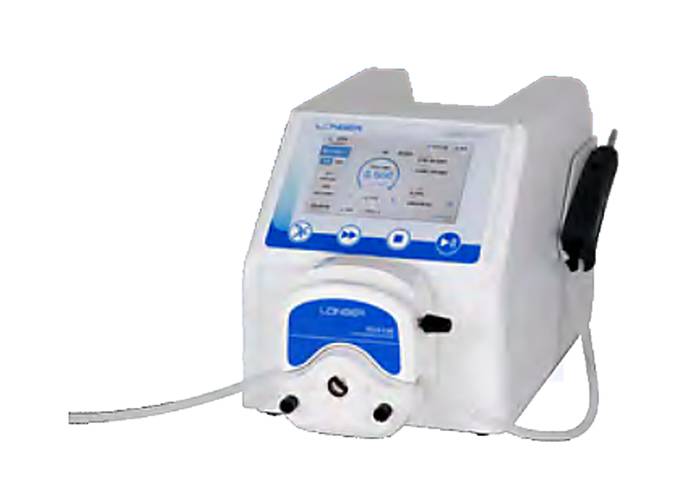
The L100, L300 and L600 intelligent peristaltic pump family combines a seven-inch touchscreen with programmed liquid-transfer and dispensing functions. Each speed class is available in -1F and -1FS versions, producing six principal drive models. Alongside continuous delivery, users can configure staged flow changes, timed operations and repeated dispensing methods. The manufacturer lists maximum single-channel reference flows of 500, 1,500 and 3,000 mL/min respectively when suitable pump-head and tubing combinations are used.
Product Overview
These drives are intended for research and engineering procedures in which liquid delivery changes during an experiment rather than remaining at one constant speed. The interface supports programmed operating sequences built from flow/running and logic functions. This makes the family relevant to automated chemical experiments, repeated liquid handling and test systems where the delivery programme needs to be saved and recalled.
The suffix also matters: the -1FS configurations include the manufacturer's automatic pump-head and tubing identification functionality, which should be used only with compatible supported configurations. Do not treat automatic identification as verification of a tubing material's chemical suitability or as an independent flow sensor.
How It Works
The controller drives a compatible peristaltic head at a programmed rate or sequence of rates. The rotating rollers compress flexible tubing, creating liquid displacement while the experimental fluid remains in the tube. Calibration functions relate the programmed flow or dispensing volume to measured output. Users can combine operating steps such as constant delivery, ramping, pauses, event-triggered actions and repeats. Actual delivery remains sensitive to the head, tube, liquid and pressure conditions.
Package / Configuration
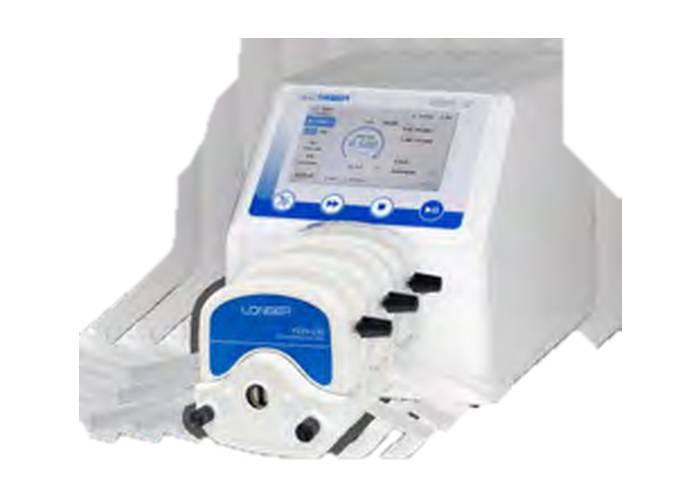
Select the appropriate L100, L300 or L600 speed class and either the -1F or -1FS interface variant. Specify a compatible pump head, tubing and necessary accessories separately. The manufacturer lists YZ, BZ, DG, DMD and FG options for appropriate configurations, but reference flow rates differ significantly between heads. Confirm the touchscreen-drive variant, power configuration, communication requirements and the exact automatic-identification accessories before quotation.
Key Features
- Seven-inch colour touchscreen with graphical operating interface.
- Six principal drive variants across three speed/flow classes.
- Continuous, time, volume, multi-dispensing and programming modes.
- Programmable stages including constant flow, ramps, step changes, delays, loops and triggers.
- Flow and dispensing-volume calibration functions.
- Reusable methods for recurring experimental routines.
- External signals, footswitch and RS485/USB communication options.
- Automatic pump-head/tubing identification on suitable -1FS configurations.
- Support for remote status and direction signals as specified for the selected drive.
Technical Specifications
| Parameter | L100-1F / L100-1FS | L300-1F / L300-1FS | L600-1F / L600-1FS |
|---|---|---|---|
| Speed range | 0.1–100 rpm | 0.1–300 rpm | 0.1–600 rpm |
| Maximum reference single-channel flow | 500 mL/min | 1,500 mL/min | 3,000 mL/min |
| Speed resolution | 0.1 rpm | 0.1 rpm below 100 rpm; 1 rpm at higher speeds | Same pattern |
| Display | 7-inch colour touchscreen | Same | Same |
| Program modes | Continuous, time, volume, repeated dispensing and programmable routines | Same | Same |
| Flow and volume calibration | Yes | Yes | Yes |
| Automatic head/tubing recognition | On -1FS, for compatible components | On -1FS, for compatible components | On -1FS, for compatible components |
| Communication | USB and RS485 / Modbus | Same | Same |
| Drive dimensions | 294 × 180 × 235 mm | 294 × 180 × 235 mm | 294 × 180 × 235 mm |
| Enclosure | IP31 | IP31 | IP31 |
Applications
The family is appropriate for automated reagent dosing, timed liquid introduction, flow-programming studies and suitable laboratory production workflows. A programmed electrolyte-flow profile may be useful when developing a membrane-electrode-assembly (MEA) experiment with controlled changes in liquid circulation. However, the pump controls the liquid path only; potential, current, gas supply, temperature and other MEA test parameters must be managed by separate compatible equipment.
Compatibility and Selection Guidance
Begin with the maximum and minimum required flow, allowable pulsation, viscosity and system pressure. Choose L100 for lower-capacity routines, L300 for moderate flow or L600 for higher-demand liquid transfer. Then determine whether standard programming (-1F) or supported automatic component identification (-1FS) is warranted. If continuous delivery alone is required, a less complex pump may be more economical and easier to operate. Check protocol compatibility, tubing chemistry and actual output under operating conditions before running an unattended experiment.
Why Source Through ScienceGears
ScienceGears can help Australian and New Zealand customers select the appropriate intelligent pump variant, review programmed-flow requirements and coordinate head, tubing and controller-connection options for a complete laboratory enquiry.
Frequently Asked Questions
How do the L100, L300 and L600 models differ?
Their speed ceilings and maximum configuration-dependent reference flow rates increase across the range; the general intelligent-control architecture is shared.
What is the difference between -1F and -1FS?
-1FS adds automatic identification of supported head/tubing combinations. Confirm compatibility and what is included in the chosen configuration.
Can the pump ramp flow during an experiment?
The programmable running-control functions include ramp and step changes. The resulting liquid flow should be verified for the actual system.
Does the pump automatically measure the real flow rate?
Calibration and displayed values do not by themselves establish independent sensor-based flow feedback.
Can I run a timed repeating dispensing sequence?
The family supports programmed dispensing and repeat functions, subject to the selected settings and fluid-path limits.
Can it control both anolyte and catholyte independently?
Not simply through two heads on one motor. Use independently controllable pumps if the two streams need different flow profiles.
Are the models suitable for all electrochemical electrolytes?
No. Verify the actual wetted tubing, fittings, pressure limits and containment measures for the solution and experiment.
Contact ScienceGears
Contact ScienceGears with the desired flow programme, target volume, connected equipment, number of independent channels and liquid properties to request the appropriate intelligent-drive configuration.
Customer Reviews
Related Product
Explore our precision instruments designed for electrochemical research and energy applications
Still Wondering About Something?
Explore our FAQ for fast, clear answers to the most common questions—available 24/7.