
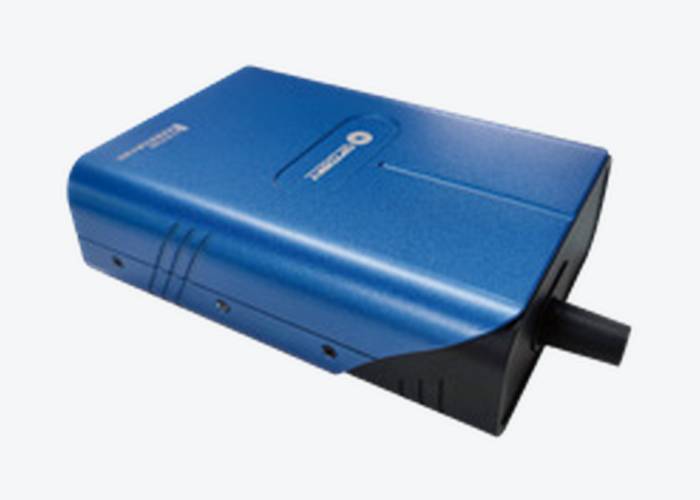
ATR2500 Series Compact Raman Spectrometers
Compact laboratory Raman spectroscopy with low-noise detection and configurable Raman range
Description
The ATR2500 Series is a compact laboratory Raman platform for researchers who need a small instrument and fibre-probe measurement without the complexity of a Raman microscope or large field workstation. It combines a free-space Raman optical path, low-noise signal processing, USB computer control and configurable Raman range. The platform is suited to routine research, materials identification and laboratory measurements where portability and small footprint are useful.
Product Overview
ATR2500 occupies the entry point of the research-oriented portable Raman range.
Unlike a handheld identification analyser, it is designed to operate as a spectroscopic instrument rather than primarily as a library-matching device. Unlike ATR3100/3110, it uses a simpler, compact architecture.
This makes it relevant to laboratories that want a dedicated Raman spectrum from solids, powders or liquids but do not require microscope imaging or extensive automation.
How It Works
A narrow-linewidth laser is delivered to the sample through a Raman probe. Raman-scattered light is collected through the same probe and passed through filters that suppress the much stronger Rayleigh-scattered laser wavelength.
The filtered Raman light enters the spectrometer, where it is separated by wavelength and measured by the detector.
The computer software then converts detector wavelength into Raman shift and provides spectrum display, peak analysis and other processing functions.
Configuration
Current product documentation describes two principal Raman-range/resolution pathways:
| Configuration | Raman range | Resolution |
|---|---|---|
| Narrower-range configuration | 250–2700 cm⁻¹ | 4–6 cm⁻¹ |
| Wider-range configuration | 200–4000 cm⁻¹ | 7–10 cm⁻¹ |
The underlying laser/probe configuration should be confirmed before ordering.
Key Features
- Compact laboratory format.
- Free-space Raman optical architecture.
- High-sensitivity detector.
- Low-noise electronics.
- USB 2.0 communication.
- PC spectral-analysis software.
- Fluorescence-background processing functions.
- Peak search and spectrum display.
- Multiple Raman-range configurations.
- Fibre Raman probe.
Technical Specifications
| Parameter | Verified value |
|---|---|
| Integration time | 4 ms–120 s |
| Power | DC 5 V ±5% |
| Operating temperature | −10 to 45 °C |
| Operating humidity | <95% |
| Weight | 390 g documented |
| Dimensions without probe | 119.2 × 89 × 35 mm |
| Dimensions with probe | 139 × 89 × 35 mm |
| USB interface | USB 2.0 |
| Standard detector range | 200–1100 nm documented |
| Effective detector pixels | 2048 |
The final Raman laser and range should be specified as part of the configured product.
Applications
- routine materials identification
- polymers
- powders
- pigments
- mineral samples
- pharmaceutical materials
- SERS research
- educational laboratory research
- comparative Raman studies
Compatibility and Selection Guidance
ATR2500 is well suited when the goal is to collect Raman spectra in a compact PC-controlled system.
Choose ATR3100 or ATR3110 instead if detector cooling, higher sensitivity, more excitation options or long integration is required.
Choose a Raman microscope if the measurement must be targeted to microscopic regions.
The probe and sample holder should also be selected according to whether the laboratory will measure bulk solids, powders, liquids or small components.
Why Source Through ScienceGears
ScienceGears can help confirm the Raman range, excitation wavelength, probe arrangement and sample format and determine whether ATR2500 provides sufficient sensitivity or whether a cooled ATR3xxx platform is more appropriate.
Frequently Asked Questions
Is ATR2500 a handheld analyser?
It is compact, but its intended workflow is closer to a laboratory Raman spectrometer controlled from a computer.
Does it include a microscope?
No. Microscopic imaging requires a Raman microscope platform.
Can it measure liquids?
Yes, with an appropriate Raman probe and liquid sample arrangement.
Why are there two Raman-range options?
Spectrometer configuration creates a trade-off between spectral range and resolution.
When should I move to ATR3110?
When cooled detection, additional wavelength options or higher-sensitivity long-integration work is important.
Contact ScienceGears
Contact ScienceGears with your sample types, Raman range, excitation wavelength and sensitivity requirements to confirm the appropriate ATR2500 configuration.
Customer Reviews
Related Product
Explore our precision instruments designed for electrochemical research and energy applications
Still Wondering About Something?
Explore our FAQ for fast, clear answers to the most common questions—available 24/7.