
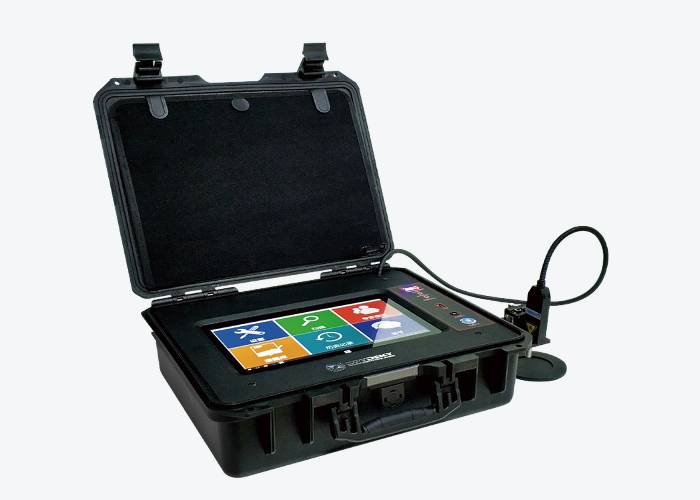
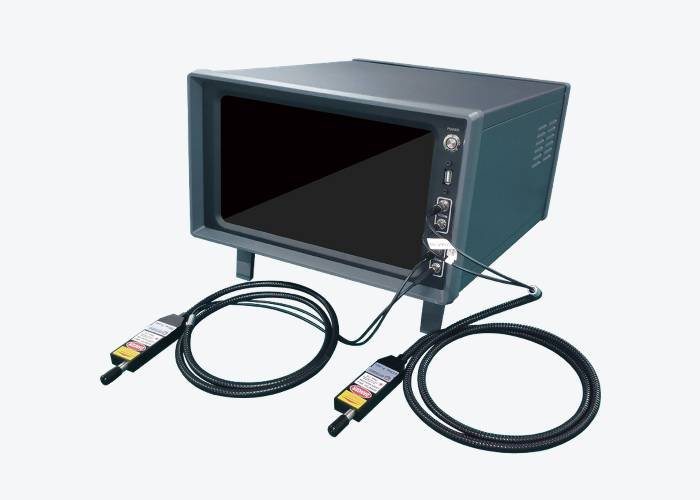
ATR3020 Series Differential Raman Spectrometers
Shifted-excitation Raman spectroscopy for suppressing fluorescence in difficult samples
Description
The ATR3020 Series is designed for Raman measurements where fluorescence overwhelms the normal Raman signal. It uses shifted-excitation Raman difference spectroscopy, commonly abbreviated SERDS, with two very closely spaced excitation wavelengths. Raman peaks shift when the laser wavelength changes slightly, whereas the broad fluorescence background changes much less. Mathematical comparison of the two spectra therefore helps separate Raman information from fluorescence.
Product Overview
Fluorescence is one of the most common practical limitations in Raman spectroscopy.
A sample illuminated with a visible or near-infrared laser can emit broad fluorescence that is thousands or millions of times stronger than its Raman peaks. Baseline subtraction can help when the fluorescence is smooth and stable, but it cannot always recover weak Raman bands reliably.
ATR3020 addresses this problem optically and mathematically rather than relying only on conventional baseline correction.
How SERDS Works
The system contains two lasers with very similar wavelengths.
- The first wavelength excites the sample and a Raman spectrum plus fluorescence background is recorded.
- The second, slightly shifted wavelength repeats the measurement.
- Raman bands move in detector position because their shift is referenced to the excitation wavelength.
- Most fluorescence remains nearly stationary.
- Subtracting the spectra suppresses much of the common fluorescence background.
- A reconstruction algorithm converts the differential result into a more conventional Raman spectrum.
This is fundamentally different from a dual-wavelength Raman instrument such as ATR3200, which uses widely separated excitation wavelengths for sample flexibility.
Model Selection
| Model | Raman range | Resolution |
|---|---|---|
| ATR3020-27 | 250–2700 cm⁻¹ | 4–6 cm⁻¹ |
| ATR3020-35 | 200–3500 cm⁻¹ | 6–8 cm⁻¹ |
| ATR3020-43* | 200–4300 cm⁻¹ | 7–10 cm⁻¹ |
*Some catalogue revisions label the widest configuration -42; the current manufacturer product page uses -43. Confirm the final quotation code before publication/order.
Key Features
- Shifted-excitation differential Raman spectroscopy.
- Two closely spaced excitation wavelengths.
- Fluorescence-background suppression.
- TEC-cooled CCD.
- Low-noise electronics.
- Embedded spectral processing.
- Integrated touchscreen.
- Android operating platform on documented configuration.
- USB 2.0.
- Battery operation.
- LAN remote-control support.
- IP-rated portable enclosure in current documentation.
Applications
- fluorescent pigments
- biological samples
- pharmaceuticals
- food and agricultural samples
- coloured polymers
- forensic materials
- gemstones
- environmental samples
- materials that produce strong broad fluorescence under conventional Raman excitation
Compatibility and Selection Guidance
ATR3020 should be selected specifically when fluorescence rejection is the analytical problem.
If the laboratory simply wants two widely separated excitation wavelengths, ATR3200 is the correct family.
If fluorescence can be adequately reduced by 1064 nm excitation, a 1064 nm ATR3000, ATR3110 or ATR6600 may provide a simpler alternative.
SERDS does not guarantee that every fluorescent sample will yield a useful spectrum. Signal level, noise, sample stability and photobleaching can still influence reconstruction.
Why Source Through ScienceGears
ScienceGears can review representative sample fluorescence, expected Raman bands and whether differential Raman, 1064 nm excitation or another approach is the better solution before an ATR3020 configuration is selected.
Frequently Asked Questions
Is ATR3020 the same as SERS?
No. SERDS suppresses fluorescence by shifted excitation. SERS enhances Raman signal using specialised metallic substrates or nanoparticles.
Is ATR3020 the same as ATR3200?
No. ATR3020 uses two very close wavelengths to mathematically remove fluorescence. ATR3200 uses distinct laser wavelengths for measurement flexibility.
Does differential Raman remove all fluorescence?
Not necessarily. Performance depends on background stability, Raman signal strength and sample behaviour.
Why are there several Raman-range configurations?
Spectrometer design creates a trade-off between Raman range and spectral resolution.
Can ATR3020 be used in the field?
It is designed as a portable system, but operating and environmental requirements should be checked for the intended site.
Contact ScienceGears
Contact ScienceGears with example spectra or information about sample fluorescence, required Raman bands and field/laboratory workflow to determine whether ATR3020 is the appropriate fluorescence-rejection approach.
Customer Reviews
Related Product
Explore our precision instruments designed for electrochemical research and energy applications
Still Wondering About Something?
Explore our FAQ for fast, clear answers to the most common questions—available 24/7.