
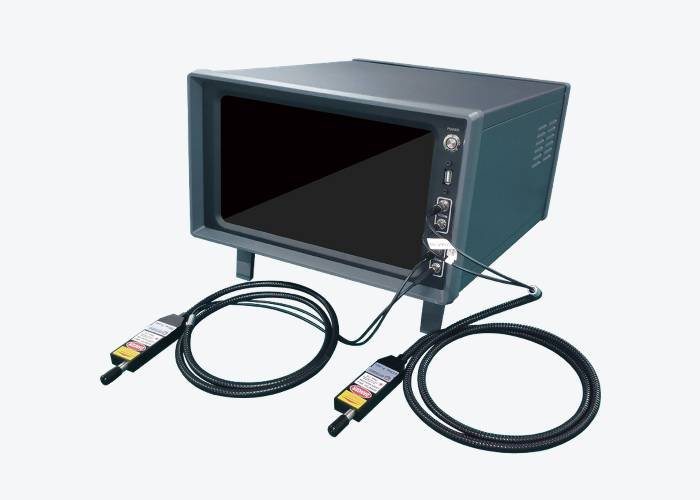
ATR3200 Series Dual-Wavelength Raman Spectrometers
Two-laser Raman spectroscopy for switching excitation wavelength within one research platform
Description
The ATR3200 Series combines two distinct Raman excitation wavelengths within one instrument so researchers can switch excitation according to the optical behaviour of the sample. This is useful because fluorescence, Raman intensity, penetration depth and detector response all depend on wavelength. Five documented wavelength combinations allow visible and near-infrared Raman measurements to be brought together in a single fibre-probe research platform.
Product Overview
No single Raman laser is ideal for every material.
A 532 nm system may produce a strong Raman signal from one material but overwhelming fluorescence from another. A 1064 nm system may solve the fluorescence problem but require longer acquisition.
ATR3200 provides two excitation pathways in one instrument, reducing the need to maintain two independent Raman spectrometers.
Documented Wavelength Combinations
| Configuration | Excitation wavelengths |
|---|---|
| ATR3200-785+1064 | 785 + 1064 nm |
| ATR3200-532+633 | 532 + 633 nm |
| ATR3200-532+1064 | 532 + 1064 nm |
| ATR3200-532+785 | 532 + 785 nm |
| ATR3200-633+1064 | 633 + 1064 nm |
Each laser has its own wavelength-dependent Raman range and resolution.
How It Works
The instrument contains two laser excitation pathways connected to the Raman measurement system.
The operator selects the appropriate wavelength for the sample. Raman light is collected through the probe, filtered and analysed by the configured spectrometer/detector system.
The same sample can therefore be measured under two significantly different excitation conditions and the spectra compared.
Important Difference from Differential Raman
ATR3200 should not be confused with ATR3020.
ATR3020 uses two very closely spaced wavelengths and subtracts the spectra to suppress fluorescence.
ATR3200 uses two substantially different Raman wavelengths so the researcher can choose the excitation that works better for the sample.
Key Features
- Two Raman excitation wavelengths in one instrument.
- Five documented wavelength combinations.
- Fibre-probe sampling.
- High-sensitivity detector architecture.
- PC-based Raman software.
- Non-contact measurement with appropriate probe geometry.
- Suitable for solids and liquids with appropriate accessories.
- Different Raman range/resolution per laser channel.
- Reduced need for two separate Raman systems.
Applications
- polymers
- pigments
- biological materials
- pharmaceuticals
- crystals
- textiles
- carbon materials
- fluorescent samples
- liquids
- mixed sample portfolios in shared research laboratories
Compatibility and Selection Guidance
The wavelength combination should be selected based on the laboratory's actual sample range.
532 + 633 nm provides two visible wavelengths for materials that do not exhibit excessive fluorescence.
532 + 785 nm combines strong visible Raman excitation with a commonly used NIR wavelength.
532 + 1064 nm provides a large wavelength separation for very different fluorescence conditions.
785 + 1064 nm can be attractive for laboratories that frequently handle fluorescent materials.
Do not select dual wavelength if nearly all samples can be handled effectively by one laser; a single-wavelength ATR3110 may provide a simpler and less complex system.
Why Source Through ScienceGears
ScienceGears can review representative sample spectra and fluorescence characteristics and help select the wavelength pair that provides useful complementary capability rather than redundant performance.
Frequently Asked Questions
Can both lasers be used at exactly the same time?
The platform integrates both wavelengths, but normal Raman acquisition uses the selected excitation channel. The exact switching/acquisition workflow depends on system configuration.
Why would I choose 532 + 1064 nm?
The two wavelengths provide very different excitation conditions, allowing strong visible Raman measurements on compatible samples and lower-fluorescence 1064 nm measurements on difficult samples.
Is dual wavelength automatically better?
No. It is useful only when the laboratory genuinely benefits from two excitation regimes.
Can liquids be measured?
Yes, with an appropriate Raman probe or vial/sample holder.
Does each wavelength have the same Raman range?
No. The accessible Raman-shift range and resolution depend on excitation wavelength and spectrometer configuration.
Contact ScienceGears
Contact ScienceGears with your sample types and preferred excitation wavelengths to determine which ATR3200 dual-wavelength configuration provides the most useful combination.
Customer Reviews
Related Product
Explore our precision instruments designed for electrochemical research and energy applications
Still Wondering About Something?
Explore our FAQ for fast, clear answers to the most common questions—available 24/7.