
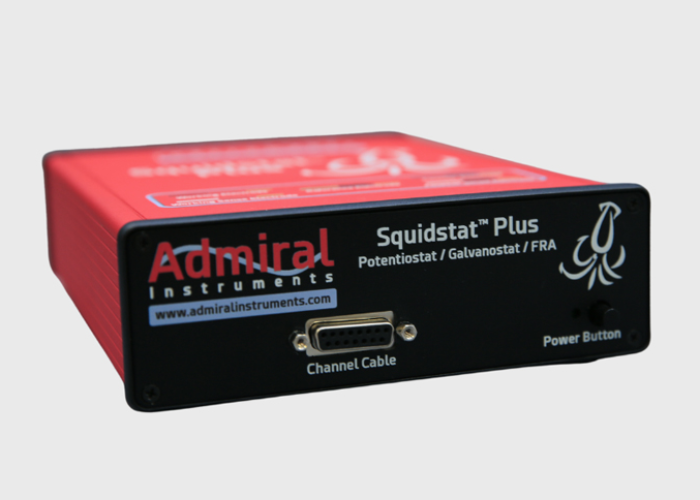
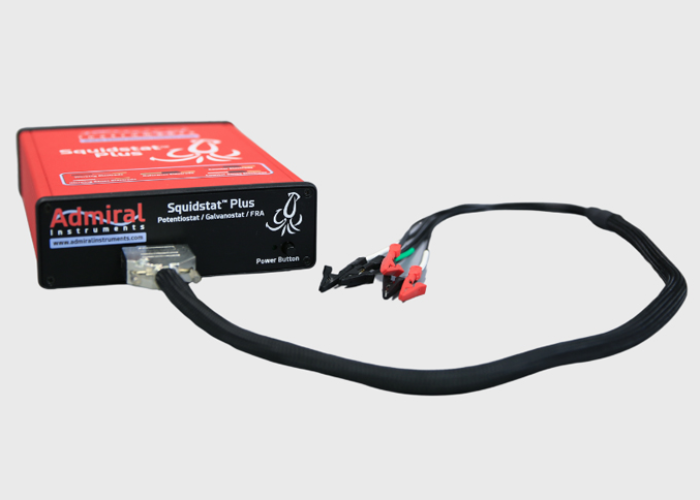
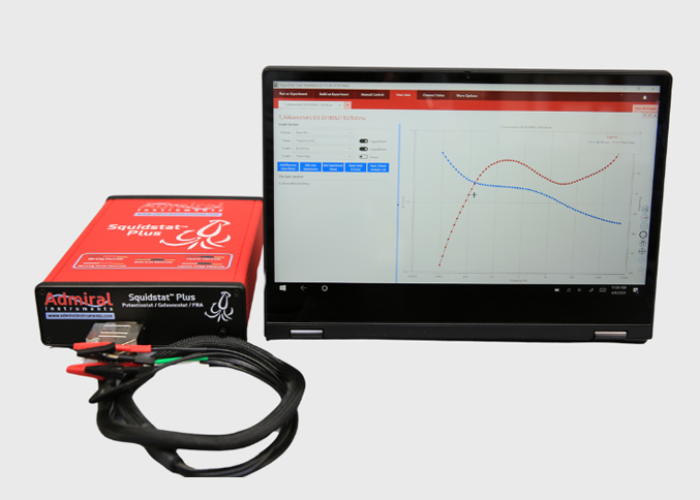
Admiral Instruments Squidstat Plus Potentiostat/Galvanostat (±1 A) with EIS
Squidstat Plus Potentiostat/Galvanostat with EIS
Squidstat Plus overview
The Squidstat Plus is a compact, single-channel potentiostat/galvanostat with integrated frequency response analysis (FRA) for electrochemical impedance spectroscopy (EIS), designed for researchers who need reliable benchtop electrochemistry without a complex setup. It supports standard electrochemical cell wiring (including 2–5 electrode connections) and can be expanded into a multichannel platform by connecting multiple Squidstat units to the same computer.
How it works (principle of operation)
In potentiostatic mode, the Squidstat Plus controls the working electrode potential versus a reference electrode while measuring current at the counter electrode; in galvanostatic mode it controls current while measuring the resulting cell potential. For EIS, a small sinusoidal perturbation is applied and the instrument measures amplitude/phase across frequency to resolve interfacial kinetics, transport, and equivalent-circuit parameters.
Key features and technical highlights
- Voltage scan range: ±10 V (typical electrochemical sweeps and steps)
- Maximum current: ±1 A with multiple current ranges (down to low-current resolution)
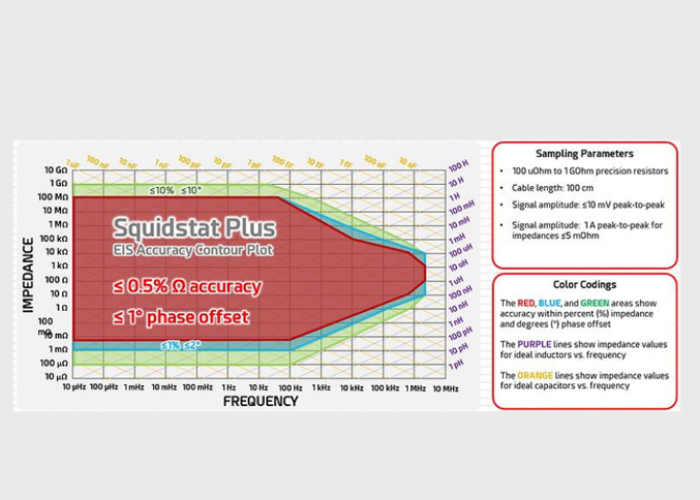
- EIS frequency range: 10 μHz to up to 2 MHz (some earlier literature lists 1 MHz)
- Modes: Pot / Gal / ZRA / FRA (useful for corrosion coupling and impedance work)
- Onboard data backup: 16 GB for failsafe experiment recovery
- Fast data capture: short sampling/recording intervals for transient methods
- Software workflow: prebuilt methods plus a drag-and-drop experiment builder for custom protocols (no coding)
Typical applications and compatibility
Use the Squidstat Plus for battery and supercapacitor testing (CV, charge/discharge, GITT/PITT), corrosion and polarisation methods, electrocatalysis screening, sensors, and photoelectrochemistry. It pairs naturally with electrochemical cells, RDE/RRDE accessories (RRDE workflows may use multiple units), and can be complemented by battery cyclers or spectroscopy integrations (e.g., Raman-SEC setups) depending on your experiment design.
Why choose ScienceGears
ScienceGears supports Australian and New Zealand labs with local instrument guidance and a portfolio that helps you build a complete workflow—from potentiostats and electrochemical cells through to in-situ spectroscopy and energy testing platforms—so your setup stays coherent as your research scales.
Technical Specifications
Precision engineering for accurate measurements
| Voltage Scan Range | ±10 V |
|---|---|
| Max Current | ±1 A |
| EIS Frequency Range | 10 µHz - 2 MHz |
| Best Current Accuracy | 1 nA |
| Channels Per Unit | 1 |
Methods/Techniques
Want to learn more about these techniques?
Check out our Introduction to Electrochemical Techniques blog for an in-depth overview of their principles and applications.
Resources & Downloads
Everything you need to get started
Brochure
Squidstat Plus Brochure
Data Sheet
Squidstat Plus Data Sheet
Calculating Corrosion Rates From a Tafel Plot
Calculating Corrosion Rates From a Tafel Plot
Accuracy Contour Plots and EIS Accuracy
Electrochemical Impedance Spectroscopy EIS for Advanced Battery Diagnostics
Introduction to Electrochemical Impedance Spectroscopy EIS
IR Drop Compensation in Squidstats
Potentiostat Design and Engineering
Understanding and Validating Potentiostat DC Accuracy
Using Cyclic Voltammetry To Study Redox Reactions
Using Squidstat To Perform Corrosion Testing On A Metal Coupon
Using Squidstats for Stack Measurements on Batteries or Fuel Cells
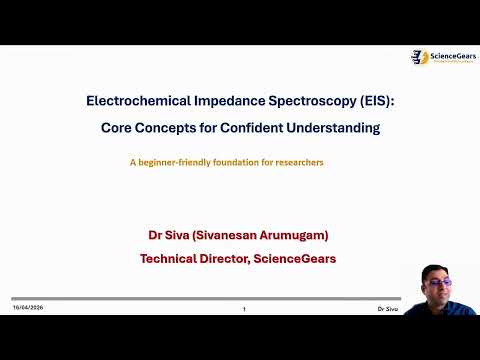
Electrochemical Impedance Spectroscopy (EIS): Core Concepts for Confident Understanding
Squidstat - Admiral
Publications
Research powered by Squidstat technology
Squidstat Publications
Squidstat Publications 1
Squidstat Publications 2
Customer Reviews
Related Product
Explore our precision instruments designed for electrochemical research and energy applications
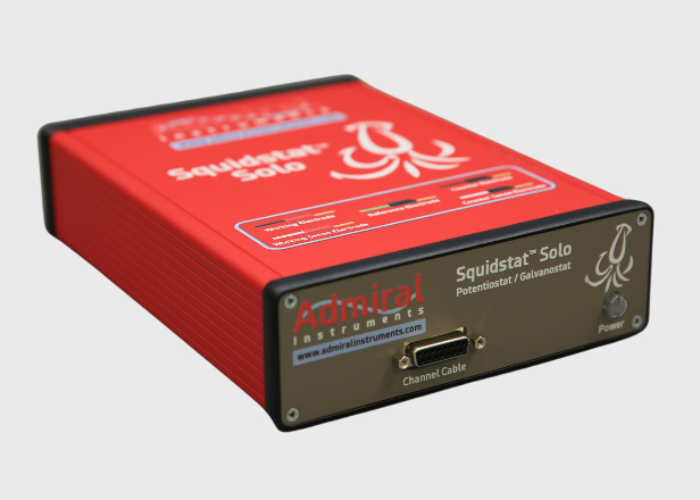
Squidstat Solo Single-Channel Potentiostat/Galvanostat
- Voltage Scan Range: ±10 V
- Max Current: ±100 mA
- Best Current Accuracy : 1 nA
- Channels Per Unit: 1

Admiral Instruments Squidstat Penta Potentiostat/Galvanostat with FRA (EIS to 2 MHz)
- Voltage Scan Range: ±10 V
- Max Current: ±5 A
- EIS Frequency Range: 10 µHz - 2 MHz
- Best Current Accuracy: 1 nA

Squidstat Decka Potentiostat/Galvanostat with FRA (±10 A, 2 MHz EIS)
- Voltage Scan Range: ±10 V
- Max Current: ±10 A
- EIS Frequency Range: 10 µHz - 2 MHz
- Best Current Accuracy: 1 nA
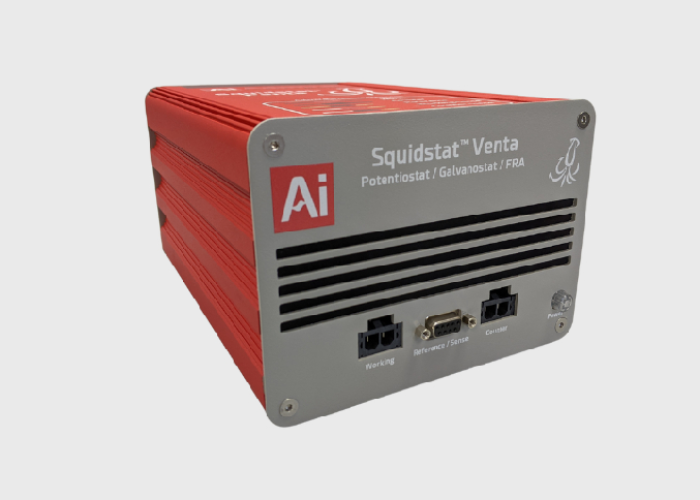
Squidstat Venta High-Current Potentiostat/Galvanostat (±20 A) with 2 MHz EIS
- Voltage Scan Range: ±6 V
- Max Current: ±20 A
- EIS Frequency Range: 10 µHz - 2 MHz
- Best Current Accuracy: 1 nA

IM7c
- Voltage Scan Range: ±14 V (software-switchable low-noise mode available)
- Max Current: ±125 fA
- EIS Frequency Range: 10 µHz to 5 MHz
- Min Measurable Current: ±125 fA (corrected from Zahner data)
- AC Resolution: 24-bit (HDP technology)
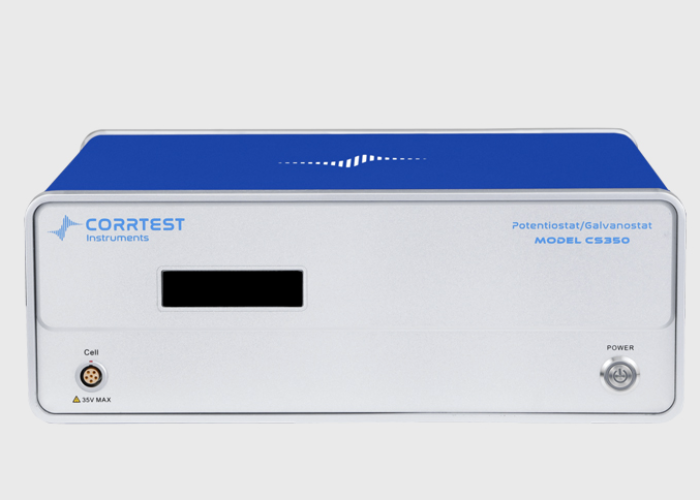
CS350M
- Potential Range: ±10 V (customizable to ±12 V)
- Current Range: ±2 A (10 programmable ranges)
- EIS Frequency Range: 10 µHz to 1 MHz
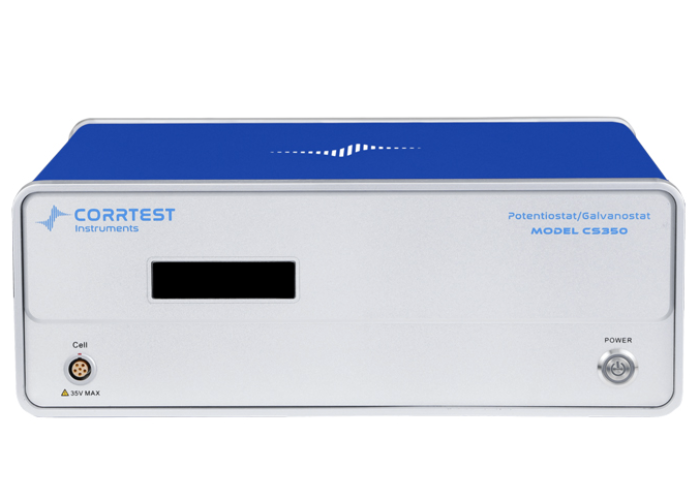
CS310M Single-Channel Potentiostat/Galvanostat with EIS (Electrochemical Workstation)
- Potential range: ±10 V (customizable to ±12 V)
- Current range: ±2 A (10 programmable ranges)
- EIS frequency range: 10 µHz – 1 MHz
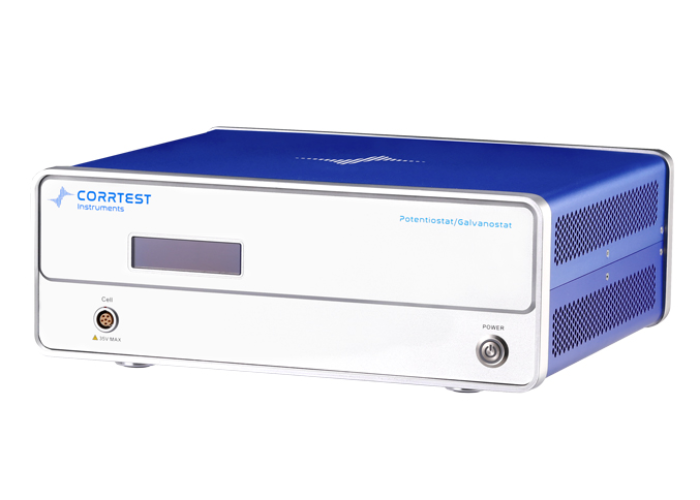
CS300M Potentiostat/Galvanostat (Without EIS) – Single-Channel Electrochemical Workstation
- Potential control range: ±10 V (customizable to ±12 V)
- Current control range: ±2 A (10 programmable ranges)
- EIS frequency range: EIS not supported for this model
Still Wondering About Something?
Explore our FAQ for fast, clear answers to the most common questions—available 24/7.