
Small-Volume Conical Three-Electrode Electrochemical Cell
Low-Volume Conical Three-Electrode Electrochemical Cell
Overview
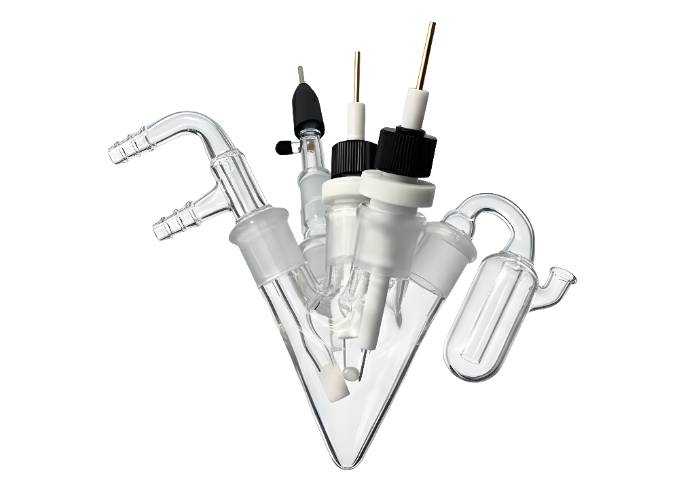
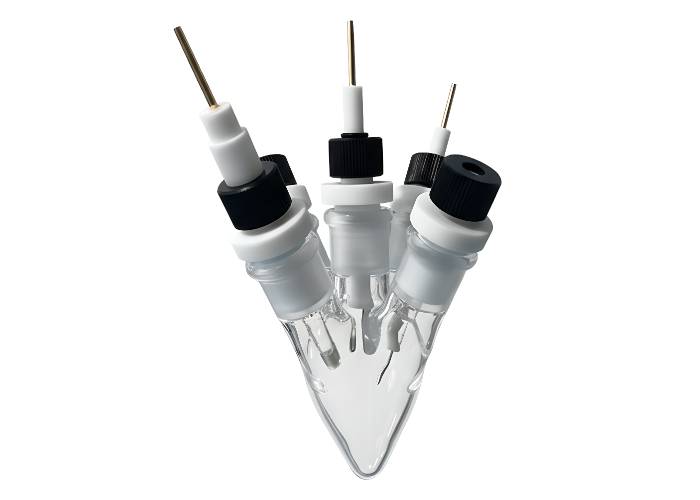
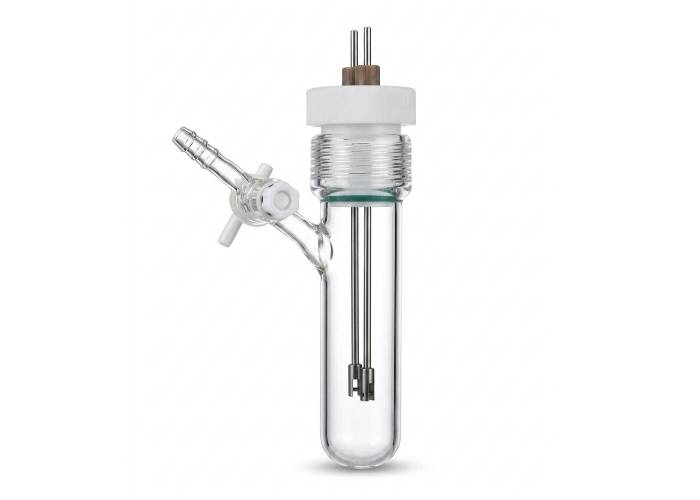
The Small-Volume Conical Three-Electrode Electrochemical Cell is a precision borosilicate glass cell designed for high-sensitivity electrochemical measurements when sample volume is limited (typically ~5–20 mL). Its conical geometry supports efficient mixing, improved mass transport, and low solution resistance — ideal for laboratories that need accurate, repeatable data without wasting electrolyte, catalyst ink, or expensive reagents.
Design & Working Principle
This cell follows the classical three-electrode configuration (working, counter, and reference electrode), arranged through a multi-port head to support stable positioning and consistent current distribution.
The conical base helps reduce dead volume and stagnant zones, and it assists with bubble release during gas-evolving reactions (e.g., HER/OER, CO₂ reduction, chlorine evolution).
Gas handling (two key glass parts shown in the image)
To enable oxygen-free and moisture-controlled experiments, the cell is typically used with two common glass accessories:
1) Fritted gas inlet tube (sparger / gas dispersion tube / fritted dip tube)
A long glass dip tube fitted with a porous frit near the bottom is used to introduce inert gas (typically N₂ or Ar) directly into the electrolyte as fine bubbles. This provides:
- Fast deaeration (removes dissolved O₂ for sensitive redox systems)
- Improved mixing without a stir bar in very small volumes
- More stable baselines for CV, LSV, CA/CP, and kinetic measurements
2) Gas bubbler (oil bubbler / exhaust bubbler / backflow trap / one-way vent bubbler)
The outlet side is commonly fitted with a small glass bubbler that:
- Gives a visual indication of purge flow (you can see the bubbling)
- Maintains a slight positive pressure, reducing air ingress
- Helps prevent suck-back/backflow if gas supply pressure drops
- Allows safe venting during continuous purging or mild gas evolution
(In many labs the bubbler is filled with silicone oil; some applications use water, but oil is often preferred for better backflow resistance and lower evaporation.)
Key Features
- Sample capacity: ~5–20 mL, optimised for limited-electrolyte studies
- Construction: High-purity borosilicate glass with chemically resistant PTFE fittings
- Three-electrode operation: Supports standard 6 mm OD electrodes and common reference formats (e.g., Ag/AgCl, Hg/HgO depending on user setup)
- Conical geometry: Helps minimise dead volume, supports uniform current distribution, and assists bubble removal
- Gas-ready design: Compatible with
- Fritted gas sparging tube (deaeration / mixing)
- Outlet bubbler / exhaust trap (visual flow + backflow protection) - Sealing: Ground-glass joints with O-rings help support leak-minimised operation
- Applications: Electrocatalysis, corrosion screening, redox kinetics, battery half-cell electrolyte studies, and general small-volume electrochemical method development
Why Choose ScienceGears
ScienceGears Australia provides locally supported, research-grade electrochemical hardware built for precision, reliability, and customisation. This cell can be supplied with optional gas accessories (spargers, bubblers, fittings) and electrode interface options to match your experimental workflow.
For detailed specifications or custom dimensions, please contact us.
Resources & Downloads
Everything you need to get started

Electrochemical Impedance Spectroscopy (EIS): Core Concepts for Confident Understanding
Squidstat - Admiral
Customer Reviews
Related Product
Explore our precision instruments designed for electrochemical research and energy applications




Still Wondering About Something?
Explore our FAQ for fast, clear answers to the most common questions—available 24/7.