

In electrochemical testing, small setup details can make a large difference to data quality. One of the most misunderstood accessories is the Luggin capillary, also called a Luggin probe, Luggin tip or reference-electrode salt bridge.
Researchers often know that a Luggin capillary is used to reduce iR drop or uncompensated resistance, but they are less sure about one practical question: should I use a Luggin capillary with a frit or without a frit?
This question matters in corrosion testing, cyclic voltammetry, electrocatalysis, sensors, batteries, fuel cells, coatings and electrochemical impedance spectroscopy (EIS). Choosing the wrong configuration can lead to noisy data, potential drift, reference-electrode contamination, slow response, poor reproducibility or misleading impedance spectra.
By the End of This Guide, You Will Understand:
- What a Luggin capillary actually does.
- Why it reduces uncompensated resistance near the working electrode.
- The difference between fritted and non-fritted Luggin capillaries.
- When each option is suitable.
- How frits affect EIS, corrosion testing, reference-electrode stability and contamination control.
- Practical setup tips for reproducible electrochemical measurements.
1 What Is a Luggin Capillary?
A Luggin capillary is a narrow tube used to position the reference electrode sensing point close to the working electrode surface. In a three-electrode electrochemical cell, the potentiostat controls the working electrode potential relative to the reference electrode. Ideally, the reference electrode should sense the solution potential as close as practical to the working electrode surface.
In real electrochemical cells, the electrolyte has resistance. When current flows between the working electrode and counter electrode, part of the applied potential is lost through the solution. This unwanted voltage loss is called ohmic drop or iR drop.
The Luggin capillary helps by bringing the reference sensing point close to the working electrode, without placing the large reference electrode body directly in front of the working surface. This is especially useful when the bulky reference electrode would disturb current distribution, solution flow, bubble release, optical access or the exposed electrode area.
Here
Emeasured = potential seen by the potentiostat
Etrue = actual working electrode potential
i = current
Ru = uncompensated resistance between the working electrode and the reference sensing point
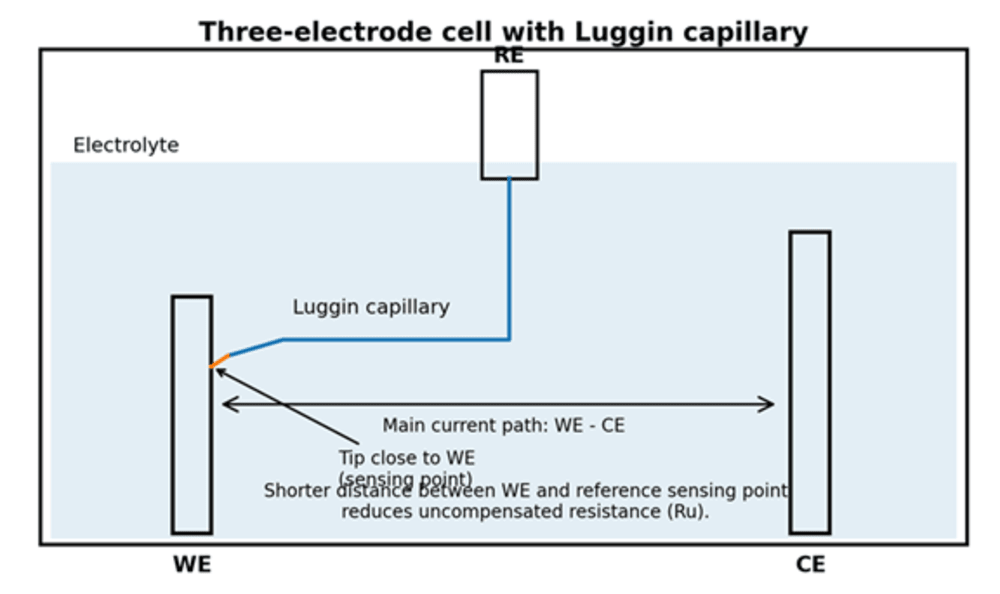
Figure 1. Three-electrode cell with a Luggin capillary positioning the reference sensing point close to the working electrode.
2 Why Does Uncompensated Resistance Matter?
Uncompensated resistance becomes important when the electrolyte has low conductivity, the current is high, the reference electrode is far from the working electrode, the cell geometry is not optimised, or accurate potential control is required.
The basic relationship is simple: potential error increases with both current and resistance.
| Current | Uncompensated Resistance | Potential Error |
|---|---|---|
| 1 mA | 10 Ω | 10 mV |
| 10 mA | 10 Ω | 100 mV |
| 100 mA | 10 Ω | 1 V |
| 10 mA | 100 Ω | 1 V |
This is why Luggin capillary placement becomes critical in corrosion, electrocatalysis, hydrogen evolution, oxygen evolution, fuel cell, electrolyser, battery and other high-current electrochemical experiments. Accurate potential control depends on pairing the right Luggin configuration with well-matched potentiostats and galvanostats.
3 The Important Concept: The Reference Electrode Does Not Need to Be Physically Close
A common source of confusion is this: if the reference electrode body is still physically far from the working electrode, how does the Luggin capillary help?
The answer is that the electrical sensing point is not necessarily the physical body of the reference electrode. The Luggin capillary is filled with electrolyte, creating an ionic pathway between the reference electrode and the capillary tip.
The potentiostat reference input draws almost no current under normal operation. Because almost no current flows through the reference path, there is very little voltage drop along the capillary itself. Therefore, the potentiostat effectively senses the solution potential near the capillary tip, not simply at the large reference electrode body.
A Luggin capillary improves potential control mainly because the reference sensing point is moved close to the working electrode. The frit, if present, mainly changes the chemical isolation and junction behaviour; it is not the main reason iR drop is reduced.
4 Luggin Capillary With Frit vs Without Frit: The Core Difference
The main difference is simple. A non-fritted Luggin capillary has an open electrolyte path at the tip. A fritted Luggin capillary includes a porous barrier — usually glass, ceramic or polymer — between the reference path and the test solution.
The frit allows ionic conduction but slows liquid mixing. Therefore, the fritted version provides better chemical separation, while the non-fritted version usually provides lower resistance and faster response.
ScienceGears supplies the both types of Luggin Capillary (J-Type Fritted Luggin Capillary) alongside a full range of electrochemistry accessories to support both configurations in Australian and New Zealand research labs.
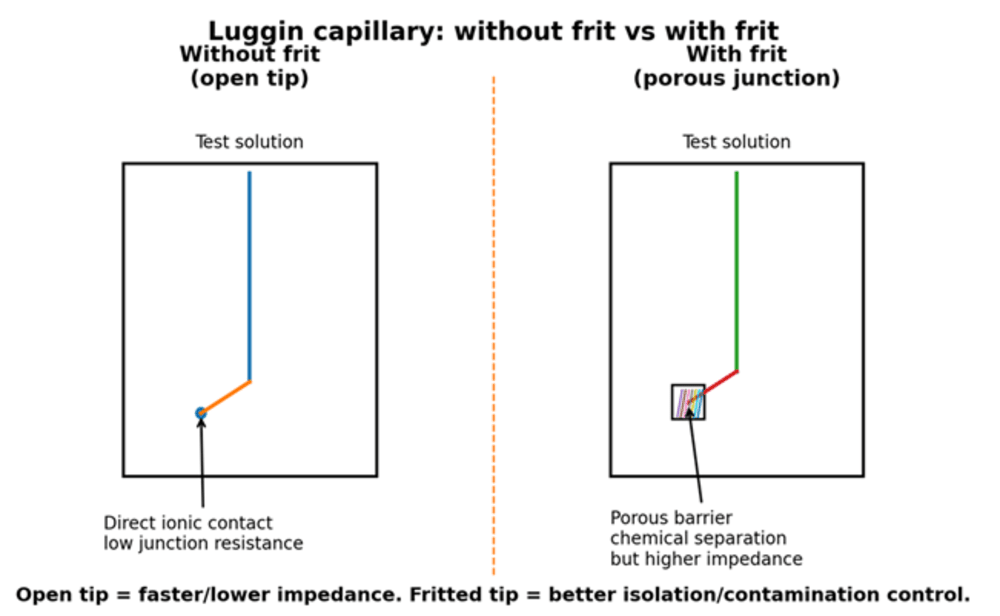
Figure 2. Comparison of an open-tip Luggin capillary and a fritted Luggin capillary.
5 What Is a Frit?
A frit is a porous material that allows ions to pass through while restricting bulk liquid mixing. In electrochemical cells and reference electrodes, frits are used to maintain ionic contact between two solutions while reducing contamination, leakage or crossover.
Frits may be made from porous glass, porous ceramic, porous polymer or other chemically compatible porous materials. In reference-electrode systems, a frit can help separate the internal filling solution from the sample electrolyte. However, it can also introduce additional resistance and liquid junction potential.
6 Non-Fritted Luggin Capillary: Advantages and Limitations
A non-fritted Luggin capillary is usually an open glass or plastic capillary filled with the test electrolyte or a compatible supporting electrolyte.
Advantages
- Lower reference-path impedance.
- Faster potential response.
- Less risk of blockage.
- Often better for high-frequency EIS when the electrolyte is clean and compatible.
- Lower chance of junction-related artefacts from a dirty or clogged frit.
- Simpler cleaning and inspection.
- More direct ionic contact with the test solution.
This configuration is often preferred when the reference electrode and test electrolyte are chemically compatible. For example, in many aqueous corrosion experiments using chloride-containing media, an Ag/AgCl reference electrode with an open Luggin path may be acceptable because chloride is already part of the test environment.
Limitations
- Less separation between the reference-electrode filling solution and the test solution.
- Possible KCl leakage from Ag/AgCl reference electrodes into the sample.
- Possible chloride contamination in chloride-sensitive experiments.
- Possible sample electrolyte entry into the capillary.
- Possible movement of reaction products, particles or gas bubbles into the reference path.
- Less protection for the reference electrode in aggressive, dirty, fouling, biological, viscous or particle-containing electrolytes.
Simple Summary
Without frit = better electrical performance and faster response, but less chemical separation and contamination control.
7 Fritted Luggin Capillary: Advantages and Limitations
A fritted Luggin capillary includes a porous junction at or near the tip. This maintains ionic contact while reducing direct mixing between the reference-electrode pathway and the test solution.
Advantages
- Better separation between reference filling solution and sample solution.
- Reduced contamination of the sample by KCl or other filling electrolytes.
- Better protection of the reference electrode from aggressive or dirty solutions.
- Useful in chloride-sensitive systems.
- Useful in non-aqueous electrochemistry.
- Useful in biological, catalyst, battery, trace-analysis or low-volume experiments where solution purity is important.
- Useful where the sample electrolyte must remain chemically controlled over time.
For example, if a researcher studies chloride-sensitive corrosion, catalyst poisoning, silver-sensitive chemistry, non-aqueous redox couples or trace analytes, a fritted or double-junction arrangement is usually safer than an open reference pathway.
Limitations
- Higher junction resistance.
- Slower potential response.
- Higher risk of clogging.
- Possible liquid junction potential.
- More difficult cleaning.
- Possible EIS artefacts if the junction impedance becomes high.
- Possible noise or instability if the reference path impedance is too large.
Simple Summary
With frit = better chemical isolation and reference protection, but higher impedance and potentially slower or noisier measurements if the frit becomes resistive or blocked.
8 Does the Frit Reduce iR Drop?
Usually, no. The Luggin capillary reduces iR drop mainly by positioning the reference sensing point close to the working electrode. The frit itself is not normally the reason iR drop is reduced.
In fact, the frit can add extra resistance to the reference path. Because the reference electrode path carries negligible current, this additional resistance is not the same as the main working-electrode-to-counter-electrode solution resistance. However, it can still affect reference stability, response time, noise and high-frequency EIS behaviour.
| Component or Factor | Primary Role |
|---|---|
| Luggin capillary tip position | Reduces uncompensated resistance between working electrode and reference sensing point. |
| Frit | Improves chemical separation and reduces contamination/crossover. |
| Capillary length and diameter | Affects reference-path impedance and response. |
| Electrolyte conductivity | Affects iR drop and measurement stability. |
| Reference-electrode condition | Affects potential drift, noise, EIS artefacts and potentiostat stability. |
9 Practical Comparison Table
| Parameter | Luggin Without Frit | Luggin With Frit |
|---|---|---|
| Tip design | Open tip | Porous fritted tip or junction |
| Main benefit | Low resistance and fast response | Chemical separation and reference protection |
| Reference-path impedance | Lower | Higher |
| Response speed | Faster | Slower |
| Contamination control | Lower | Higher |
| Risk of KCl leakage into sample | Higher | Lower |
| Risk of clogging | Lower | Higher |
| EIS suitability | Often better in clean, compatible systems | Suitable when isolation is required, but check for high impedance |
| Maintenance | Easier | More careful cleaning and wetting required |
| Best for | Clean, compatible aqueous systems | Sensitive, reactive, fouling or non-aqueous systems |
| Main risk | Contamination or crossover | High impedance, drift or junction potential |
10 Which One Should You Choose?
Choose a Non-Fritted Luggin Capillary When:
- Your electrolyte is compatible with the reference electrode.
- Small leakage of reference filling solution is not critical.
- You need fast response.
- You are performing EIS and want to minimise reference-path impedance.
- You are working in relatively clean aqueous solutions.
- You are doing standard corrosion testing in chloride-containing media.
- You want simple handling and lower maintenance.
Typical examples include general cyclic voltammetry in aqueous supporting electrolyte, standard corrosion tests in NaCl solution, LPR and Tafel studies where chloride is already present, EIS on metals or coatings where the reference junction is clean and stable, and teaching or routine electrochemical setup demonstrations.
Choose a Fritted Luggin Capillary When:
- Your sample is sensitive to chloride or KCl contamination.
- You need to protect the reference electrode from aggressive chemistry.
- The test solution contains particles, proteins, polymers, catalysts or fouling species.
- You are working with non-aqueous solvents.
- You need to reduce crossover between reference solution and test solution.
- You need better chemical control of the sample environment.
Typical examples include non-aqueous electrochemistry, chloride-sensitive catalyst studies, trace metal analysis, biological or biosensor measurements, battery electrolyte studies, electrocatalysis where catalyst poisoning is possible, and experiments where reference electrolyte contamination may change the reaction pathway. Consult the reference electrode selection guide for additional guidance on matching reference-electrode chemistry to your system.
11 Recommended Selection Matrix
| Experimental Priority | Recommended Choice |
|---|---|
| Lowest resistance | Non-fritted Luggin capillary |
| Fastest response | Non-fritted Luggin capillary |
| High-frequency EIS in clean electrolyte | Usually non-fritted, if chemically compatible |
| Avoiding KCl or chloride contamination | Fritted Luggin, double-junction reference or compatible alternative reference strategy |
| Protecting reference electrode from aggressive chemistry | Fritted Luggin or double-junction reference |
| Dirty or fouling electrolyte | Fritted Luggin with regular maintenance; check for clogging |
| Non-aqueous electrochemistry | Fritted or double-junction system; match solvent/electrolyte where possible |
| Routine corrosion in NaCl | Often non-fritted is sufficient |
| Chloride-sensitive corrosion | Fritted or chloride-free reference approach |
| Long-term unattended testing | Depends on electrolyte; prioritise stability, wet junction and low clogging risk |
12 How Close Should the Luggin Tip Be to the Working Electrode?
There is no single universal distance, because the correct distance depends on electrode geometry, electrolyte conductivity, working electrode size, current density, flow conditions and whether gas evolution occurs.
As a practical starting point, many laboratory setups place the Luggin tip approximately 1–2 mm from the working electrode surface where the geometry allows it. The tip should be close enough to reduce iR drop but not so close that it touches the surface, blocks the working area, shields the electrode, traps bubbles or changes mass transport.
13 Effect on Electrochemical Impedance Spectroscopy
EIS is especially sensitive to poor reference-electrode setup. A high-impedance reference path can introduce high-frequency artefacts, apparent inductive loops, phase distortion, noisy spectra, potentiostat overload or poor reproducibility.
The problem becomes worse when the frit is clogged, the Luggin capillary is too long or too narrow, bubbles enter the capillary, the electrolyte path is discontinuous, the reference filling solution is old or the reference junction has partially dried out.
For EIS, the best choice is not simply “fritted” or “non-fritted”. The best choice is the configuration that gives a stable reference potential, low reference-path impedance, no unacceptable contamination, no bubble blockage and reproducible geometry.
- In many clean aqueous EIS experiments, a non-fritted Luggin capillary can provide better electrical performance.
- In contamination-sensitive EIS experiments, a fritted or double-junction arrangement may be necessary, but researchers should check junction condition and reference-path impedance carefully.
14 Effect on Corrosion Testing
Luggin capillaries are widely used in corrosion testing because corrosion measurements depend strongly on accurate working electrode potential. Poor reference placement can affect open circuit potential, Tafel slopes, corrosion current density, linear polarisation resistance, pitting potential, repassivation potential and EIS-derived coating resistance.
For standard corrosion studies in chloride-containing electrolytes, a simple Luggin capillary or salt bridge is often sufficient. ScienceGears flat corrosion cells, jacketed flat corrosion cells and 5-port corrosion cells support three-electrode corrosion workflows with controlled working-electrode exposure and flexible reference-electrode placement.
However, a fritted Luggin or double-junction arrangement may be preferred when the corrosion system is chloride-sensitive, the reference filling solution could alter corrosion behaviour, the electrolyte contains inhibitors that may foul the reference junction, or the experiment is a long-term exposure where reference-electrode protection matters.
15 Common Mistakes Researchers Make
| Mistake | Why It Matters |
|---|---|
| Thinking the frit reduces iR drop. | The tip position reduces iR drop. The frit mainly provides chemical separation. |
| Placing the Luggin tip too far away. | If the tip is far from the working electrode, significant uncompensated resistance remains. |
| Placing the Luggin tip too close. | If the tip is too close, it can block current distribution, disturb mass transport or trap gas bubbles. |
| Ignoring bubbles. | Air bubbles can interrupt the ionic path and cause noise, drift or EIS artefacts. |
| Using a clogged frit. | A clogged frit can cause slow response, potential drift, noisy data and poor EIS spectra. |
| Using the wrong reference electrode chemistry. | For example, Ag/AgCl is convenient, but chloride leakage may not be suitable for chloride-sensitive or non-aqueous experiments. |
| Not reporting the setup. | Research reports should state the reference electrode type, Luggin type, tip distance, electrolyte, frit/junction details and any iR compensation method used. |
16 Best Practice Setup Tips
- Fill the Luggin capillary completely with electrolyte.
- Avoid trapped air bubbles inside the capillary.
- Use the same electrolyte as the test solution where chemically appropriate.
- Position the tip close to the working electrode without touching it.
- Keep the capillary geometry consistent between experiments.
- Avoid placing the tip in a way that blocks current distribution or mass transport.
- For fritted designs, check that the frit remains wet and unclogged.
- For EIS, check whether the reference path is causing high-frequency artefacts.
- Clean or replace fritted components when drift, noise or slow response appears.
- Record the configuration in the lab notebook and method section.
17 Frequently Asked Questions
These are the questions we receive most often from Australian researchers and lab managers working on Luggin capillary selection and electrochemical cell setup.
Q1 What is the main purpose of a Luggin capillary?
Q2 Does a fritted Luggin capillary reduce iR drop better than a non-fritted one?
Q3 Which is better for EIS: fritted or non-fritted Luggin capillary?
Q4 When should I use a fritted Luggin capillary?
Q5 When should I avoid a fritted Luggin capillary?
Q6 How close should the Luggin capillary tip be to the working electrode?
Q7 Can I use the same electrolyte inside the Luggin capillary?
Q8 What happens if air bubbles enter the Luggin capillary?
Q9 Is a Luggin capillary the same as a salt bridge?
Q10 Can ScienceGears help me choose the right Luggin capillary?
18 Conclusion: Choose Based on the Experiment, Not Habit
The choice between a Luggin capillary with frit and without frit is not about which one is universally better. It depends on the experiment.
Use a non-fritted Luggin capillary when you want low resistance, fast response and clean electrical performance, and when contamination is not a serious concern.
Use a fritted Luggin capillary when chemical separation, reference-electrode protection and contamination control are more important.
For many routine aqueous corrosion, CV and EIS experiments, a non-fritted Luggin capillary can be simple and effective. For chloride-sensitive, non-aqueous, biological, catalyst or trace-analysis work, a fritted or double-junction configuration may be more appropriate.
The most important point is to treat the Luggin capillary as part of the electrochemical measurement system, not as a minor accessory. Its geometry, placement, cleanliness, electrolyte path and frit condition can directly affect data quality.
- iR drop is reduced by tip position, not the frit: Move the Luggin tip close to the working electrode surface.
- Frit = chemical separation: Use a fritted design when contamination, crossover or reference-electrode protection matters.
- No frit = lower impedance: Use a non-fritted design when low resistance, fast response and clean EIS data are the priority.
- EIS is the most sensitive technique: Check junction condition and reference-path impedance regardless of which design you use.
- Always report the setup: Reference electrode type, Luggin type, tip distance, electrolyte, frit/junction details and iR compensation method.
- Corrosion cell compatibility: ScienceGears flat corrosion cells, jacketed flat corrosion cells and 5-port corrosion cells support both fritted and non-fritted Luggin configurations.
Ready to Set Up the Right Luggin Configuration in Your Australian Lab?
ScienceGears supplies electrochemical cells, reference electrodes, fritted and non-fritted Luggin capillary configurations, corrosion test cells and potentiostat systems for Australian and New Zealand researchers. If you are unsure which configuration suits your experiment, contact ScienceGears with your electrolyte, working electrode, reference electrode, current range and measurement method. Our team can help you build a reliable setup for reproducible electrochemical data.
19 References and Further Reading
- Bard, A. J.; Faulkner, L. R.; White, H. S. Electrochemical Methods: Fundamentals and Applications, 3rd ed.; Wiley, 2022. Link
- Myland, J. C.; Oldham, K. B. Uncompensated Resistance. 1. The Effect of Cell Geometry. Analytical Chemistry 2000, 72, 3972–3980. DOI: 10.1021/ac0001535
- Oldham, K. B.; Stevens, N. P. C. Uncompensated Resistance. 2. The Effect of Reference Electrode Nonideality. Analytical Chemistry 2000, 72, 3981–3988. DOI: 10.1021/ac000154x
- Elgrishi, N.; Rountree, K. J.; McCarthy, B. D.; Rountree, E. S.; Eisenhart, T. T.; Dempsey, J. L. A Practical Beginner’s Guide to Cyclic Voltammetry. Journal of Chemical Education 2018, 95, 197–206. DOI: 10.1021/acs.jchemed.7b00361
- Kelly, R. G.; Scully, J. R.; Shoesmith, D. W.; Buchheit, R. G. Electrochemical Techniques in Corrosion Science and Engineering; CRC Press, 2002/2003. Link
- ASTM G5-14(2021), Standard Reference Test Method for Making Potentiodynamic Anodic Polarization Measurements. Link