

1 Why the MEA Determines Everything — and Where Most Variability Enters the System
If you have followed the Pillar 1 membrane selection series and the Pillar 2 Nafion specifications guide, you have selected your membrane, confirmed its properties, and pre-treated it correctly. The next step is where a large share of experimental variability can be introduced: the MEA fabrication, assembly, compression, and conditioning workflow.
A poorly assembled MEA with an excellent catalyst can underperform a well-assembled MEA using a less active catalyst. This reflects a central principle of MEA-based electrochemical research: the interfaces between the membrane and the catalyst layers — the three-phase boundaries where protons, electrons, and reactant gases meet — are major determinants of performance, and those interfaces are strongly affected by fabrication, compression, conditioning, and operating history.
The two most common results of poor fabrication practice are:
- Irreproducible run-to-run performance — because an MEA assembled with incorrect gasket geometry or inconsistent hotpress temperature will behave differently each time it is disassembled and reassembled
- Systematic underperformance vs literature — because an unconditioned MEA or one fabricated with the wrong I/C ratio may never reach its expected benchmark performance, making benchmarking against published datasets misleading
This guide gives you the complete workflow: build, condition, test, diagnose, and optimise. All MEA test cells discussed are available through ScienceGears in graphite, titanium, and PTFE configurations, with local AU/NZ stock and full technical support.
2 What an MEA Is and What Each Layer Does
Caption: A membrane electrode assembly consists of five functional layers. Performance is determined primarily by the quality of the interfaces between the membrane and the two catalyst layers — regions where proton transport, electron transport, and gas-phase reactant access must all coexist simultaneously. Browse ScienceGears MEA test cells →
2.1 The Five-Layer Structure
A complete MEA consists of five layers assembled in a defined sequence:
Gas diffusion layer (GDL) — anode and cathode: The GDL is usually a carbon fibre-based porous layer, with thickness depending on grade and compression, that distributes gas uniformly across the catalyst layer surface, collects electrons from the catalyst layer, and manages water removal from the cathode. Many research GDLs are bilayered: a macroporous carbon fibre substrate for structural support and a carbon microporous layer (MPL) on the catalyst-facing side for more uniform gas distribution and improved electrical contact.
Catalyst layer (CL) — anode and cathode: The catalyst layer contains the electrocatalyst, support where applicable, and the appropriate ionomer binder. For PEM systems this may be a PFSA ionomer such as Nafion; for AEM systems it should be an anion-exchange ionomer matched to the membrane and electrolyte chemistry. The ionomer creates the ionic pathway from the catalyst particles to the membrane; the carbon support creates the electronic pathway to the GDL. The intersection of ionic, electronic, and reactant-transport pathways is the electrochemically active interface where the target reactions occur. The density and quality of this three-phase boundary is the primary determinant of catalyst utilisation efficiency.
Proton exchange membrane (PEM): The membrane conducts protons from the anode catalyst layer to the cathode catalyst layer, physically separates the hydrogen and oxygen gas streams, and provides the mechanical substrate that holds the entire MEA assembly together under compression.
2.2 Why Interfaces Determine Performance
The PEM/CL interfaces strongly influence PEMFC performance. Excellent interfacial contact at the PEM/CL interface improves the three-phase boundary where electrochemical reactions occur. A gap, a void, or delamination between the membrane and the catalyst layer does not merely add resistance — it removes reaction sites from the available active area entirely. Even local voids or delamination at the PEM/CL interface can cause disproportionate performance loss if catalyst regions become ionically or electronically isolated.
This is why the fabrication methods described in Section 4 — particularly hotpress temperature, pressure, and duration — are not arbitrary numbers. They are the conditions that create and maintain intimate PEM/CL contact under the compression forces your test cell will apply.
3 CCM vs GDE: Choosing Your Fabrication Approach
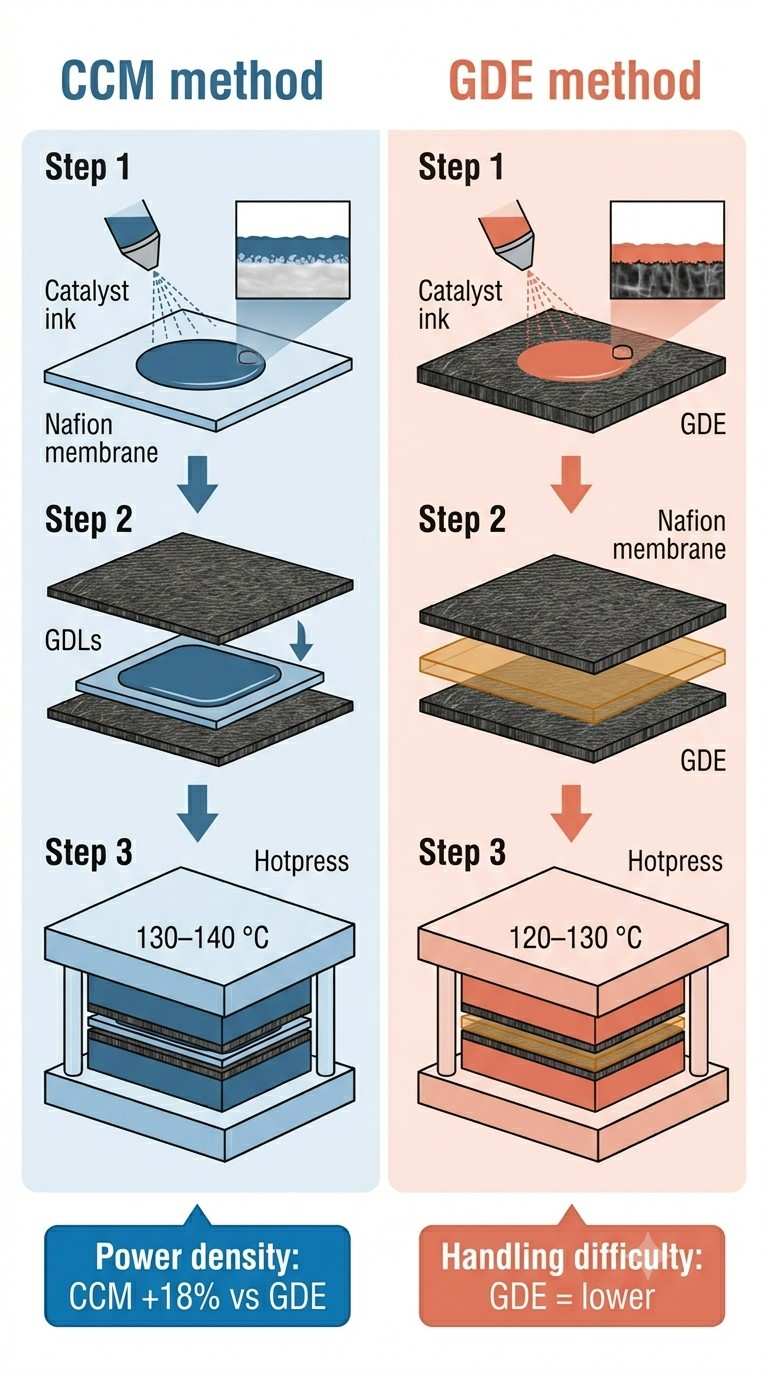
The first major decision in MEA fabrication determines every subsequent step. Two primary methods exist — catalyst-coated membrane (CCM) and gas diffusion electrode / catalyst-coated substrate (GDE/CCS) — and they produce meaningfully different performance outcomes, handling requirements, and failure modes.
CCM can produce higher peak power density than comparable GDE-based MEAs in some reported studies, but the magnitude depends on catalyst loading, membrane, GDL, hot-press conditions, and test protocol — but requires more precise control of solvent content and drying during catalyst coating. For researchers new to MEA fabrication, GDE is the more forgiving starting point. Browse MEA test cells at ScienceGears →
3.1 Catalyst-Coated Membrane (CCM)
In CCM fabrication, the catalyst ink is applied directly onto the surface of the pre-treated membrane. GDLs are then placed either side of the coated membrane and the complete assembly is hotpressed.
CCM is often selected for higher-performance MEA studies when coating, drying, and membrane handling are well controlled. First, direct catalyst coating creates an intimate ionic interface between the catalyst layer and the membrane sulphonate groups — direct contact between the catalyst layer and PEM supports efficient proton transport and catalyst utilisation. Second, CCM is compatible with the most advanced catalyst deposition methods and has been reported to produce higher peak power density than GDE-based MEAs under specific experimental conditions.
The fabrication challenge: if the ink is too wet when it contacts the membrane surface, the solvent causes the membrane to swell locally before drying, producing surface cracks and uneven catalyst loading. Catalyst layers deposited with excess solvent in the ink undergo surface deformation as the excess solvent evaporates — a common failure mode in new CCM fabrication setups.
3.2 Gas Diffusion Electrode / Catalyst-Coated Substrate (GDE/CCS)
In GDE fabrication, the catalyst ink is applied to the GDL rather than to the membrane. The coated GDL becomes a gas diffusion electrode. Two GDEs are then placed either side of the pre-treated membrane and hotpressed to form the complete MEA.
The advantage is that the catalyst coating step is physically separated from the membrane handling step — reducing the risk of membrane damage during fabrication. The performance trade-off: the interface between the CL and the PEM can be weak, resulting in delamination and reduced durability of the MEA. Without the intimate bonding achieved by direct coating onto the membrane surface, the PEM/CL interface relies entirely on hotpress conditions.
3.3 The Decal Transfer Method
A third option for AEMWE MEAs or any situation where membrane fragility makes direct CCM coating risky: the catalyst layer is coated onto a PTFE decal sheet, then transferred to the membrane surface during hotpress and the PTFE backing peeled away. This can provide a compromise between the interface quality targeted by CCM and the handling advantages of GDE fabrication. It may be suitable for fragile or thin AEM grades, subject to current manufacturer guidance and availability where direct airbrush coating risks mechanical damage.
3.4 At-a-Glance Comparison
| Property | CCM | GDE / CCS | Decal Transfer |
|---|---|---|---|
| Peak power density | Often higher under controlled fabrication | Baseline for comparison | Can approach CCM, depending on transfer quality |
| Catalyst utilisation | Often high | Often moderate | Can be high |
| Membrane handling risk during fabrication | Higher | Lower | Low |
| Fabrication complexity | Higher | Lower | Medium |
| Interface durability | Often strong when coating is well controlled | Higher delamination risk if hot-pressing is insufficient | Can be good with optimised transfer |
| Best for | High-performance studies, publication benchmarking | Iterative catalyst screening, new researchers | AEM MEAs, fragile membrane grades |
| AEMWE compatibility | Possible with care | Preferred | Preferred |
4 MEA Fabrication — Step-by-Step Protocols
4.1 Materials Checklist Before You Begin
- Pre-treated ion-exchange membrane, such as Nafion for PEM systems or a compatible AEM for AEMWE, stored according to the manufacturer’s instructions — see Nafion pre-treatment protocol
- Catalyst powder (Pt/C for PEMFC cathode; IrO₂ for PEMWE anode)
- Appropriate ionomer dispersion for the selected membrane and electrode chemistry
- Solvent system (DI water + IPA; add glycerol for viscosity control if spray coating)
- Gas diffusion layer (carbon paper or carbon cloth, appropriate PTFE content)
- Gaskets (PTFE or silicone, thickness matched to hydrated membrane — see Section 4.5)
- Hot press with temperature control over the validated range for the selected membrane and MEA architecture
- PTFE release sheets (two per MEA assembly)
- ScienceGears MEA test cell torque wrench and bolt sequence diagram
4.2 Catalyst Ink Preparation
Catalyst ink quality is a commonly overlooked variable in MEA fabrication. An ink with poor dispersion produces agglomerated catalyst particles that create uneven coating thickness, can puncture the membrane during hotpress, and leave large portions of the catalyst surface electrochemically inactive.
Standard ink composition for PEMFC cathode (Pt/C):
| Component | Ratio / Quantity |
|---|---|
| Pt/C catalyst (40 wt% Pt) | Reference mass |
| Nafion dispersion (5 wt%) | I/C = 0.5 (standard starting point) |
| DI water | Equal volume to IPA |
| IPA (isopropanol) | 3–4 mL per 50 mg catalyst |
| Glycerol (optional) | 5–10 vol% of IPA for spray viscosity |
Suggested dispersion sequence — validate for the selected catalyst, ionomer, solvent system, and coating method:
- Combine catalyst and DI water; bath sonicate 10 minutes to wet the catalyst surface before adding Nafion
- Add Nafion ionomer dispersion; bath sonicate 20 minutes
- Add IPA; bath sonicate 10 minutes
- Tip: Sonicate using a validated amplitude and duration for the probe and ink volume, for example around 30% amplitude for 5 minutes where appropriate — use a clean probe tip to avoid metallic contamination
- Verify: ink should be uniformly dark with no visible agglomerates and no phase separation
4.3 Catalyst Application — Three Methods
Method 1 — Hand painting / brush coating: Acceptable for preliminary screening only. Can produce substantial loading non-uniformity across the active area unless carefully controlled. Run 3 MEAs from the same ink batch and average their performance.
Method 2 — Airbrush spray coating: Dilute the prepared ink with additional IPA to spray-compatible viscosity. Spray in controlled passes at a validated nozzle-to-surface distance and drying interval for the ink, nozzle, substrate temperature, and humidity. Maintain consistent nozzle-to-surface distance — catalyst layers deposited at incorrect nozzle heights contain surface cracks attributed to excess solvent depositing on the membrane as the film undergoes surface deformation during solvent evaporation.
Method 3 — Ultrasonic spray coating: Can provide high coating uniformity and may help realise the performance advantages of CCM fabrication when ink formulation and drying are optimised. The ultrasonic nozzle atomises ink into a fine uniform mist. A commonly used PEMFC cathode benchmarking loading is 0.33 mg Pt cm⁻², but the selected loading should match the study objective and comparison protocol. Weigh the membrane before and after coating to verify loading.
4.4 Hotpress Assembly — Full Parameters
| Parameter | Nafion 115 | Nafion 117 | Nafion 212 | Nafion 211 | Fumasep FAA-3 (AEM) |
|---|---|---|---|---|---|
| Temperature (°C) | 130–135 | 130–135 | 130–140 | 120–130 | 60–80 |
| Pressure (MPa) | 4–5 | 4–5 | 3–4 | 3–4 | 2–3 |
| Duration (min) | 3–5 | 3–5 | 2–3 | 2 | 2 max |
| Pre-warm membrane | 60 °C, 2 min | 60 °C, 2 min | 60 °C, 1 min | 60 °C, 1 min | No |
| PTFE release sheets | Both sides | Both sides | Both sides | Both sides | Both sides |
Why 130–140 °C
This temperature deliberately exceeds the glass transition temperature of Nafion 115 and 117 (~120–130 °C). Above Tg, the membrane softens slightly, allowing intimate contact to form between the membrane surface and the catalyst layer during compression. Below the validated hot-press range, the membrane may not conform sufficiently to the catalyst-layer surface, reducing interfacial contact even when pressure is applied.
AEM Hotpress — Why Different
AEMs can have lower thermal and chemical tolerance than PFSA PEMs, and hot-press conditions must be checked against the current manufacturer guidance for the exact membrane grade and counter-ion form. AEM MEA hotpress must use lower temperature and pressure; GDE or decal transfer methods are generally preferred for AEMWE MEA fabrication.
For many PFSA PEM MEAs, hot pressing is often performed in the 120–140 °C and 3–5 MPa range, but conditions must be validated for the membrane, catalyst layer, GDL, and cell hardware. In this article, we describe the final assembly as a GDL/CCM/GDL stack or five-layer MEA, not simply a three-layer MEA.
4.5 Gasket Assembly and Cell Torque
Design gasket geometry using the hydrated membrane thickness, GDL/electrode thickness, target compression, sealing requirement, and specific cell hardware. Do not rely on dry membrane datasheet values alone.
| Membrane Grade | Hydrated Thickness (μm) | Target Gasket Thickness (μm) |
|---|---|---|
| Nafion 115 | ~160 | ~120–130 |
| Nafion 117 | ~230 | ~170–185 |
| Nafion 212 | ~64 | ~48–52 |
| Nafion 211 | ~32 | ~24–26 |
| Fumasep FAA-3-50 | ~60 | ~45–50 |
Cell assembly torque sequence: Apply bolts in a star (cross) pattern — never in a circular sequence. For a standard ScienceGears MEA test cell with four corner bolts, apply 25% of target torque in the first pass, 50% in the second, 75% in the third, and 100% in the fourth. This progressive cross-torque sequence ensures uniform compression across the active area.
5 MEA Conditioning — Why It Is Mandatory and How to Do It
An unconditioned MEA will not perform at its rated capability. The performance difference between a conditioned and an unconditioned MEA of identical construction is large enough to be the deciding factor in whether a catalyst appears competitive in published data.
Conditioning serves three functions:
- Fully hydrates the ionic channels of the membrane and ionomer within the catalyst layer
- Establishes ionic contact between the Nafion ionomer in the catalyst layer and the membrane sulphonate network
- Removes residual solvents from the catalyst ink not fully expelled during drying and hotpress
5.1 PEMFC Conditioning Protocols
Common conditioning approaches include the following; suitability depends on cell type, MEA design, operating conditions, and the comparison protocol:
Method 1 — Constant voltage protocol: Hold at 0.5–0.6 V for 8–12 hours at 80 °C, 100% RH. Simple to implement; appropriate for most research-scale PEMFC conditioning.
Method 2 — Current ramping protocol: Gradually increase current density in 200 mA cm⁻² steps from 0 to 1 A cm⁻², then operate at 1 A cm⁻² for 40 minutes with inlet gases at 100% relative humidity to maximise hydration of the MEA.
Method 3 — Protocol-based conditioning for publication-quality comparisons: MEA conditioning by constant low current density is not an effective procedure compared to constant voltage and USFCC protocol conditioning methods — the conditioning protocol choice has a measurable impact on final MEA performance and EIS response. The USFCC protocol uses a defined sequence of current density steps with hold times at each level, cycling between defined minimum and maximum operating points.
Conditioning Completion Criterion : OCV stable within ±5 mV and HFR stable within ±5 mΩ cm² across three consecutive polarisation curves. When both criteria are met simultaneously, formal BOL characterisation can begin.5.2 PEMWE Conditioning Protocol
PEMWE MEA conditioning can be more demanding than PEMFC conditioning because catalyst layers, porous transport layers, ionomer distribution, and interfacial hydration may evolve during initial operation. One published PEMWE benchmarking approach uses a voltage hold at 1.85 V for 12 hours, followed by 10 slow polarisation curves and 10 fast polarisation curves; cite the protocol if these values are retained. In that reported benchmark example, current density increased during the voltage hold and cell potential decreased during the slow polarisation sequence, indicating progressive activation for that MEA and test configuration.
An alternative validated protocol for PEMWE test stations: square-wave cycling (500 cycles) from 0.6 V to 1.6 V at 2.5 seconds hold per potential, followed by a constant current hold at 2 A cm⁻² for 3 hours. Performance is then measured using a 3-way polarisation curve — first anodic scan, cathodic scan, and second anodic scan — and only the second anodic scan is used for comparison.
5.3 AEMWE Conditioning Protocol
For AEMWE systems operated with alkaline electrolyte, equilibrate the membrane and electrode compartments according to the selected electrolyte concentration, membrane form, and manufacturer guidance before applying current to ensure the AEM has reached ionic equilibrium. Apply current gradually — begin at 100 mA cm⁻² and increase in 100 mA cm⁻² steps every 10 minutes. Do not apply full operating current to an un-equilibrated AEM MEA — sudden ionic gradients cause non-uniform membrane swelling that produces irreproducible performance.
6 MEA Testing — Polarisation Curves, EIS, and HFR Measurement
6.1 The Polarisation Curve — What It Tells You and How to Run It
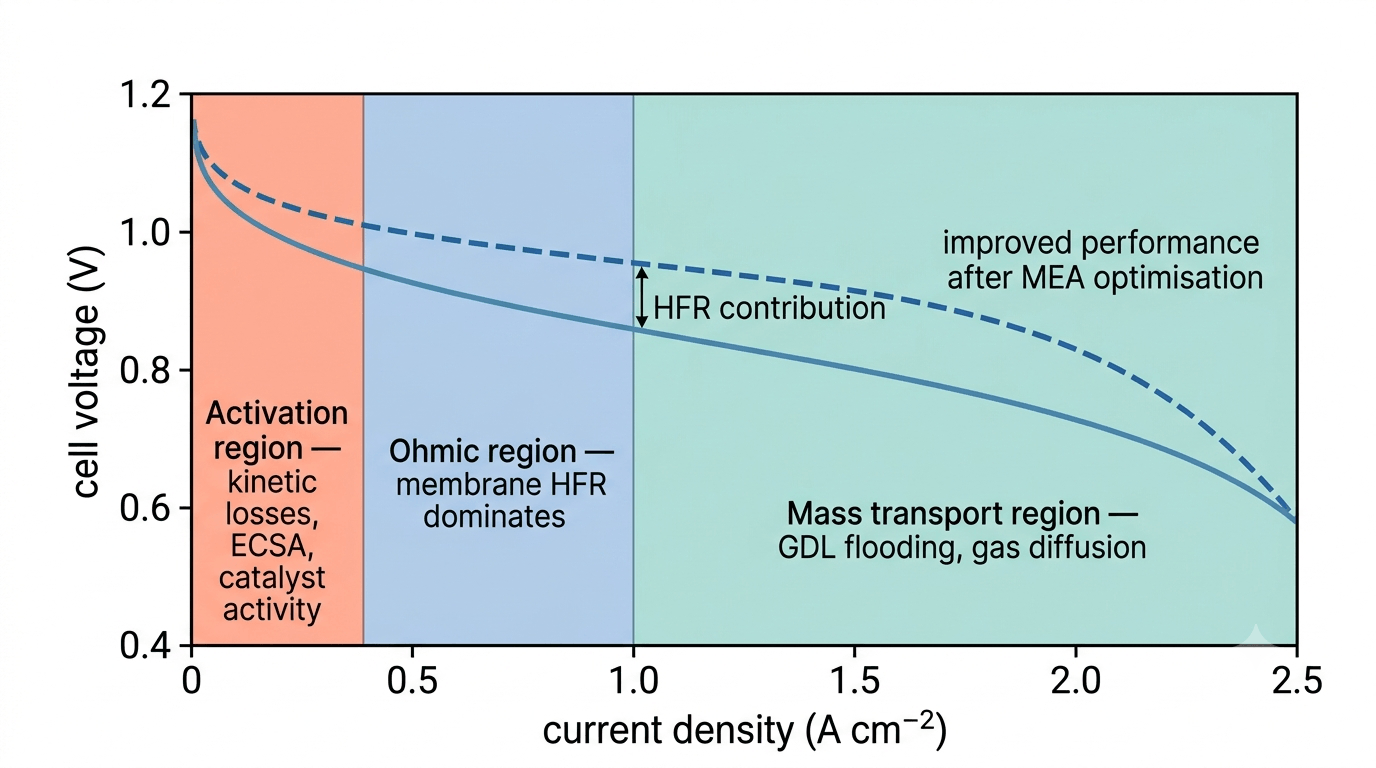
Caption: A polarisation curve separates the three loss mechanisms in an MEA. Diagnosing which region limits your MEA’s performance is the first step in systematic optimisation. Run with a ScienceGears potentiostat for full data acquisition and EIS integration.
The polarisation curve — cell voltage vs current density — is the primary MEA performance characterisation. Understanding the three regions converts a performance number into a diagnostic tool.
Activation region, illustrated here at low current density: Kinetic losses dominate — governed by catalyst activity (exchange current density) and available three-phase boundary area (ECSA). A large activation loss indicates insufficient catalyst loading, poor catalyst dispersion, or poor ionic contact between catalyst and ionomer.
Ohmic region, illustrated here at intermediate current density: Ohmic losses dominate — cell voltage decreases approximately linearly. The magnitude of the voltage–current-density slope is related to the total area-specific resistance over the approximately linear region. Every 0.1 Ω cm² of ASR produces 100 mV of voltage loss at 1 A cm⁻². If membrane ASR is reduced from about 0.20 Ω cm² to about 0.05 Ω cm² under the same operating conditions, the expected ohmic voltage saving at 1 A cm⁻² is about 150 mV. Do not present this as a guaranteed result from switching membrane grade alone.
Mass-transport region, illustrated here at higher current density: Concentration losses dominate. At high current density, the reaction consumes reactants faster than they can diffuse to the catalyst surface. Liquid water produced at the PEMFC cathode floods GDL pores, blocking oxygen access — the characteristic steep voltage drop above 1.5–2 A cm⁻² in poorly optimised MEAs.
How to run a polarisation curve: Use your ScienceGears potentiostat in galvanostatic mode. Apply current density steps from OCV to maximum in 50–100 mA cm⁻² increments. Slow curves: hold each point 3–5 minutes (steady state, use for BOL characterisation). Fast curves: hold 30–60 seconds (reproducibility checks). For PEMWE, follow the scan sequence defined by the selected benchmark protocol; when using a 3-way protocol, state which scan is reported and why.
6.2 EIS — Separating the Three Resistance Contributions
EIS can help separate ohmic, charge-transfer, and transport-related contributions when the frequency range, perturbation amplitude, operating point, and interpretation model are appropriate — allowing you to diagnose which layer limits performance rather than simply observing that performance is poor.
Standard EIS parameters for MEA testing:
| Parameter | Value |
|---|---|
| Frequency range | Select for the diagnostic objective; include sufficiently low frequencies if mass-transport features are being interpreted |
| AC amplitude | Use a small perturbation that remains in the linear-response regime; specify consistently as current, current density, voltage, or percentage of DC bias |
| DC bias | At operating current density |
| Points per decade | 50–100 |
High-frequency resistance (HFR) is measured at each point on the polarisation curve — the high-frequency real-axis intercept gives the membrane resistance. High- and low-frequency features can be associated with charge-transfer and transport processes, but assignment should be made using an appropriate equivalent-circuit or physics-based model.
Run EIS at a minimum of three current density points — one in each polarisation curve region. The HFR should remain approximately constant across current densities — if it increases at high current density, the membrane is dehydrating, indicating insufficient humidification.
For detailed EIS configuration and interpretation, see our EIS proton conductivity measurement protocol →
6.3 OCV Measurement — The Membrane Integrity Diagnostic
Measure OCV at zero current before every test session:
- PEMFC (H₂/O₂, 25 °C): Measured typically 0.95–1.05 V
- PEMFC (H₂/air, 25 °C): Measured typically 0.85–0.95 V
OCV below the expected range in a PEMFC can indicate gas crossover, leakage, mixed potentials, catalyst contamination, or measurement/setup issues. Confirm with appropriate leak and crossover diagnostics before performance characterisation. Do not proceed with performance characterisation on a low-OCV MEA.
7 Troubleshooting — Eight Common MEA Problems Diagnosed
| # | Symptom | Most Likely Cause | Diagnostic Test | Fix |
|---|---|---|---|---|
| 1 | High HFR from first run | Membrane not fully hydrated; conditioning incomplete | OCV check; EIS HFR vs expected ASR for grade | Complete conditioning protocol; verify 100% RH inlet gases; confirm pre-treatment |
| 2 | Poor performance at low current density (large activation loss) | Insufficient catalyst-ionomer contact; low ECSA | EIS — large high-frequency arc (charge transfer resistance) | Increase I/C ratio slightly; verify catalyst dispersion; switch GDE to CCM |
| 3 | Sharp voltage drop at high current density | GDL flooding or gas starvation | EIS — large low-frequency feature; check outlet water | Optimise humidification, gas stoichiometry, pressure, flow distribution, and GDL/PTFE specification; avoid reducing RH without checking membrane hydration and HFR response |
| 4 | Performance varies run-to-run (>5% between identical conditions) | Gasket over/under-compression; inconsistent assembly torque | Measure gasket thickness vs hydrated membrane | Redesign gasket to hydrated membrane dimensions; apply torque in cross-pattern to specified value |
| 5 | OCV below 0.85 V (PEMFC) | Membrane pinhole or gas crossover | Linear sweep voltammetry — crossover current above the limit defined by the selected protocol | Replace membrane; check hotpress pressure; verify gasket did not over-compress |
| 6 | MEA performs well on day 1, degrades after 3–5 runs | Catalyst layer delamination at PEM/CL interface | Post-test visual inspection; SEM if available | Check interface bonding, compression, and hot-press conditions against the validated membrane-specific range; consider CCM or decal transfer if GDE delamination persists |
| 7 | HFR increases progressively over testing campaign | Membrane cation contamination from electrolyte or hardware | Compare EIS HFR vs BOL baseline | For PFSA PEMs only, consider re-protonation using a validated acid-cleaning protocol; do not apply PEM acid-boiling steps to AEMs. If there is no recovery, replace the membrane and audit hardware for contamination sources |
| 8 | Asymmetric anode/cathode performance | Electrode identity mixed up during assembly | Disassemble; verify catalyst identity on each face | Label anode and cathode faces of membrane before hotpress; use robust labelling and handling controls outside the active area; do not alter catalyst loading solely as a visual marker unless it is part of the experimental design |
8 MEA Optimisation — The Four Systematic Levers
Once you have a working MEA with a documented BOL polarisation curve and EIS baseline, systematic optimisation is possible. Vary one parameter at a time and re-characterise after each change — EIS tells you which lever moved the correct resistance contribution.
8.1 Catalyst Loading
Reducing platinum loading whilst maintaining performance is the primary objective in most academic MEA studies. Establish BOL at current loading (typically 0.33 mg Pt cm⁻²), then fabricate MEAs at 50% and 25% of this loading. Compare EIS charge transfer resistance — an increase in the high-frequency arc confirms the lower loading has reduced kinetic performance. Quantify the trade-off against the cost saving.
8.2 Ionomer-to-Carbon (I/C) Ratio
- Increase I/C (0.5 → 0.8): Reduces gas transport but improves ionic contact — beneficial if EIS shows dominant charge transfer resistance
- Decrease I/C (0.5 → 0.3): Improves gas access but reduces ionic pathways — beneficial if EIS shows dominant mass transport resistance at the catalyst layer
Optimise separately for anode and cathode — the optimal I/C differs for each electrode environment.
8.3 Membrane Grade
Switching to a lower-resistance membrane grade can be a high-impact optimisation when the ohmic region is membrane-resistance limited. Expected improvement: Nafion 117 ASR ~0.20 Ω cm² vs Nafion 212 ~0.05 Ω cm² predicts ~150 mV improvement at 1 A cm⁻². If measured improvement is significantly less, the limiting resistance is not the membrane — recheck contact resistances. Full grade guidance: Nafion 117 vs 212 vs 115 →
8.4 GDL Specification
GDL porosity, PTFE content, and MPL design control the mass transport region of the polarisation curve. Higher PTFE content improves water expulsion but reduces gas transport; lower PTFE content improves gas access but increases flooding risk. For specific GDL selection guidance, see ScienceGears application notes →
9 Frequently Asked Questions
Q1 How do I know if my MEA hotpress was done correctly — and can I re-press if it was not?
The primary indicators of a successful hotpress: (1) the catalyst layer does not peel from the membrane surface when gently contacted with tweezers at the edge; (2) the membrane surface under the catalyst layer is uniformly amber/translucent with no white dry patches or dark cracked spots; (3) the GDL layers are not separable from the CCM by hand without visible tearing of the catalyst layer.
If the hotpress was performed at the correct temperature but inadequate pressure or insufficient duration, a second pressing is acceptable — place the MEA back between clean PTFE sheets and apply the same conditions for 50% of the original duration. Do not re-press at higher temperature than originally used.
Q2 Why does my MEA perform well on the first polarisation curve but poorly on the second?
This almost always indicates conditioning was declared complete prematurely. The first polarisation curve temporarily hydrates the membrane and establishes partial ionic contact. When the cell is cooled between runs, the membrane partially de-hydrates, and the second curve measures the un-conditioned state. Run the full conditioning protocol from the start, confirm OCV and HFR stability across three consecutive polarisation curves, and never cool the cell to room temperature between conditioning and BOL characterisation.
Q3 What is the correct Nafion ionomer loading in the catalyst ink for PEMFC research?
The standard research starting point is I/C = 0.3–0.5 by weight, with I/C = 0.5 as the most common published baseline. The most reliable approach is to start at I/C = 0.5, run EIS to identify whether ionic transport or mass transport is limiting in your specific catalyst layer, then adjust accordingly. Catalyst loading is typically 0.33 mg Pt cm⁻² for PEMFC cathode research benchmarking.
Q4 Can I reuse a GDL between MEA experiments?
GDL reuse may be acceptable for rough screening within a controlled campaign, but fresh GDLs are preferred for quantitative comparison, publication-quality benchmarking, or cross-campaign reproducibility, subject to visual inspection — no permanent compression deformation, no contamination visible from previous catalyst layers. Between campaigns using different catalysts or electrolytes, replace the GDL. For durability studies running over weeks, replace the GDL at every membrane replacement — compression state and hydrophobicity change over extended operation in ways that are not fully reversible.
Q5 How long should I condition a new PEMWE MEA before taking BOL data?
A minimum of 12 hours at 1.85 V followed by 10 slow polarisation curves before declaring BOL. Published PEMWE benchmarking protocols may use extended conditioning, including 12–35 hours before BOL characterisation; cite the specific protocol used. Taking BOL data after only 1–2 hours produces results that are not representative of stable MEA performance and will not compare reliably to published data using the standard conditioning protocol.
Q6 My MEA performs well in H₂/O₂ but poorly in H₂/air — what is causing this?
H₂/O₂ and H₂/air performance differ primarily in the mass transport region — oxygen concentration in air is ~21% vs 100% in pure O₂, so the maximum current density before mass transport limitation is lower in air. This is expected and normal. If the H₂/O₂ to H₂/air gap is large at 1 A cm⁻², possible causes include excessive ionomer loading, cathode flooding, insufficient air stoichiometry, pressure differences, GDL selection, catalyst-layer structure, or cell setup. Use EIS, flow variation, and humidity checks to identify the limiting mechanism. Reduce I/C to 0.3 from the baseline 0.5 and re-characterise. Alternatively, increase air stoichiometry to confirm whether the limitation is transport-controlled.
10 Expert Support — How ScienceGears Works Alongside Your Research
Building a high-performance MEA is technically demanding — not because any individual step is particularly complex, but because the steps interact in ways that are often only apparent after systematic troubleshooting and repeated validation to understand what each parameter controls. ScienceGears is founded and directed by PhD-trained electrochemists who have fabricated CCM and GDE MEAs for PEMFC, PEMWE, and AEMWE research. The protocols in this guide are the ones we use in our own experimental work.
What Expert Support Looks Like in Practice
Pre-Fabrication Consultation
If you are setting up MEA fabrication for the first time and are unsure whether to use CCM or GDE, which Nafion grade to use, or how to match gasket thickness to your membrane, contact us before purchasing hardware. A short technical consultation can often identify the most important choices and reduce the risk of common first-MEA failure modes.
Talk to our technical team before ordering →
MEA Test Cell Material Selection
ScienceGears MEA test cells are available in graphite, titanium, and PTFE configurations:
- Graphite: Appropriate for PEMFC and CO₂RR at moderate anode potentials
- Titanium: Commonly required for PEMWE anode environments where graphite can oxidise under high anodic potential
- PTFE: Appropriate for corrosive electrolyte environments
Contact us to confirm the correct configuration before ordering — selecting the correct material before ordering avoids costly rework or replacement.
Hotpress Protocol Verification
If your hotpress is producing cracked catalyst layers, delaminating interfaces, or wrinkled membranes, contact us with the details of your protocol. The most common errors — hot-pressing outside the validated thermal and chemical limits of the selected AEM grade, insufficient PTFE release sheets, pressing at ambient humidity — are rapidly diagnosable.
Conditioning Protocol Confirmation
If your MEA is not stabilising after conditioning — OCV drifting, HFR not converging — contact us before assuming the MEA is defective. Premature declaration of conditioning complete is the most common cause of apparent MEA instability.
Complete System Supply
ScienceGears can help configure compatible options across the following categories:
- MEA test cells — graphite, titanium, PTFE
- Ion-exchange membranes — Nafion 115, 117, 211, 212, Fumasep FAA-3
- PEMFC test stations
- PEMWE test stations — single-cell systems and larger systems up to 200 kW, depending on configuration
- AEMWE test stations
- Potentiostats and galvanostats
- In-situ and operando cells
Local AU/NZ Stock
Where available, local inventory can reduce lead times for membranes, MEA test cells, and accessories. When you need to replace a membrane mid-campaign or switch cell configurations, you may avoid extended international freight delays.
“The MEA is where most performance variation enters the experimental system. Get the fabrication and conditioning workflow right, and the membrane and catalyst can speak for themselves. Get it wrong, and no amount of catalyst optimisation will tell you what you actually need to know.” — ScienceGears Technical Team
Further Reading
- → What Is MEA? Membrane Electrode Assembly — Complete Guide
- → MEA Test Cell Setup and Assembly — Step-by-Step Lab Guide
- → Fuel Cell Testing with Potentiostats — Polarisation Curves, EIS, Data Interpretation
- → CCM vs GDE MEA Fabrication — Which Approach for Your Research?
Membrane Selection
- → Which Membrane Should You Choose for Electrochemical Research?
- → Nafion 117 vs 212 vs 115 — Which Grade Is Right for Your Experiment?
- → Membrane Selection Guide: Fuel Cells vs Electrolysers vs H-Cells
Nafion Specifications
- → Complete Nafion Membrane Specifications — Thickness, Properties and Pre-Treatment
- → Standard Nafion Membrane Pre-Treatment Protocol
- → Nafion 117 Specs — Dry, Wet, and Hydrated Thickness Explained
Measurement and Characterisation
- → Measuring Nafion Proton Conductivity with EIS — Lab Protocol