
1 Why a Complete Specification Reference Matters
A researcher who has confirmed that Nafion is the correct membrane for their application faces a second, equally consequential decision: which grade, prepared in which way, stored under which conditions, and assembled into which cell geometry.
Getting this wrong does not produce suboptimal results. It produces uncontrolled experimental variability that appears in your data as noise, irreproducibility between runs, or anomalously high cell resistance — variability that is invisible until you trace it back to a membrane hydration state you did not control, a pre-treatment step you modified without realising the consequence, or a gasket geometry you designed to the dry membrane thickness rather than the hydrated one.
The published literature offers fragments of this information — Chemours datasheets give some properties, individual papers report others, ResearchGate threads debate pre-treatment protocols — but no single freely available resource consolidates all of it in a form that a researcher can use at the bench.
This article is that resource. The numerical values below are compiled from manufacturer data and peer-reviewed characterisation literature where available; final design values should be checked against the current manufacturer datasheet or supplier certificate of analysis. Where values differ between sources, the range is given and the discrepancy noted. All four Nafion grades discussed — 115, 117, 211, and 212 — are available from ScienceGears’ ion-exchange membrane range with local AU/NZ stock and same-day dispatch.
2 Nafion Polymer Architecture — The Structural Source of Its Properties

Caption: Nafion's unique combination of chemical inertness and proton conductivity arises from two distinct structural domains: the hydrophobic PTFE backbone (grey) and the hydrophilic sulphonate-terminated side chains (blue). The equivalent weight (EW) defines how many grams of dry polymer contain one mole of sulphonate groups — lower EW means more ionic groups, higher conductivity, but greater swelling. Browse Nafion grades at ScienceGears →
2.1 The Two Structural Domains
Nafion is a perfluorinated polymer membrane consisting of a polytetrafluoroethylene (PTFE) backbone with hydrophilic perfluorinated side chains that contain sulphonic ionic functional groups — known for high proton conductivity and excellent chemical stability. This architecture creates two chemically distinct domains within a single polymer:
The hydrophobic domain: The PTFE backbone gives Nafion high chemical resistance to many acids, oxidants, and common solvents, although compatibility still depends on concentration, temperature, exposure time, and ionic contamination. It is responsible for Nafion’s extraordinary chemical resistance and its ability to operate for extended periods in PEMFC and PEMWE environments when hydration, temperature, chemical purity, and operating conditions are controlled. It is also responsible for Nafion’s mechanical integrity — the PTFE backbone provides the crystalline reinforcement that gives extruded Nafion 117 its robustness.
The hydrophilic ionic domain: The pendant sulphonate-terminated side chains cluster into interconnected ionic channels within the membrane. These channels are filled with water under hydrated operating conditions and provide the pathways for proton transport via the Grotthuss mechanism — a process in which protons hop between water molecules along the hydrogen-bonded network rather than diffusing as hydrated ions. This mechanism accounts for Nafion’s exceptionally high proton conductivity relative to its water content.
The practical consequence of this two-domain architecture is that Nafion’s electrochemical and mechanical properties are deeply interdependent — any condition that changes the membrane’s water content (temperature, relative humidity, electrolyte concentration, pre-treatment history) simultaneously changes its conductivity, dimensions, and mechanical stiffness.
2.2 Equivalent Weight — The Master Parameter
Equivalent weight (EW) is the single most important intrinsic parameter for comparing Nafion grades. It is defined as the mass of dry polymer (in grams) that contains one mole of sulphonate exchange sites. Lower EW means more sulphonate groups per gram — higher ion exchange capacity (IEC), higher proton conductivity per unit thickness, and higher water uptake and swelling.
- Extruded grades (N-115, N-117): EW ~1,100 g mol⁻¹, IEC ~0.88–0.91 meq g⁻¹
- Dispersion-cast grades (NR-211, NR-212): EW ~1,000 g mol⁻¹, IEC ~0.95–0.98 meq g⁻¹
The lower ASR of NR-211 and NR-212 is primarily driven by their lower thickness; any grade-to-grade conductivity difference should be attributed only where supported by the cited source.
2.3 Extruded vs Dispersion-Cast — The Manufacturing Distinction
Nafion 115 and 117 are extrusion-cast membranes — a process that creates a highly ordered, semicrystalline polymer structure with pronounced in-plane alignment of the ionic channels. This produces higher mechanical stiffness, better dimensional stability under repeated hydration–dehydration cycling, and slightly lower through-plane conductivity (because the ionic channels are partially oriented in-plane rather than through-plane).
Nafion 211 and 212 (the NR-series) are manufactured by dispersion casting — the polymer is dissolved in solvent and cast as a film, producing a more isotropic, less crystalline structure. This gives the NR-series slightly higher through-plane conductivity per unit thickness but also higher in-plane swelling ratios and, in the case of NR-211, significantly lower mechanical robustness during handling.
3 Master Properties Reference — All Four Grades in One Table
This table is the centrepiece of this guide. It consolidates every property a researcher needs for experimental design, gasket specification, and performance prediction into a single verifiable reference.
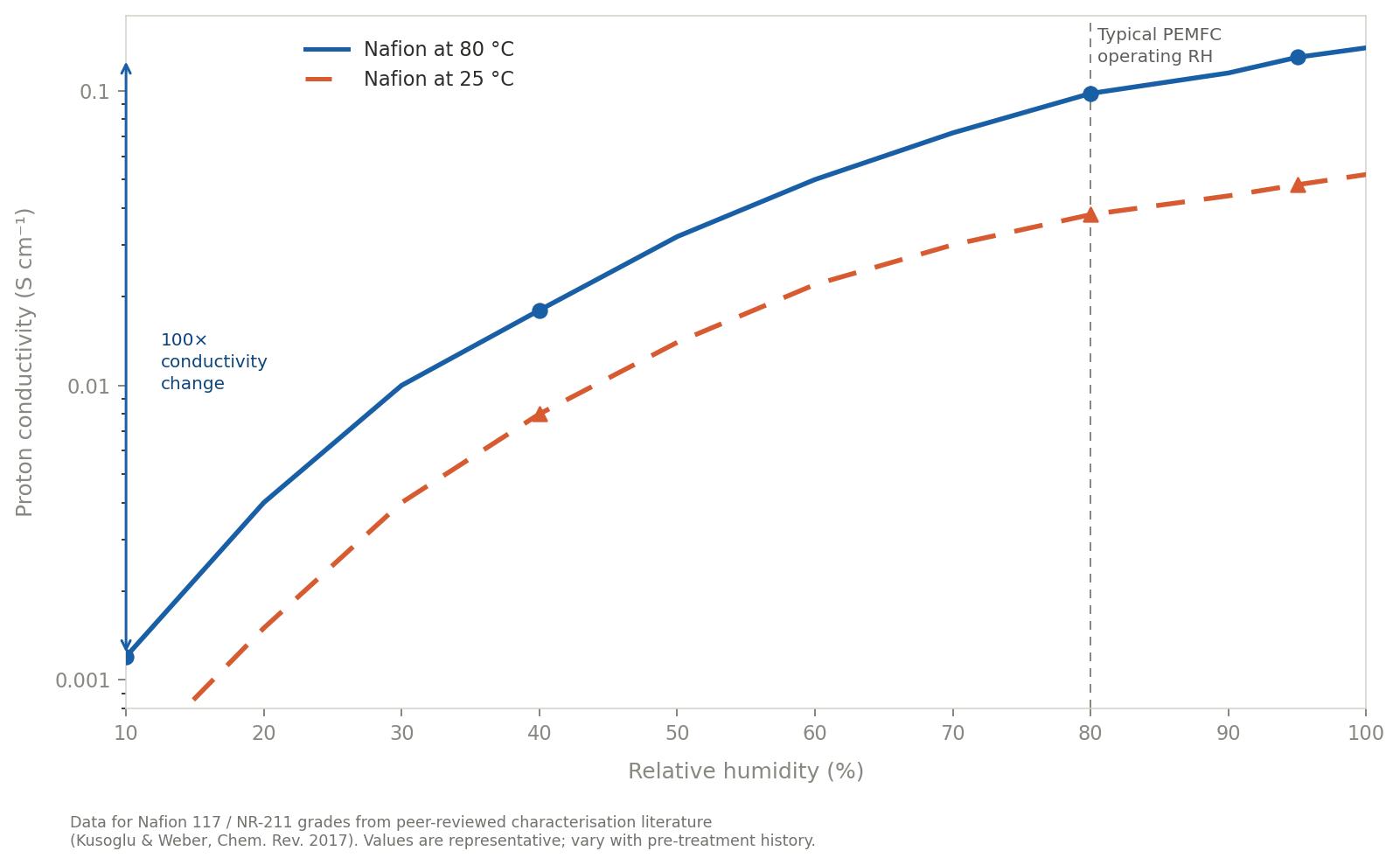
Caption: Nafion proton conductivity changes by approximately 100-fold between 10% and 95% relative humidity at 80 °C — from about 0.0012 S cm⁻¹ to about 0.13 S cm⁻¹ in the cited representative dataset. Relative humidity is a primary experimental variable and one of the dominant controls on membrane resistance in MEA-based cells. See potentiostat and EIS measurement options at ScienceGears →
| Property | Nafion 115 | Nafion 117 | Nafion 211 (NR-211) | Nafion 212 (NR-212) |
|---|---|---|---|---|
| Manufacturing method | Extruded | Extruded | Dispersion-cast | Dispersion-cast |
| Nominal dry thickness (μm) | ~127 | ~178–183 | ~25 | ~51 |
| Wet thickness, 25 °C DI water (μm) | ~145 | ~210 | ~29 | ~58 |
| Hydrated thickness, 80 °C (μm) | ~160 | ~230 | ~32 | ~64 |
| Equivalent weight (g mol⁻¹) | ~1,100 | ~1,100 | ~1,000 | ~1,000 |
| IEC, proton form (meq g⁻¹) | ~0.88–0.91 | ~0.88–0.91 | ~0.95–0.98 | ~0.95–0.98 |
| Proton conductivity, 25 °C, fully hydrated (S cm⁻¹) | 0.083–0.10 | 0.083–0.10 | 0.10–0.13 | 0.10–0.13 |
| Proton conductivity, 80 °C, 95% RH (S cm⁻¹) | ~0.12–0.15 | ~0.12–0.15 | ~0.13 | ~0.13 |
| Proton conductivity, 80 °C, 10% RH (S cm⁻¹) | ~0.003 | ~0.003 | ~0.0012 | ~0.0012 |
| Water uptake, 25 °C, as-received (% dry weight) | ~25–28 | ~25–28 | ~38–42 | ~38–42 |
| Water uptake, 25 °C, after H₂SO₄ pre-treatment (%) | ~28–34 | ~28–35 | ~42–48 | ~42–48 |
| In-plane swelling, 25 °C → 80 °C (%) | ~10–12 | ~10–12 | ~13–15 | ~14–15 |
| ASR, 25 °C, fully hydrated (Ω cm²) | ~0.13–0.16 | ~0.18–0.23 | ~0.02–0.03 | ~0.04–0.05 |
| Glass transition temperature, dry (°C) | ~120–130 | ~120–130 | ~104–106 | ~104–106 |
| Recommended max operating temp, humidified (°C) | 80 | 80 | 80 | 80 |
| Hardness peak (GPa) | ~0.12 | ~0.143 at 45 °C | ~0.09 | ~0.10 |
| Tensile strength, dry (MPa) | ~32–43 | ~32–43 | ~18–24 | ~18–24 |
| Chemical form, as received | H⁺ or Na⁺ form | H⁺ or Na⁺ form | H⁺ form | H⁺ form |
How to read this table:
The three thickness rows (dry, wet, hydrated) reflect the membrane's dimensions in three distinct states you will encounter in the lab. Dry is the as-received dimension — use this for ordering and initial cutting. Wet at 25 °C is after immersion in deionised water at room temperature — use this for gasket design in H-cell configurations. Hydrated at 80 °C is the equilibrium dimension under MEA and electrolyser operating conditions — always use this value for gasket geometry in MEA, PEMWE, and PEMFC test cells. Using the dry value for gasket design is the single most common source of membrane over-compression in research labs.
The conductivity rows use three reference conditions: fully hydrated at 25 °C (the standard ex-situ measurement condition), 80 °C at 95% RH (representative of well-humidified PEMFC conditions), and 80 °C at 10% RH (representative of dry or poorly humidified operation). The difference between the last two values — 0.13 S cm⁻¹ vs 0.0012 S cm⁻¹ — illustrates why humidification control is the single most important operating variable in any Nafion-based MEA cell.
4 Proton Conductivity in Depth — The RH and Temperature Dependence
4.1 The Dominant Effect of Relative Humidity
The most important fact about Nafion conductivity is that it is not a fixed value. At 80 °C, conductivity increases from 0.0012 S cm⁻¹ at 10% relative humidity to 0.13 S cm⁻¹ at 95% RH — a 100-fold variation across the operating humidity range. This is not a marginal effect that can be accounted for with an error bar. It is the difference between a membrane that is effectively non-conducting and one that is operating at its rated performance.
The physical explanation is straightforward: proton transport in Nafion occurs predominantly via the Grotthuss mechanism, in which protons hop along hydrogen-bonded chains of water molecules within the sulphonate ionic channels. When the membrane is dehydrated — whether due to low ambient humidity, insufficient gas humidification, or elevated operating temperature without pressurisation — the connectivity of the water network within the ionic channels collapses. The dominant conduction pathway is destroyed, and the membrane is forced to conduct protons via the slower vehicular diffusion mechanism (protons moving as hydronium ions, H₃O⁺, through the membrane bulk). The result is a dramatic conductivity loss that is fully reversible on re-hydration but which invalidates any experiment run under unknown or uncontrolled humidification conditions.
Reporting Requirement for MEA and Electrolyser Experiments
In any PEMFC test station or PEMWE test station experiment, the relative humidity of the inlet gases must be measured, controlled, and reported. A researcher who publishes polarisation curve data without reporting inlet gas RH is reporting an uncharacterised variable that makes direct comparison with any other published dataset impossible.
4.2 The Temperature Effect — Arrhenius Behaviour and Its Limits
Under fully humidified conditions (RH ≥ 90%), Nafion conductivity increases with temperature in a broadly Arrhenius fashion between 20 °C and 80 °C. The activation energy for proton transport in fully hydrated Nafion is approximately 10–15 kJ mol⁻¹ — low enough that the temperature effect over the 20–80 °C range approximately doubles conductivity.
Above 80 °C without pressurisation, this relationship breaks down sharply. As the operating temperature approaches and exceeds the boiling point of water at ambient pressure, liquid water within the ionic channels is converted to vapour and expelled from the membrane. Conductivity falls dramatically, and repeated dehydration–rehydration cycles above 80 °C cause progressive structural damage: excessive swelling of the polymer occurs at temperatures exceeding its structural transition temperature, causing changes to the internal architecture that reduce long-term conductivity even after re-hydration. For pressurised PEMWE operation above 80 °C, the increased water partial pressure under pressure maintains membrane hydration — but the structural degradation risk at extended exposure above 110 °C remains.
4.3 Cation Contamination — The Invisible Conductivity Killer
The conductivity values in the master properties table assume a membrane that is fully in the proton (H⁺) form. In practice, Nafion in contact with any electrolyte containing multivalent cations — Fe²⁺, Ni²⁺, Co²⁺, Ca²⁺, Mg²⁺ — will progressively exchange those cations into its sulphonate sites, displacing protons. Even trace amounts of Fe²⁺ in solution result in significant uptake of iron in the membrane due to the strong affinity between transition metal cations and sulphonate exchange sites. A membrane with 10% of its sulphonate sites occupied by Fe²⁺ shows measurably higher resistance than a clean H⁺-form membrane — and the contamination is not visible to the naked eye.
The practical consequences:
- Use only reagent-grade or ultra-high-purity electrolytes with Nafion membranes
- Use electrochemical cells and H-cells fabricated from compatible materials (PTFE, polypropylene, or stainless steel passivated surfaces) — avoid bare carbon steel hardware
- Verify membrane conductivity by EIS before and after each extended experiment; unexpected resistance increase is the diagnostic signal for cation contamination
- If contamination is confirmed, attempt re-protonation by boiling in 0.5 M H₂SO₄ for 60 minutes (the protonation step of the standard pre-treatment); if resistance does not recover, replace the membrane
5 Water Uptake and Dimensional Behaviour
Water uptake — the percentage increase in mass of a Nafion membrane upon hydration relative to its dry mass — governs both the membrane’s conductivity and its physical dimensions. These two consequences are inseparable: the same water molecules that enable proton transport also cause the membrane to swell. Understanding water uptake quantitatively is essential for reproducible cell assembly.
5.1 The Three Hydration States
As-received (dry): Commercial Nafion is shipped in the dry or lightly humidified state. As-received water uptake is negligible. Dry dimensions are used for ordering, initial cutting, and as the reference for calculating swelling.
Wet at 25 °C (DI water immersion): After immersion in deionised water at room temperature for 30–60 minutes, Nafion reaches equilibrium hydration at ambient conditions. Water uptake at this state is ~25–28% (N-series) or ~38–42% (NR-series) by dry weight. This is the state you should assemble into an H-cell at atmospheric pressure — the membrane will not change dimensions significantly during the subsequent experiment at 25 °C.
Hydrated at operating temperature (80 °C): At PEMFC and PEMWE operating conditions (80 °C, fully humidified), Nafion swells further than at 25 °C. The in-plane swelling ratio from 25 °C to 80 °C is approximately 10–12% for the extruded grades and 13–15% for the dispersion-cast grades. This additional swelling means a membrane cut to fit a gasket at room temperature will be over-compressed at operating temperature if the gasket geometry does not account for it — the single most common cause of anomalously high membrane resistance in electrolyser experiments that look correct at room temperature.
5.2 The Effect of Pre-Treatment on Water Uptake and Dimensions
Acid treatment increases water uptake by around 15% compared to the untreated membrane — from approximately 22% as-received to ~25–28% after the standard H₂SO₄ pre-treatment for Nafion 117. This increase occurs simultaneously with increases in conductivity and a decrease in crystallinity.
The dimension change is not trivial. A Nafion 117 membrane sheet cut to 50 × 50 mm as received will measure approximately 53–54 mm × 53–54 mm after pre-treatment and hydration at 80 °C — an increase of 6–8% in linear dimension. For an H-cell where the membrane simply needs to cover the opening between compartments, this can be accommodated. For an MEA where the membrane must fit precisely within a defined active area and gasket geometry, this dimensional change must be designed in advance.
5.3 Why the NR-Series Swells More Than the N-Series
The higher water uptake and in-plane swelling of NR-211 and NR-212 compared to N-115 and N-117 is a direct consequence of their lower EW (~1,000 vs ~1,100 g mol⁻¹) and their dispersion-cast microstructure. More sulphonate groups per gram means more water-binding sites per gram — the membrane absorbs more water at equilibrium. The less crystalline, more isotropic structure of the dispersion-cast film also provides less physical constraint on swelling than the ordered semicrystalline structure of the extruded grades.
In practice, this means that NR-212 MEA gasket design requires more careful accommodation of dimensional change than N-117 H-cell gasket design — the consequence of swelling is larger and less predictable in the lateral (in-plane) direction.
6 Thermal Stability and Mechanical Properties
6.1 Glass Transition Temperature and Structural Limits
The glass transition temperature (Tg) marks the temperature at which the polymer transitions from a glassy, rigid state to a softer, viscoelastic state. For Nafion:
- Extruded grades (N-115, N-117): Tg ~120–130 °C (dry). The higher crystallinity of the extruded grades raises Tg compared to the dispersion-cast series.
- Dispersion-cast grades (NR-211, NR-212): Tg ~104–106 °C (dry). Pre-treatment slightly lowers Tg — a membrane treated with H₂O₂ shows a Tg of ~104 °C vs ~106 °C for untreated NR-212, reflecting reduced crystallinity.
Above Tg, Nafion loses dimensional stability and its selective transport properties degrade. The Tg sets the absolute upper thermal operating limit — not a guideline, but a hard structural constraint.
Hotpressing for MEA Fabrication
Hotpressing at 130–140 °C is deliberately performed above the Tg of the extruded grades (and above the Tg of the NR-series) to allow the membrane to soften and form intimate contact with the catalyst layers. This is the intended use of the thermal transition — controlled, brief, and under defined pressure. Extended operation above Tg is not. For ScienceGears MEA test cell configurations, torque specifications for cell assembly are calibrated to room-temperature assembly.
6.2 The 80 °C Practical Operating Limit
The practical upper operating temperature for all standard Nafion grades under non-pressurised conditions is 80 °C, determined by the membrane’s ability to retain sufficient liquid water at elevated temperature rather than by Tg. At 80 °C and atmospheric pressure, the vapour pressure of water is sufficient to begin expelling water from the ionic channels — conductivity begins to decline. This limit can be extended by pressurisation (elevated partial pressure of water prevents membrane dehydration) or by operating in liquid water contact rather than gas-phase humidity.
A decrease in conductivity of Nafion 117 is confirmed at temperatures of 110–150 °C and pressures of 0.5–0.7 MPa in liquid water environments, caused by changes in internal structure — excessive polymer swelling — rather than chemical degradation of the backbone. The distinction is important: the backbone is chemically intact, but the ionic channel network has swollen beyond its optimal structure, disrupting proton transport pathways. This structural change is not fully reversible on cooling.
6.3 Mechanical Properties and the Temperature–Stiffness Relationship
Both hardness and elastic modulus of Nafion 117 show a non-monotonic transition with temperature, reaching peak values of 0.143 GPa (hardness) and 0.833 GPa (reduced modulus) at 45 °C. Below 45 °C, the membrane becomes stiffer as temperature falls; above 45 °C, it softens progressively toward Tg. The membrane also exhibits a shape memory effect — if deformed above Tg and then cooled, it retains the deformed geometry until reheated.
The practical implications for MEA assembly: compression applied at room temperature (stiff membrane) produces different gasket sealing behaviour than compression applied at operating temperature (softer membrane). For precision MEA test cells from ScienceGears, torque specifications for cell assembly are calibrated to room-temperature assembly — do not assemble MEA cells at elevated temperature unless the torque specification has been adjusted accordingly.
7 Chemical Resistance and Compatibility
7.1 What Nafion Resists
The PTFE backbone gives Nafion its extraordinary chemical inertness. Under standard research conditions, Nafion is chemically stable in contact with:
- All common inorganic acids at working concentrations: HCl, H₂SO₄, HNO₃, HClO₄, H₃PO₄
- Common aqueous electrolytes: KHCO₃, K₂SO₄, Na₂SO₄, NaClO₄, KOH at low concentration
- Hydrogen and oxygen gases under PEMFC and PEMWE operating conditions
- CO₂ and N₂ gases under standard electrochemical cell operating conditions
- Most organic solvents at room temperature for brief contact periods (minutes to hours)
- Dilute oxidants (H₂O₂ at concentrations up to ~5%)
7.2 What Nafion Does Not Resist
Strong bases at elevated temperature: KOH and NaOH above approximately 0.1 M at 60–80 °C attack the ether linkages connecting the sulphonate side chains to the PTFE backbone. Brief alkaline exposure at room temperature (minutes) is generally tolerable. Extended operation in 1 M+ KOH at 60 °C+ causes progressive conductivity loss and eventual mechanical degradation. For alkaline experiments requiring OH⁻ transport, use Fumasep FAA-3 (AEM) rather than Nafion.
DMSO and DMF at elevated temperature: Dimethyl sulfoxide (DMSO) and dimethylformamide (DMF) both interact with Nafion’s polymer microstructure at temperatures above 60 °C — they act as plasticising solvents that swell the hydrophobic domains and alter the ionic channel geometry. Do not use DMSO- or DMF-containing electrolytes in Nafion-based MEA cells at elevated temperature.
Highly concentrated oxidising acid mixtures: Nafion is chemically dissolved only by aggressive oxidising acid combinations — aqua regia (HNO₃ + 3HCl) and concentrated H₂O₂/H₂SO₄ mixtures at high concentration. Standard lab pre-treatment concentrations (3% H₂O₂, 0.5 M H₂SO₄) are well below the dissolution threshold. Do not confuse pre-treatment reagent concentrations with the incompatible concentrated forms.
Repeated freeze–thaw cycling: Freezing a hydrated Nafion membrane causes ice crystal formation within the ionic channels, which can disrupt the channel geometry irreversibly. Never freeze Nafion membranes — store at 4–8 °C (above freezing) in deionised water.
7.3 The Organic Solvent Incompatibility Table
| Solvent | Risk Level | Mechanism | Recommendation |
|---|---|---|---|
| DMSO (>60 °C) | High | Plasticises hydrophobic domain; alters microstructure | Avoid in MEA at elevated temperature |
| DMF (>60 °C) | High | Similar plasticising effect to DMSO | Avoid in MEA at elevated temperature |
| NMP | Moderate | Casting solvent — swells polymer at elevated temperature | Avoid at elevated temperature |
| Ethanol / IPA | Low at RT | Short-term contact acceptable; alters surface wettability | Brief contact only; rinse with DI water |
| Acetonitrile | Low at RT | Minimal interaction at room temperature | Acceptable for brief contact; avoid extended immersion |
| Aqua regia | Extreme | Dissolves the polymer completely | Never use — incompatible |
| Conc. H₂O₂/H₂SO₄ mixture | Extreme | Oxidative degradation risk | Do not mix; use H₂O₂ and H₂SO₄ only as separate sequential pre-treatment reagents with the mandatory intermediate DI-water rinse |
8 The Standard Pre-Treatment Protocol — Step by Step
For reproducible electrochemical measurements, pre-treatment or documented membrane conditioning is strongly recommended. Commercial Nafion may be supplied in acid form, but its surface condition, storage history, hydration state, and exposure to cations can still affect electrochemical performance: (1) surface organic impurities from the manufacturing process reduce surface wettability and can contaminate the electrolyte; (2) old stock, unclear supplier stock, or previously used membranes may be partially exchanged into Na⁺ or other cationic forms rather than remaining fully in the H⁺ form, reducing conductivity by up to 60% relative to a fully protonated membrane.
Pre-treatment serves three purposes: remove surface contaminants (H₂O₂ step), fully protonate all sulphonate sites (H₂SO₄ step), and fully hydrate the ionic channel network (DI water steps). The result is a membrane with a defined and reproducible conditioning history — essential when comparing results against the representative values in Section 3.

Caption: The standard Nafion pre-treatment protocol in order. The intermediate DI water rinse between H₂O₂ and H₂SO₄ is the step most commonly skipped and the step whose omission is most consequential. Residual H₂O₂ in contact with H₂SO₄ generates Caro's acid — a powerful oxidiser that degrades the membrane rather than cleaning it.
8.1 The Standard H₂O₂ Protocol — Recommended for All Grades
| Step | Reagent | Concentration | Temperature | Duration | Purpose |
|---|---|---|---|---|---|
| 1 | H₂O₂ | 3% (v/v) | ~80 °C (slight boil) | 60 min | Remove organic surface impurities; oxidise carbonaceous contaminants |
| 2 | Deionised water | — | ~80 °C (slight boil) | 60–120 min | Remove all H₂O₂ residue — mandatory before Step 3 |
| 3 | H₂SO₄ | 0.5 M | ~80 °C (slight boil) | 60 min | Fully protonate sulphonate sites; convert from Na⁺ / mixed form to H⁺ form |
| 4 | Deionised water | — | ~80 °C (slight boil) | 60 min × 2 rinses | Remove residual H₂SO₄; confirm neutral pH of final rinse water with indicator |
| 5 | Storage | DI water | 4–8 °C | Until use | Maintain hydration; do not allow membrane to dry |
Equipment requirements: A laboratory hotplate with stirring, a glass beaker (200–500 mL), PTFE-tipped tweezers for membrane handling, pH indicator strips for Step 4 verification.
Membrane size and volume: Use sufficient reagent volume to ensure the membrane is fully submerged and can equilibrate uniformly — minimum 5 mL of reagent per cm² of membrane area.
8.2 Critical Notes for Each Step
Step 1 — H₂O₂ concentration: Use 3% (v/v) H₂O₂, not the 30% laboratory stock solution directly. Dilute accordingly. Higher concentrations increase the risk of membrane oxidation and reduce Tg slightly — the 3% concentration is the validated research standard.
Step 2 — The non-negotiable rinse: Do not proceed from Step 1 to Step 3 without Step 2. Residual H₂O₂ in contact with H₂SO₄ generates Caro's acid (peroxomonosulphuric acid, H₂SO₅) — a far more aggressive oxidant than either reagent alone. Exposure to Caro's acid degrades the Nafion side chains, reduces IEC, increases fluoride release, and lowers Tg. The intermediate rinse takes 60–120 minutes; the cost of skipping it is a membrane that appears functional but has been oxidatively damaged.
Step 3 — H₂SO₄ concentration: The standard is 0.5 M H₂SO₄. Some literature reports 1 M — this also works, and some researchers report slightly higher conductivity with 1 M treatment due to more complete protonation. The acid treatment with H₂SO₄ increases water uptake and conductivity and decreases crystallinity in a dose-dependent manner. However, the structural effect (increased swelling) is also concentration-dependent — 0.5 M is the validated standard for research reproducibility.
Step 4 — pH verification: After the final DI water rinse, check the pH of the rinse water with indicator strips. It should be neutral (pH 6–7). If the rinse water remains acidic (pH < 5), perform an additional 60-minute rinse in fresh DI water. Residual acid in the membrane will migrate into your electrolyte during the first experimental run, acidifying the catholyte and potentially invalidating your first set of data.
8.3 The HNO₃ Alternative Protocol
Some literature uses HNO₃ as the oxidant in Step 1 instead of H₂O₂. When HNO₃ is used as the oxidant agent, the membrane is immersed in approximately 7 M HNO₃ at 80 °C for 30 minutes, then boiled in distilled water for 15 minutes, then immersed in 1 M H₂SO₄ at 80 °C for 30 minutes, followed by three final washes in boiling water for 15 minutes each.
The HNO₃ protocol produces equivalent conductivity enhancement to the H₂O₂ protocol. However, it produces slightly higher membrane swelling at elevated temperature, and the use of 7 M HNO₃ requires more careful fume hood handling than 3% H₂O₂. Use the H₂O₂ protocol as the default; use the HNO₃ protocol only if H₂O₂ is unavailable or if you are replicating a specific literature protocol that used HNO₃.
8.4 What Pre-Treatment Changes — Quantified
| Property | Before Pre-Treatment | After Standard H₂SO₄ Pre-Treatment | Change |
|---|---|---|---|
| Water uptake, Nafion 117 | ~19–22% | ~25–28% | +~15% |
| Proton conductivity | Baseline (varies with ionic form) | Maximised (full H⁺ form) | Up to +60% if Na⁺ form initially |
| Crystallinity | Higher (as extruded) | Slightly reduced | ~5–10% reduction |
| Tg (NR-212) | ~106 °C | ~104 °C | Slight reduction |
| Membrane dimensions | As-received | Swollen by ~5–8% in-plane | Must redesign gasket to post-treatment dimensions |
9 Storage, Handling, and Reuse
9.1 As-Received Storage — Before Pre-Treatment
Store in original sealed packaging at room temperature, away from UV light and above-ambient humidity. Avoid refrigeration in original packaging — condensation on removal creates uncontrolled partial hydration that alters the membrane’s dimensional state before pre-treatment. Properly stored as-received Nafion retains its properties for 2–3 years.
Do not cut larger than required from the stock sheet before you are ready to use the piece — edge damage accumulated during storage is irreversible and compromises sealing integrity in cell assemblies.
9.2 Post-Pre-Treatment Storage
Store submerged in deionised water at 4–8 °C in a sealed container (glass or PTFE-lined, not standard polyethylene, which leaches plasticisers). Replace the storage water weekly for membranes stored longer than 2 weeks to prevent biological growth. Do not add bacteriostatic agents such as sodium azide (NaN₃) to Nafion storage water — sodium from NaN₃ will exchange into the sulphonate sites and partially convert the membrane to Na⁺ form. (NaN₃ is appropriate for Fumasep FBM bipolar membranes but not for Nafion.)
Never Allow a Hydrated Nafion Membrane to Dry Once the ionic channels have been hydrated and expanded, drying causes irreversible collapse of the channel network. The membrane will re-hydrate on re-immersion, but will not fully recover the channel geometry or the conductivity of a properly maintained membrane.
9.3 Reuse Guidelines
Nafion membranes can often be reused across multiple experimental runs from the same campaign, subject to the following checks before each run:
Visual inspection: Hold the membrane up to the light source. It should be uniformly translucent with no opaque patches, pinholes, or visible discolouration. Yellow or orange patches indicate transition metal cation contamination; white opaque patches may indicate membrane drying damage or delamination between layers. (relevant for reinforced grades).
Dimensional check: Measure the membrane against its initial dimensions. Expansion beyond the expected hydrated dimensions (>15% in-plane vs as-received) indicates excessive swelling from alkaline exposure or elevated temperature damage.
EIS resistance verification: Measure membrane resistance at open circuit in your assembled cell using ScienceGears potentiostats before applying experimental current. Compare against the expected ASR range for the grade from the master properties table. An ASR reading above 0.35 Ω cm² for Nafion 117 at 25 °C may indicate degradation, contamination, poor contact, or incorrect hydration —repeat protonation in 0.5 M H₂SO₄ before concluding the membrane must be replaced. For detailed EIS verification protocols, see our EIS proton conductivity measurement guide.
10 Frequently Asked Questions
For broader questions about ScienceGears products, ordering, and shipping, visit our main FAQ page.
Q1 Does pre-treatment reduce the mechanical strength of Nafion — and does it matter for MEA assembly?
Yes, measurably. Pre-treatment decreases Nafion’s crystallinity by approximately 5–10% and lowers the glass transition temperature of the NR-series by roughly 2 °C. Higher mechanical resistance is confirmed for untreated Nafion compared to pre-treated membranes — confirming that pre-treatment trades a degree of mechanical robustness for improved electrochemical performance.
In practice, the mechanical reduction is not significant for H-cell assembly or standard MEA hotpress at 130–140 °C. It becomes relevant in two scenarios: (1) extended durability testing where the membrane undergoes thousands of hydration–dehydration cycles — pre-treated membranes may show earlier onset of mechanical fatigue than as-received membranes under identical cycling conditions; (2) aggressive MEA compression above recommended torque specifications — a pre-treated membrane is more susceptible to compression-induced pinhole formation than an as-received membrane. For standard research-scale experiments, pre-treat without concern. For long-duration durability studies, document the pre-treatment protocol meticulously and consider including membrane resistance measurements at regular intervals as a degradation diagnostic.
Q2 I boiled my Nafion in H₂SO₄ but skipped the H₂O₂ step — do I need to repeat the full protocol?
Skipping the H₂O₂ step means the membrane was not exposed to the oxidative impurity removal step. If your membrane was fresh from sealed packaging and you are using ultra-high-purity electrolytes, the omission is low-risk for a short experiment. For an experiment requiring publication-quality data or for a membrane that has been stored in non-ideal conditions, run the complete protocol from the start on a fresh piece of membrane. The H₂O₂ step is straightforward and inexpensive — the cost of repeating it is minimal compared to the cost of a contaminated experiment.
Q3 My Nafion shows a white opaque patch after pre-treatment — what caused it and is it still usable?
Three common causes. First, the membrane was partially dried during handling between pre-treatment steps — a brief dry period on tweezers or a bench surface causes localised channel collapse visible as opacity. Re-immerse in DI water for 30–60 minutes; if the patch clears, the membrane is recoverable. Second, if you used more than 5% H₂O₂ or temperatures approaching 100 °C, localised oxidative damage to the side chains creates permanent opacity — the membrane should be replaced. Third, for reinforced grades, delamination between polymer layers appears as a white blister — not repairable, replace.
Q4 Can I use 1 M H₂SO₄ instead of 0.5 M for the protonation step — will it improve conductivity further?
Modestly, yes. Some published literature uses 1 M H₂SO₄ and reports marginally higher conductivity and water uptake compared to the 0.5 M standard — the higher acid concentration more completely protonates all sulphonate sites and produces slightly greater chain mobility via reduced crystallinity. The trade-off is slightly greater dimensional change (more swelling) and slightly lower Tg. For most research applications, the difference between 0.5 M and 1 M is within experimental uncertainty — use 0.5 M for straightforward reproducibility with the broadest published literature baseline, or 1 M if you are deliberately optimising membrane conductivity for a specific high-performance measurement.
Q5 What is the difference between Nafion in H⁺ form and Na⁺ form — and how do I tell which one I have?
Nafion in H⁺ form has all sulphonate sites occupied by protons — this is the form produced by the H₂SO₄ pre-treatment and the correct form for all PEMFC, PEMWE, and H-cell electrochemistry. Nafion in Na⁺ form has some or all sulphonate sites occupied by sodium ions — this is the as-received form of some commercial Nafion sheets. Na⁺ form Nafion has approximately 40–60% lower proton conductivity than H⁺ form Nafion because Na⁺ ions block the proton transport sites whilst contributing essentially no conductivity themselves.
You can distinguish them in two ways: (1) A simple EIS resistance measurement — Na⁺ form Nafion shows significantly higher resistance than H⁺ form at equivalent hydration. If your freshly assembled cell shows unexpectedly high membrane resistance despite correct hydration, Na⁺ form is the most common cause. (2) The pre-treatment resolves the ambiguity — boiling in 0.5 M H₂SO₄ for 60 minutes converts the membrane to full H⁺ form regardless of its starting state. When in doubt, always pre-treat before use.
11 Expert Support — How ScienceGears Works Alongside Your Research
This article is the complete Nafion specification reference for the series — the resource you return to each time you need to confirm a property value, verify a pre-treatment step, or check a compatibility limit before starting a new experiment. The data here is not drawn from a product catalogue. It is compiled from peer-reviewed characterisation literature and manufacturer specifications, cross-checked against multiple independent sources.
ScienceGears is founded and directed by PhD-trained electrochemists who have pre-treated Nafion membranes for PEMFC, PEMWE, H-cell CO₂RR, and redox flow battery research. The pre-treatment protocol in Section 8 is the one we use in our own experimental work — not a condensed version of a datasheet note.
What Expert Support Looks Like in Practice
Membrane Form Verification
If you have received a Nafion membrane and are unsure whether it is in H⁺ or Na⁺ form — because it is old stock, came from an unclear supplier, or has been stored in non-ideal conditions — contact us before running your first experiment. A brief EIS check protocol confirming ionic form takes 15 minutes and prevents an entire experimental campaign with an under-performing membrane.
Pre-Treatment Protocol Confirmation
If your pre-treatment is producing unexpected results — membrane yellowing, persistent high resistance, unusual swelling, visible opacity — contact us with the details of your protocol. The most common issues (H₂O₂ concentration too high, Step 2 omitted, pre-treatment in hard water rather than DI water, cooling the membrane in air between steps) are rapidly diagnosable and fixable.
Gasket Specification for Your Cell Format
Section 5’s discussion of the three hydration states gives the framework; the specific gasket thickness depends on your cell format, membrane grade, and compression specification. For ScienceGears MEA test cells and H-cells, our technical team can confirm the correct gasket specification for your chosen grade before you order hardware.
EIS Measurement Protocol
Section 9.3 references EIS-based membrane quality verification. For guidance on setting up this measurement with your specific potentiostat and cell format, our EIS proton conductivity measurement protocol provides the full step-by-step procedure. Contact the technical team if your Nyquist plot does not match the expected profile.
System Integration
The Nafion grades stocked by ScienceGears are commonly used with ScienceGears cells, test stations, and potentiostats, subject to membrane grade, gasket design, electrolyte, and operating conditions:
- Ion-exchange membranes — Nafion 115, 117, 211, 212
- MEA test cells
- H-cells
- Electrochemical cells
- PEMWE test stations
- PEMFC test stations
- Potentiostats and galvanostats
- Application notes and datasheets
Local AU/NZ Stock — Same-Day Dispatch
Nafion 115, 117, 211, and 212 are held in local Australian inventory. When you need a fresh membrane between experimental campaigns, you are not waiting 4–8 weeks for international freight.
“A membrane that has not been pre-treated will not match the specification values in any datasheet. A membrane stored incorrectly between runs will not reproduce the results of the first run. These are not subtle effects — they are a major, preventable source of unexplained variability in Nafion-based electrochemistry.” — ScienceGears Technical Team
Further Reading
- → Nafion 117 Specs — Dry, Wet, and Hydrated Thickness Explained
- → Standard Nafion Membrane Pre-Treatment Protocol — Step-by-Step
- → Nafion 117 vs 212 vs 115 — Which Grade Is Right for Your Experiment?
- → Which Membrane Should You Choose for Electrochemical Research?
- → Membrane Selection Guide: Fuel Cells vs Electrolysers vs H-Cells