
1 Why ISO and ASTM Are Companions, Not Duplicates
If you have read our companion guide to ASTM electrochemical corrosion test methods, you will already know that the G-series, F-series, and B-series standards cover a wide range of techniques. ISO maintains a parallel but structurally distinct family of standards covering much of the same experimental ground — and the two systems are not simple 1:1 translations of each other.
The differences matter in practice. ISO splits electrochemical impedance spectroscopy into four separate documents covering terminology, data collection, dummy cell verification, and example spectra, where ASTM folds the equivalent guidance into a single instrument-verification practice. ISO specifies reference electrolytes and apparatus details that sometimes diverge from the ASTM equivalent for ostensibly the same technique. And several ISO standards — electrochemical noise, sensitisation detection by the double-loop method, and accelerated coating evaluation — have ASTM counterparts that use a different test electrolyte, a different statistical treatment, or a different acceptance criterion entirely.
This guide treats ISO as its own coherent system rather than as an ASTM equivalence table. Where a genuine ASTM counterpart exists, it is noted for orientation, but the ISO standard is described on its own terms — its own scope, its own apparatus requirements, its own data conventions. Standard corrosion cells referenced in this guide are available through ScienceGears’ corrosion test electrochemical cell range, with local AU/NZ stock available for selected configurations. For practical test setup options, see the ScienceGears corrosion test electrochemical cell range →
2 The Foundational Standards
Two ISO documents underpin every other electrochemical corrosion standard in this guide. Skipping them is the most common reason researchers misapply the test methods that follow.
2.1 ISO 8044 — Corrosion of Metals and Alloys: Vocabulary
ISO 8044 defines the terms relating to corrosion that are widely used in modern science and technology, with IUPAC rules for electrode potential signs applied consistently throughout the document. This is the ISO equivalent of having a single dictionary everyone in the field agrees to use — without it, “corrosion rate,” “polarisation resistance,” and “repassivation potential” would mean subtly different things depending on which paper, supplier, or laboratory you read them from. The current published edition is ISO 8044:2024, edition 6.
2.2 ISO 17474 — Conventions Applicable to Electrochemical Measurements in Corrosion Testing
ISO 17474 is intended to provide conventions for reporting and displaying electrochemical corrosion data — conventions for potential, current density, and electrochemical impedance, as well as conventions for the graphical presentation of such data. This is the document that specifies, for example, which axis convention to use when plotting a polarisation curve and how to express impedance data consistently across the rest of the ISO corrosion series.
Use ISO 17474 as the baseline reporting and graphical-presentation convention for electrochemical corrosion data, unless a specific method standard, customer specification, or journal requirement states otherwise. ISO confirms ISO 17474 covers conventions for potential, current density, impedance, and graphical presentation.
3 Polarisation and Localised Corrosion Methods
3.1 ISO 17475 — Guidelines for Conducting Potentiostatic and Potentiodynamic Polarisation Measurements
ISO 17475 applies to corrosion of metals and alloys, and describes the procedure for conducting potentiostatic and potentiodynamic polarisation measurements. The test method can be used to characterise the electrochemical kinetics of anodic and cathodic reactions, the onset of localised corrosion, and the repassivation behaviour of a metal. This single document covers ground that ASTM splits across G5 (anodic polarisation characterisation) and G59 (polarisation resistance) — ISO 17475 is genuinely broader in scope than either ASTM standard taken alone, since it explicitly addresses repassivation behaviour as part of the same procedure rather than as a separate test.
Equipment Mapping: ISO 17475A flat corrosion cell with its multi-port glass top supports the three-electrode configuration ISO 17475 requires — working electrode holder, reference electrode, and counter electrode, with the final wetted-material selection checked against the electrolyte, temperature, and cleaning procedure required for the specific test. For standard three-electrode polarisation workflows, see the flat corrosion cell and potentiostats and galvanostats.
3.2 ISO 11463 — Guidelines for the Evaluation of Pitting Corrosion
ISO 11463 is a meaningfully different kind of document from the polarisation methods around it, and it is worth being precise about this distinction. It is primarily concerned with the extent and characteristics of pitting after it has occurred — determining how to estimate the remaining life in a corroded metal structure, or how to characterise pit depth, density, and morphology in a laboratory test programme used to select pitting-resistant materials. The current second edition covers identification and examination of corrosion pits, evaluation of pitting corrosion, and evaluation of pit growth rate.
This means ISO 11463 is not itself an electrochemical measurement technique in the way ISO 17475 or the EIS series are — it is the evaluation and characterisation standard you apply after an electrochemical pitting experiment (such as one run under ISO 17475 conditions, or under the critical pitting temperature approach used in the related ASTM G150 method) to properly quantify and report the pits that resulted. ISO 17475 itself references ISO 11463 directly for this reason, alongside ISO 11846 for intergranular corrosion evaluation in aluminium alloys.
Equipment Mapping: ISO 11463ISO 11463 does not require a dedicated electrochemical cell of its own — it applies to specimens that have already undergone pitting exposure, whether by electrochemical or chemical means, and is carried out using surface analysis and metallographic techniques rather than potentiostat-based measurement. If your pitting exposure step was electrochemical, the same flat corrosion cell or jacketed flat corrosion cell used for that step is relevant; ISO 11463 itself is a post-test evaluation protocol.
4 Sensitisation Detection — ISO 12732
ISO 12732 specifies the method for measuring the degree of sensitisation (DOS) in stainless steel and nickel-based alloys using the double loop electrochemical potentiokinetic reactivation (DL-EPR) test, based on Čihal’s method. Sensitisation usually refers to thermally induced alloy-element-depleted zones at grain boundaries or within the matrix. In many stainless steels, chromium carbide precipitation near grain boundaries can deplete chromium locally and increase susceptibility to intergranular attack, even when the bulk alloy composition remains nominally corrosion-resistant.
The DL-EPR technique works by anodically polarising the specimen from the corrosion potential through the active region into a stable passive region, then reversing the scan back toward the original corrosion potential. During the forward (activation) scan, the current peak reflects general dissolution and is largely independent of sensitisation. During the reverse (reactivation) scan, only regions without a stable passive layer — the chromium-depleted, sensitised grain boundary zones — continue to corrode, producing a second current peak. The ratio of the reactivation peak current to the activation peak current (Ir/Ia) is the degree of sensitisation index: a higher ratio indicates more extensive sensitisation.
The results of the test can be used as an index to identify potential susceptibility to intergranular corrosion, pitting corrosion, and intergranular stress corrosion cracking — though the standard explicitly notes that prediction of these specific corrosion modes depends on complementary specific testing, and that particular care is needed when testing heat-affected weld zones, where sensitised regions may be distributed non-uniformly along the fusion line. ISO 12732 is the recognised ISO-side counterpart to the single-loop EPR approach in ASTM G108, though the two differ in electrolyte composition and in using a double-loop rather than single-loop scan — researchers should not treat results from the two standards as numerically interchangeable.
Equipment Mapping: ISO 12732A standard flat corrosion cell with a potentiostat capable of running the double-loop programmed scan (forward activation scan followed immediately by a reverse reactivation scan from the same vertex potential) supports this test. Specimen preparation — particularly avoiding mechanical damage that could introduce false reactivation signal unrelated to genuine sensitisation — is critical to reliable DOS measurement. For DL-EPR sensitisation testing, ScienceGears can help match the cell, reference electrode, electrolyte compatibility, and potentiostat scan programme to the required method — see the flat corrosion cell.
5 Electrochemical Impedance Spectroscopy — The Four-Part ISO 16773 Series
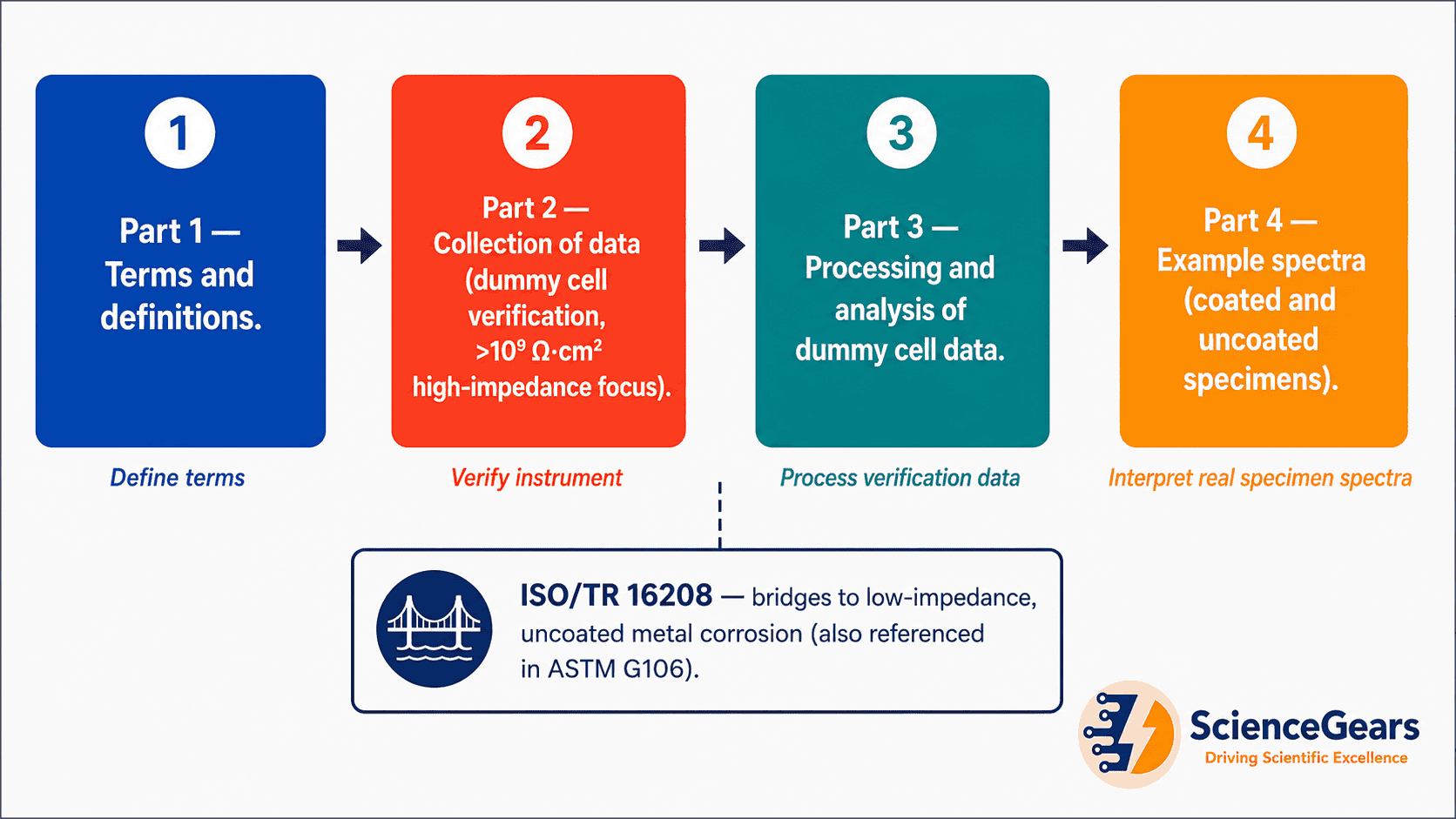
Caption: ISO 16773 splits EIS guidance into four distinct documents — a more granular structure than the single ASTM G106 instrument-verification practice. ISO/TR 16208 bridges the series to low-impedance, uncoated metal corrosion measurements. Coating evaluation cell at ScienceGears →
This is one of the most structurally distinctive parts of the ISO electrochemical corrosion landscape, because ISO separates EIS terminology, data collection, dummy-cell verification, and example spectra into separate documents. Although ISO 16773 was originally developed for coatings and major sections are specific to coatings, the general guidelines can be used also for uncoated samples, with extra information for uncoated samples available in the companion technical report ISO/TR 16208.
5.1 ISO 16773-1 — Terms and Definitions
ISO 16773-1 defines terms used in electrochemical impedance spectroscopy for use across the remaining three parts of the series. As with ISO 8044 for general corrosion vocabulary, this part exists to ensure that “high-impedance,” “dummy cell,” and related terms carry the same precise meaning throughout the rest of the standard.
5.2 ISO 16773-2 — Collection of Data
ISO 16773-2 gives guidelines for optimising the collection of EIS data with a focus on high-impedance systems. High impedance in the context of intact coatings refers to systems with an impedance greater than 10⁹ Ω·cm² — though the guidance does not preclude measurements on systems with lower impedance. The part specifies a dummy cell that models the properties of a high-impedance system, along with a test procedure and set-up parameters for collecting impedance data from both the dummy cell and real coated metal specimens, explicitly stating that it does not itself provide guidance on data interpretation — that is left to Part 4.
This is the part of the series with the most direct equipment relevance: various types of measurement cell exist which are suitable for use with this part of ISO 16773, and the cell construction requirements — non-corroding materials such as PMMA, PTFE, or glass, a fully leak-proof seal, and an insulating gasket at the specimen interface — map directly onto the design intent of a dedicated coating evaluation cell.
Equipment Mapping: ISO 16773-2
A coating evaluation cell is appropriate for this application because it seals a defined test area on a coated panel for EIS measurement. Available volumes and fixture details should be selected according to the specific ScienceGears cell model and the required electrolyte volume. For coated-panel EIS measurements, see the coating evaluation cell.
5.3 ISO 16773-3 — Processing and Analysis of Data from Dummy Cells
ISO 16773-3 specifies a procedure for the evaluation of the experimental set-up used for carrying out EIS on high-impedance coated samples, using dummy cells to simulate high-impedance coated systems. On the basis of defined equivalent circuits, this part gives guidelines for using dummy cells to increase confidence in the test protocol — covering measurement, curve fitting, and data presentation. Because investigations of high-impedance coated samples are particularly susceptible to artefacts from electromagnetic interference, the standard recommends measuring within a Faraday cage and notes that most instrument manufacturers also offer complementary dummy cells in the low- and medium-impedance range for cross-checking the setup outside the high-impedance regime.
For EIS setup verification, ask ScienceGears about potentiostat configuration, shielding, cable layout, and dummy-cell selection — see potentiostats and galvanostats.
5.4 ISO 16773-4 — Examples of Spectra of Polymer-Coated and Uncoated Specimens
ISO 16773-4 gives typical examples of impedance spectra of polymer-coated and uncoated specimens, along with guidance on interpreting such spectra. Crucially, this part explicitly states that further examples of spectra of low-impedance systems — in the range of, for example, 10 Ω to 1,000 Ω — are given in ISO/TR 16208 and in the equivalent ASTM standard for instrument verification, directly cross-referencing the two standards systems for researchers moving between low-impedance bare-metal corrosion work and high-impedance coating work.
Equipment Mapping for Bare-Metal EIS: For EIS on bare, actively corroding metal specimens rather than coated panels, the standard flat corrosion cell configuration is appropriate, with the low-impedance guidance of ISO/TR 16208 as the relevant reference document.
6 Electrochemical Noise — ISO 17093
ISO 17093 is intended to assist in corrosion testing by electrochemical noise measurement. It covers test procedures and analysis methods for reliable measurement of electrochemical noise for both uncoated and organically coated metal — making it broader in stated scope than the otherwise closely related noise-measurement guide, since it explicitly addresses coated specimens within the same document rather than treating coating assessment separately.
Electrochemical noise measurement (ENM) relies on the simultaneous recording of current and potential fluctuations generated spontaneously by a corroding electrode, in the absence of any externally applied voltage or current. Because no perturbing signal is applied, the technique is genuinely non-destructive and is well suited to monitoring corrosion behaviour without disturbing the specimen’s natural state — a meaningful advantage over polarisation-based techniques where the applied potential sweep itself alters the surface being measured.
ISO 17093 and its closest equivalent in the ASTM system are frequently used together or cited side by side in published corrosion noise research, reflecting that both describe essentially the same fundamental measurement with broadly compatible apparatus requirements — though researchers should confirm which specific analysis conventions (statistical treatment of the noise resistance, frequency-domain versus time-domain analysis) their chosen standard specifies before comparing results across the two systems.
Equipment Mapping: ISO 17093Electrochemical noise measurement requires a potentiostat with sufficiently low intrinsic current and potential noise to resolve genuine corrosion-related fluctuations from instrument noise — not every general-purpose potentiostat meets this requirement, and a zero-resistance ammeter (ZRA) mode is typically used for the coupled-electrode configuration. A flat corrosion cell configured with two or three nominally identical working electrodes — rather than a single specimen against an inert counter electrode — is the standard configuration for ISO 17093 noise measurement. For electrochemical noise and ZRA-style measurements, check instrument mode compatibility before ordering — see electrochemistry instrumentation.
7 Accelerated Coating Evaluation — ISO 17463
ISO 17463 gives guidelines on how to perform the accelerated cyclic electrochemical technique (ACET) with organic protective coatings on metals, specifying the execution of an ACET test along with considerations for samples, the electrochemical cell, test parameters, and procedure, plus guidance for presenting results such as Bode plots and relaxation curves.
The technique is structured as a repeating AC/DC/AC cycle. An initial EIS measurement is taken at the open-circuit potential — or, where the coating’s barrier properties prevent a measurable open-circuit potential, at a fixed DC potential equal to that of the underlying metal in the test electrolyte. A cathodic polarisation step is then applied as a deliberate stress mechanism to accelerate coating degradation, followed by a potential relaxation period and a further EIS measurement to assess how the coating’s impedance has changed as a result of the induced stress. This cycle of EIS, cathodic polarisation, and relaxation repeats, allowing comparison of different coating systems’ degradation behaviour over a dramatically compressed timescale relative to standard immersion-based EIS testing.
This makes ISO 17463 the practical answer to a specific, recurring researcher need: standard immersion-based EIS testing under ISO 16773 may require extended exposure before coating differences become clear, whereas ISO 17463 ACET is intended as a faster comparative screening approach, with the actual duration depending on the selected test protocol by deliberately driving the coating toward failure rather than waiting for natural degradation under static immersion. The trade-off is that ACET results characterise behaviour under an artificially accelerated stress, not necessarily a behaviour that scales linearly to real-world service life — the standard’s own guidance on presenting results reflects this, treating ACET as a comparative screening tool between coating systems rather than a direct service-life prediction.
Equipment Mapping: ISO 17463The coating evaluation cell is appropriate for ACET testing, since the apparatus requirements mirror those of standard EIS on coated panels — a sealed circular test area, electrolyte compartment, and three-electrode configuration capable of both EIS measurement and the cathodic polarisation stress step within the same cell assembly without disturbing the test area seal between cycles. For ACET-style coating studies, combine a coating evaluation cell with a potentiostat capable of both EIS and controlled cathodic polarisation — see the coating evaluation cell.
8 Galvanic Corrosion and Specialised High-Temperature Methods
8.1 ISO 8057 — Galvanic Corrosion Rate for CFRP and Protection-Coated Metal Assemblies
ISO 8057 specifies the electrochemical test for determining the galvanic corrosion rate of carbon fibre reinforced plastic (CFRP) and metal assemblies with protection coating, subjected to the corrosive environment created by electrolyte diffusion through the coating. The standard specifies the apparatus, test solutions, and procedure for the assessment of Fick’s diffusion parameters for protective coatings on metallic materials and for estimating galvanic corrosion rates, building explicitly on the polarisation guidelines of ISO 17475.
This is a genuinely specialised application — relevant for aerospace, automotive, and marine engineering contexts where CFRP components are bonded to engineering metals; in galvanic terms, CFRP is typically much more noble than most metals, making the metal side the anodic member at risk when an electrolyte pathway is present, and where a protective coating at the bonded interface is the primary corrosion mitigation strategy. The standard’s own documentation is explicit that it is not intended to replace relevant field testing, to be used for ranking different protection systems by corrosion rate alone, or to account for non-corrosion field hazards such as erosion, abrasion, and ultraviolet exposure — its scope is specifically the electrochemical galvanic corrosion rate measurement, tested in a neutral sodium chloride electrolyte.
Equipment Mapping: ISO 8057A flat corrosion cell configured to accommodate the bonded CFRP-metal assembly as the working specimen, with the coating intact across the test area, supports the basic electrochemical measurement. Contact the ScienceGears technical team for guidance on specimen mounting for bonded composite-metal assemblies, since this geometry differs from a standard flat metal coupon.
8.2 ISO 4905 — Electrochemical Test Methods for High-Temperature Molten Salt Corrosion
ISO 4905 describes the general procedure for electrochemical measurements in high-temperature molten salts using potentiodynamic polarisation measurements and electrochemical impedance spectroscopy, and describes the experimental apparatus required. This standard exists in direct response to a real and growing industrial need: high-temperature molten salts are increasingly used as the heat transfer medium in concentrated solar power generation systems, and materials used for boilers and chemical plants are also severely corroded by molten salts at high temperature — yet until relatively recently there was no standard electrochemical test method to evaluate material corrosion behaviour in this environment quantitatively.
The apparatus and procedure specified are substantially different from room-temperature aqueous corrosion testing — molten salt electrochemistry requires specialised high-temperature cell materials, careful reference electrode selection (conventional aqueous reference electrodes are not usable), and thermocouple calibration procedures specific to the molten salt environment.
Equipment Mapping: ISO 4905This requires dedicated high-temperature molten salt test cell hardware, fundamentally different from the room-temperature flat and jacketed corrosion cells used elsewhere in this guide. Contact the ScienceGears technical team to discuss molten salt corrosion cell configuration if your research programme requires ISO 4905-aligned testing — this is specialised apparatus outside our standard corrosion cell range. For non-standard molten salt corrosion hardware, contact ScienceGears for a custom cell discussion before selecting materials or electrodes — see custom electrochemical cells.
9 Standards Adjacent to This Guide — Briefly Noted
A small number of ISO standards are frequently mentioned alongside the electrochemical methods above in published research and supplier technical literature, but are not themselves electrochemical measurement techniques. They are noted briefly here to clarify this guide’s scope boundary, consistent with the same boundary drawn in our companion ASTM guide:
- ISO 11846 — Determination of resistance to intergranular corrosion of solution heat-treatable aluminium alloys. This is a chemical immersion test: specimens are immersed for a defined period in a sodium chloride and hydrochloric acid solution at a controlled temperature, and the resulting attack is assessed by metallographic cross-section. No applied potential or current is involved, so it sits outside an electrochemical-methods-specific guide despite being closely associated with localised corrosion evaluation in the aluminium alloy literature.
- ISO 12944 (parts 1–9), including Part 6’s laboratory performance test methods — this series governs protective paint system performance via salt spray, water immersion, and water condensation exposure testing. Electrochemical impedance spectroscopy is sometimes used by individual laboratories as a complementary before-and-after evaluation alongside ISO 12944-6 exposure testing, but EIS is not itself a method the standard specifies, so ISO 12944 is outside the scope of this electrochemical-methods guide.
- ISO 9227 — Corrosion tests in artificial atmospheres — salt spray tests. A non-electrochemical accelerated environmental exposure test, frequently run alongside electrochemical testing as a complementary but methodologically distinct evaluation.
These standards have genuine value in a complete corrosion qualification programme and are frequently used in combination with the electrochemical methods covered above — but they assess corrosion through direct physical exposure, gravimetric measurement, or metallographic examination rather than through electrochemical signal measurement.
10 Master Decision Matrix — Standard, Technique, and Equipment
| Standard | What It Covers | Technique | Recommended Cell | Potentiostat Mode |
|---|---|---|---|---|
| ISO 8044 | Corrosion vocabulary (reference document, not a test) | — | — | — |
| ISO 17474 | Conventions for reporting electrochemical data | — | — | Applied to presentation of any technique below |
| ISO 17475 | Potentiostatic/potentiodynamic polarisation, repassivation | DC polarisation, potentiostatic hold | Flat corrosion cell | Potentiodynamic / potentiostatic |
| ISO 11463 | Ex-situ pitting evaluation and characterisation | Surface analysis / metallography (post-test) | N/A — post-test evaluation | Not applicable |
| ISO 12732 | Sensitisation detection (DOS), stainless steel and Ni alloys | Double-loop EPR (activation + reactivation scan) | Flat corrosion cell | DL-EPR (cyclic anodic/cathodic) |
| ISO 16773-1 | EIS terms and definitions (reference document) | — | — | — |
| ISO 16773-2 | High-impedance EIS data collection, dummy cell verification | EIS, dummy cell check | Coating evaluation cell | EIS |
| ISO 16773-3 | Dummy cell EIS data processing and analysis | EIS, equivalent circuit fitting | Coating evaluation cell | EIS |
| ISO 16773-4 | Example EIS spectra, coated and uncoated | EIS, interpretation guidance | Coating evaluation cell or flat corrosion cell | EIS |
| ISO 17093 | Electrochemical noise, uncoated and coated metal | Passive potential/current monitoring | Flat corrosion cell, multi-electrode | Electrochemical noise / ZRA |
| ISO 17463 | Accelerated coating evaluation (ACET) | AC/DC/AC cyclic: EIS + cathodic polarisation + relaxation | Coating evaluation cell | EIS + potentiostatic (cyclic) |
| ISO 8057 | Galvanic corrosion rate, CFRP/coated metal assemblies | Potentiodynamic polarisation, diffusion estimation | Flat corrosion cell, bonded specimen mount | Potentiodynamic |
| ISO 4905 | High-temperature molten salt corrosion | Potentiodynamic polarisation, EIS | Dedicated molten salt cell — contact technical team | Potentiodynamic / EIS |
All standard-range cells referenced are available from ScienceGears’ corrosion test electrochemical cell range with local AU/NZ stock; specialised apparatus for ISO 4905 and bonded CFRP-metal assemblies under ISO 8057 should be discussed directly with the technical team.
11 Practical Considerations Before You Start Testing
Conventions Before Measurement, Not After
Because ISO 17474 governs how electrochemical data is reported and displayed, decide on your sign convention and graphical presentation format before you begin a measurement campaign, not when you sit down to write up results. Retrofitting a dataset to a different convention after collection is error-prone and best avoided.
Distinguishing Ex-Situ Evaluation from In-Situ Measurement
ISO 11463 is easy to misclassify as an electrochemical technique because it is so closely associated with pitting corrosion experiments that are themselves electrochemical. Keep clear in your experimental design which step generated the pits (an electrochemical polarisation or potentiostatic exposure) and which step characterised them afterward (ISO 11463’s surface analysis methods) — these are sequential, not the same measurement.
High-Impedance vs Low-Impedance EIS Setups Are Not Interchangeable
A dummy cell and Faraday cage configuration validated under ISO 16773-2/3 for high-impedance coated systems (>10⁹ Ω·cm²) does not automatically transfer to low-impedance bare-metal corrosion EIS. Consult ISO/TR 16208 for the low-impedance case and verify your specific instrument configuration separately for each impedance regime you intend to measure.
ACET Is a Screening Tool, Not a Service-Life Predictor
When using ISO 17463’s accelerated cyclic technique, present results as a comparative ranking between coating systems under the specific stress protocol applied, not as a direct prediction of real-world service life — the standard’s own framing supports comparative screening, and over-interpreting accelerated results as absolute service-life figures is a common reviewer objection in published coatings research.
Specimen Preparation for DL-EPR
ISO 12732’s double-loop reactivation measurement is sensitive to surface preparation artefacts — mechanical damage or residual cold work at the specimen surface can produce a reactivation signal that mimics or masks genuine sensitisation. Follow a consistent, documented polishing procedure across all specimens in a comparative sensitisation study.
12 Frequently Asked Questions
For broader questions about ScienceGears products, ordering, and shipping, visit our main FAQ page.
Q1 Is ISO 17475 equivalent to ASTM G5?
Not exactly — ISO 17475 is broader in scope than ASTM G5 taken alone. ASTM splits its potentiodynamic anodic polarisation method (G5) and its polarisation resistance method (G59) into two separate documents. ISO 17475 covers potentiostatic and potentiodynamic polarisation measurement in a single standard, and explicitly extends its stated scope to include characterising the onset of localised corrosion and repassivation behaviour — ground that ASTM addresses across several separate standards (G61 for localised corrosion, G192 for repassivation potential specifically). If you need to directly compare data generated under the two systems, check which specific scan parameters, electrolyte, and acceptance criteria each standard specifies for your particular alloy and application, rather than assuming equivalence by title alone.
Q2 Which standard should I use for coating EIS — ISO 16773 or an ASTM equivalent?
ISO offers a far more granular, purpose-built standard for coating EIS than ASTM does. The four-part ISO 16773 series gives dedicated guidance for high-impedance coated systems, including a specific dummy cell verification procedure (Parts 2 and 3) and example spectra with interpretation guidance (Part 4) — there is no equivalent ASTM standard at this level of granularity specifically for coatings EIS. ASTM’s nearest equivalent, G106, is a general instrument and algorithm verification practice that applies across electrochemical impedance measurements broadly, not a coatings-specific standard. If your work is specifically about evaluating organic coating barrier properties by EIS, ISO 16773 is the more directly applicable and more thoroughly documented standard; if you are simply verifying that your potentiostat and software produce correct impedance data on bare or generally corroding metal, ASTM G106 — or the low-impedance guidance in ISO/TR 16208 — is the relevant reference instead.
Q3 What is the difference between ISO 17093 and electrochemical noise techniques used in general corrosion monitoring?
ISO 17093 is specifically a guideline standard — it covers test procedures and analysis methods for reliable electrochemical noise measurement, applicable to both uncoated and organically coated metal specimens, in a laboratory or controlled testing context. It does not itself prescribe a single mandatory analysis method; multiple statistical and frequency-domain approaches to analysing the resulting noise data are referenced as acceptable, reflecting the historically fragmented state of noise data analysis methodology that the standard was developed to consolidate. If you are designing a field-deployed corrosion monitoring system rather than a controlled laboratory measurement, additional considerations around long-term sensor stability and environmental noise rejection apply beyond what ISO 17093 directly addresses.
Q4 My ACET (ISO 17463) results show a coating degrading faster under acceleration than it does in real service — is this expected?
Yes, and this is the central interpretive caution with any accelerated test method. The cathodic polarisation step in ACET is a deliberate, artificial stress mechanism designed to induce failure mechanisms more quickly than natural exposure would. A coating that degrades rapidly under ACET cycling is not necessarily predicting an equally rapid real-world failure timeline — it indicates that the coating is more vulnerable to the specific stress mechanism the test applies (cathodic disbondment-type degradation) relative to a comparator coating tested under identical conditions. Use ACET results to rank coating systems comparatively against each other under the same protocol, and corroborate any service-life claims with longer-duration standard EIS testing under ISO 16773 or field exposure data before making absolute durability predictions.
Q5 Can ISO 12732 and ASTM G108 sensitisation results be directly compared for the same stainless steel sample?
Not without caution. While both methods use electrochemical reactivation concepts, their scopes are different: ISO 12732 covers stainless steel and nickel-based alloys, whereas ASTM G108 is specifically framed around AISI Type 304 and 304L stainless steels. ISO 12732 specifies a double-loop scan (forward activation followed immediately by reverse reactivation in a continuous programmed sweep) based on Čihal’s method, whereas the ASTM approach historically uses a single-loop reactivation scan with a separate, distinct electrolyte composition. The resulting DOS index values are not numerically interchangeable between the two methods even on an identical specimen, because the electrochemical conditions driving the reactivation peak differ. If a specification or customer requirement calls for a specific standard, run that exact standard rather than substituting the other and reporting an approximate equivalence.
Q6 Do I need to run ISO 8044 or ISO 17474 as actual laboratory tests?
No — neither is a test method you run on a specimen. ISO 8044 is a vocabulary reference and ISO 17474 specifies reporting and presentation conventions. You apply both by using consistent terminology and consistent data presentation conventions when designing, running, and reporting any of the actual measurement techniques covered elsewhere in this guide (ISO 17475, the ISO 16773 series, ISO 17093, ISO 12732, and so on). Citing them in a methods section signals that your terminology and data conventions follow the internationally recognised standard rather than an ad-hoc lab convention.
Q7 Can I use the same corrosion cell for ISO 17475, ISO 12732, and ISO 17093?
Often yes for ISO 17475 and ISO 12732, provided the cell supports a proper three-electrode configuration, suitable specimen mounting, and electrolyte compatibility. ISO 17475 polarisation testing and ISO 12732 DL-EPR sensitisation testing can both be run in a flat corrosion cell when the working electrode area, reference electrode position, and counter electrode geometry are appropriate. ISO 17093 electrochemical noise testing is slightly different, because it commonly uses two or three nominally identical working electrodes and ZRA/low-noise measurement. So the same cell body may be usable, but only if it can be configured for the correct electrode arrangement rather than simply reused unchanged.
Q8 Do I need a bipotentiostat for electrochemical noise testing?
Not necessarily. For ISO 17093 electrochemical noise, the key requirement is usually a low-noise instrument with suitable electrochemical noise or ZRA capability, not automatically a full bipotentiostat. A bipotentiostat may be useful for some dual-working-electrode experiments where two electrodes need to be controlled or monitored independently, but many corrosion noise measurements are based on passively recording spontaneous current and potential fluctuations between coupled electrodes. Before selecting the instrument, confirm the required electrode configuration, current-noise range, potential-noise stability, sampling settings, and software analysis method.
Q9 Can a battery cycler replace a potentiostat for ISO corrosion testing?
In most cases, no. A battery cycler is normally designed for two-terminal charge–discharge testing, where it controls cell current or full-cell voltage. Most ISO electrochemical corrosion methods require control of the working electrode potential against a reference electrode, with current passing through a counter electrode. That is the role of a potentiostat. Some advanced battery test systems may include reference-electrode monitoring, EIS, or potentiostat-style functions, but they should not be assumed suitable unless they can genuinely perform the required polarisation, EIS, or electrochemical noise method.
Q10 What is the difference between a flat corrosion cell and a coating evaluation cell?
A flat corrosion cell is typically used when the metal specimen itself is the working electrode, such as in polarisation testing, DL-EPR, bare-metal EIS, or electrochemical noise measurements. A coating evaluation cell is designed to seal a defined area of a coated panel so that the coating barrier can be tested without exposing unintended edges or damaging the surrounding coating. In simple terms, choose a flat corrosion cell when the metal surface is the main test specimen; choose a coating evaluation cell when the coating barrier and sealed exposed area are the main focus.
Q11 Which ISO corrosion methods require EIS?
The main EIS-focused standards in this guide are the ISO 16773 series, ISO 17463, and ISO 4905. ISO 16773 covers electrochemical impedance spectroscopy for coated and uncoated metallic specimens, with particular importance for coating evaluation. ISO 17463 uses EIS as part of the accelerated cyclic electrochemical technique for organic coatings, combining EIS with cathodic polarisation and relaxation steps. ISO 4905 also includes EIS for high-temperature molten salt corrosion testing. Other methods, such as ISO 17475, ISO 12732, and ISO 17093, are primarily polarisation, DL-EPR, or electrochemical noise methods rather than EIS methods.
Q12 How should I choose a reference electrode for ISO corrosion testing?
Choose the reference electrode based on the electrolyte, temperature, pH, potential range, and the specific ISO or customer method requirement. Ag/AgCl is common in many aqueous corrosion tests, but it is not automatically suitable for every electrolyte, especially where chloride contamination is a concern. Alkaline, acidic, non-aqueous, and high-temperature systems may require different reference electrode choices or salt-bridge arrangements. Always report potentials against the exact reference electrode used, and do not convert between reference scales unless the electrode condition, temperature, and electrolyte are clearly known.
13 Expert Support — How ScienceGears Works Alongside Your Research
Selecting the correct ISO standard for your material, failure mode, and research objective is only the first step. Configuring the cell, reference electrode, electrolyte, and potentiostat programme to genuinely comply with that standard’s specified procedure — and correctly interpreting the resulting data within the conventions the standard expects — is where the practical difficulty really lies.
ScienceGears is founded and directed by PhD-trained electrochemists with direct experience running ISO-aligned corrosion test programmes across polarisation, EIS, electrochemical noise, and sensitisation detection methods. When you contact us with a specific ISO standard and material in mind, you are talking to an electrochemist who can help map the standard to a practical cell, electrode, electrolyte, and potentiostat configuration.
What Expert Support Looks Like in Practice
Standard-to-Equipment Mapping for Your Specific Test
If you are setting up a corrosion test programme against a specific ISO standard and are unsure which corrosion cell configuration, electrode materials, or potentiostat mode are appropriate, contact us before ordering. We will confirm the correct cell volume, port configuration, and material compatibility for your specific electrolyte and standard.
Talk to our technical team before ordering →
High-Impedance vs Low-Impedance EIS Configuration
For ISO 16773-aligned coating EIS work, where dummy cell verification and Faraday cage shielding are integral to the standard’s procedure, our technical team can advise on coating evaluation cell configuration and dummy cell selection appropriate to your specific impedance range.
Specialised Hardware for ISO 4905 and ISO 8057
High-temperature molten salt corrosion cells and bonded CFRP-metal assembly mounting fall outside our standard flat and jacketed corrosion cell range. Contact us to discuss configuration options for these specialised test programmes.
DL-EPR and Electrochemical Noise Protocol Support
If you are establishing an ISO 12732 sensitisation testing protocol or an ISO 17093 noise measurement setup for the first time, we can advise on specimen preparation, electrolyte selection, and the instrument noise floor requirements specific to reliable noise data acquisition.
Complete System Supply
ScienceGears supplies the complete corrosion testing system as a single integrated recommendation:
- Corrosion test electrochemical cells — flat, jacketed flat, coating evaluation, 5-port, and specimen holders
- Potentiostats and galvanostats with corrosion-specific modes
- General electrochemical cells
- Application notes
Local AU/NZ Stock
Dispatch options are available for selected stocked items. Corrosion cells and accessories are held in local Australian inventory. When your test programme requires a specific cell configuration at short notice, you are not waiting 4–8 weeks for international freight.
“An ISO standard tells you the procedure and the conventions for reporting it — it does not, by itself, tell you which dummy cell to validate against, how to mount a bonded composite specimen, or what noise floor your potentiostat needs before the data is trustworthy. That is the part we help with.” — ScienceGears Technical Team
Further Reading — Related ScienceGears Resources
- → How to Choose the Right Corrosion Test Electrochemical Cell
- → Corrosion Test Electrochemical Cell Range
- → Flat Corrosion Cell
- → Jacketed Flat Corrosion Cell
- → Coating Evaluation Cell
- → Potentiostats and Galvanostats
- → Application Notes