


By the End of This Guide, You Will Understand
By the end of this guide, you should be able to:
- choose between PTFE and PEEK body materials more confidently;
- understand why PEEK is often preferred for routine reusable disc electrodes;
- understand why PTFE may be better for aggressive chemical environments;
- recognise how polishing can change the geometry of a disc electrode;
- explain why glassy carbon in PEEK may appear slightly raised after repeated polishing;
- select a suitable body material for glassy carbon, platinum, gold and silver disc electrodes.
ScienceGears Technical Team Insight
“The electrode body is not just passive plastic. It controls sealing, polishing behaviour, geometry stability and long-term reproducibility. Choosing PTFE or PEEK correctly can prevent many avoidable problems in electrochemical measurements.” — ScienceGears Technical Team
1 Introduction
When choosing a working electrode for electrochemistry, most researchers first think about the active electrode material. Should it be glassy carbon? Platinum? Gold? Silver? Boron-doped diamond? Nickel? Copper?
That is important, but it is only one part of the electrode design.
For reusable disc working electrodes, the conductive disc is normally embedded inside an insulating body material. Two of the most common body materials are PTFE and PEEK. Both are widely used in electrochemical laboratories, but they are not interchangeable in every situation.
The body material can influence: chemical compatibility; mechanical durability; polishing behaviour; sealing around the disc; long-term dimensional stability; electrode lifetime; surface geometry; and reproducibility of electrochemical data.
This becomes especially important when the electrode is repeatedly polished with alumina or diamond slurry, rinsed, briefly sonicated and reused for cyclic voltammetry, electrocatalysis, corrosion, sensors, battery-material studies, fuel-cell catalyst studies or other electrochemical measurements.
So the practical question is: Should you choose a PTFE body or a PEEK body for your electrochemistry experiment?
The answer depends on your electrolyte, electrode disc material, cleaning method and how often the electrode will be polished.
ScienceGears supplies reusable working electrodes, reference electrodes and counter electrodes for electrochemistry laboratories across Australia and New Zealand. Explore Working Electrodes →
2 Quick Answer: PTFE or PEEK?
For most routine reusable disc working electrodes: PEEK is the preferred default body material.
For chemically aggressive environments: PTFE may be preferred when maximum chemical inertness is more important than mechanical robustness.
A simple rule:
| Your Priority | Better Choice |
|---|---|
| Frequent polishing and reuse | PEEK |
| Better mechanical strength | PEEK |
| Better dimensional stability | PEEK |
| Routine cyclic voltammetry | PEEK |
| Glassy carbon disc electrode | PEEK, with gentle polishing |
| Platinum disc electrode | PEEK |
| Gold disc electrode | PEEK or PTFE, depending on chemistry |
| Silver disc electrode | PEEK or PTFE, depending on chemistry |
| Harsh chemical exposure | PTFE |
| Maximum chemical inertness | PTFE |
| Lower-cost option | Often PTFE |
| Teaching laboratory durability | PEEK |
Both materials have a place in electrochemistry. The best choice depends on the experiment.
For help selecting glassy carbon, platinum, gold or silver disc electrodes, contact the ScienceGears technical team. Browse Electrodes and Accessories →
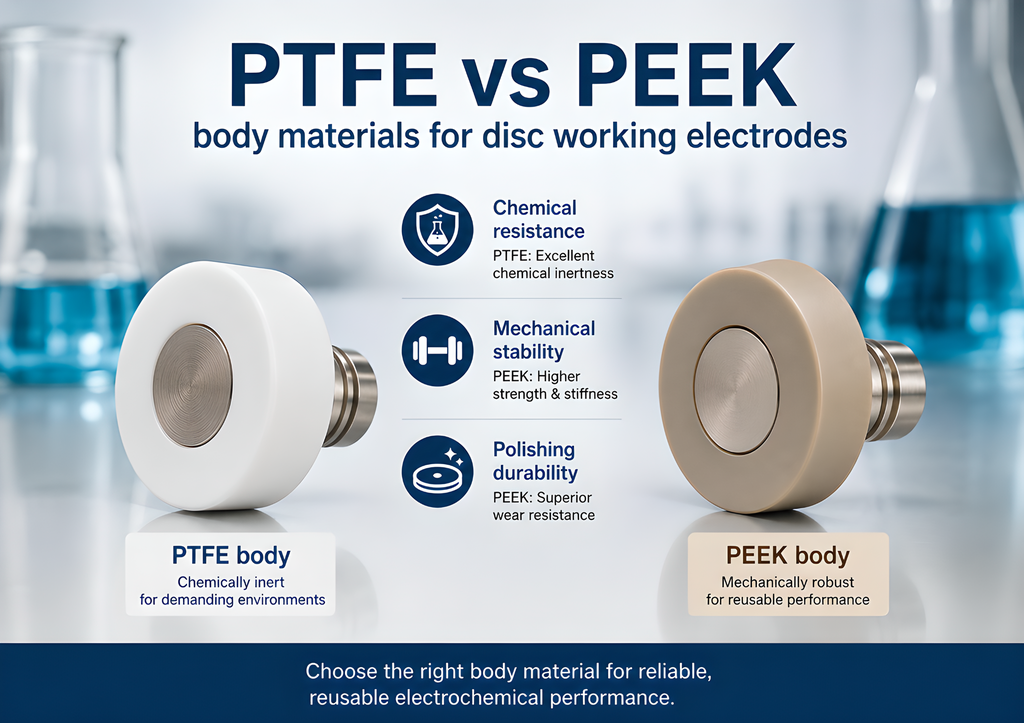
PTFE and PEEK are both used as insulating body materials for reusable working electrodes, but the best choice depends on chemistry, polishing frequency and the active disc material.
3 What Is PTFE?
PTFE stands for polytetrafluoroethylene.
It is well known for:
- Excellent chemical resistance;
- Low friction;
- Low surface energy;
- Good electrical insulation;
- Strong resistance to many aggressive chemicals.
In electrochemistry, PTFE can be useful when the electrolyte, cleaning solution or chemical environment is very aggressive. It is also used in many electrochemical cells, electrode holders, seals and chemically resistant components.
However, PTFE is relatively soft compared with many engineering plastics and electrode materials. During repeated polishing, PTFE can wear, deform or round more easily than harder materials.
This means PTFE can be very good chemically, but it may not always be the best choice mechanically.
4 What Is PEEK?
PEEK stands for polyether ether ketone.
It is a high-performance engineering polymer known for:
- Good mechanical strength;
- Good dimensional stability;
- Good chemical resistance in many electrolyte environments;
- Better rigidity than PTFE;
- Good machinability for precision electrode bodies;
- Suitability for reusable laboratory components.
PEEK is commonly used for reusable disc working electrodes because it offers a strong balance between mechanical durability and chemical resistance.
However, PEEK is still a polymer. It is harder and stronger than PTFE, but it is much softer than very hard electrode materials such as glassy carbon or boron-doped diamond.
5 Why the Electrode Body Material Matters
A reusable disc working electrode is a small precision assembly.
It normally contains:
- The conductive disc material;
- The insulating body material;
- Internal electrical contact;
- Sealing around the disc;
- A polished exposed surface.
For ideal inlaid-disc electrochemical behaviour, the disc should be flat, clean, well-defined and flush with the surrounding body.
If the disc becomes recessed below the body, or protrudes slightly above it, the electrode may still work, but its behaviour may no longer match the ideal disc-electrode geometry.
This can affect:
- Diffusion field shape;
- Limiting current;
- Current density;
- Catalyst loading uniformity;
- Surface modification reproducibility;
- RDE/RRDE measurements;
- Analytical sensor response;
- Comparison between experiments;
For routine cyclic voltammetry with a 2 mm or 3 mm disc electrode, a very small height mismatch may not necessarily invalidate the measurement, but it should still be monitored and recorded. However, for high-precision measurements, geometry becomes more important.
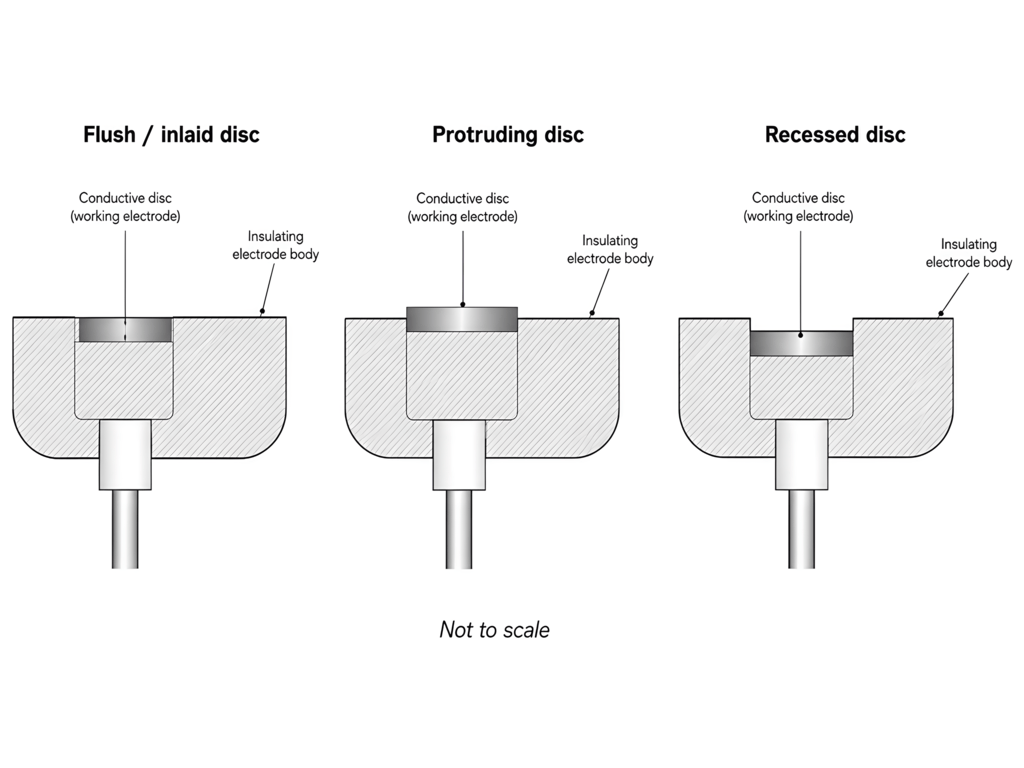
The ideal disc electrode is flat and flush with the surrounding insulating body. Recessed or protruding geometries can change the electrochemical response, especially in mass-transport-sensitive experiments.
The ideal disc electrode is flat and flush with the surrounding insulating body. Recessed or protruding geometries can change the electrochemical response, especially in mass-transport-sensitive experiments.
For complete electrochemical setups, ScienceGears can support potentiostats, cells, electrodes and accessories matched to your experiment. View Electrochemistry Instrumentation →
6 PEEK vs PTFE: Practical Comparison
| Property | PTFE Body | PEEK Body |
|---|---|---|
| Chemical resistance | Excellent | Very good for many electrolytes |
| Mechanical strength | Lower | Higher |
| Dimensional stability | Lower | Better |
| Polishing durability | Lower | Better |
| Surface rigidity | Softer | Harder |
| Resistance to deformation | Lower | Higher |
| Long-term reusable electrode use | Suitable, but may wear faster | Generally preferred |
| Harsh chemical exposure | Often preferred | Check compatibility with the electrolyte and cleaning chemistry |
| Cost | Usually lower | Usually higher |
| Best role | Chemical-resistance priority / lower-cost option | Mechanically robust reusable electrode body |
In most routine electrochemical laboratories, PEEK is preferred when the electrode will be polished and reused many times. However, PTFE is still very valuable when chemical resistance is the main concern.
7 Why Polishing Changes the Discussion
Many reusable disc electrodes are polished before use.
A typical workflow may include:
- polishing with alumina or diamond slurry;
- rinsing with ultrapure water;
- short sonication to remove trapped polishing particles;
- final rinsing;
- electrochemical testing.
This process can refresh the electrode surface and improve reproducibility. However, polishing is also a mechanical abrasion process. That means it does not only affect the conductive disc. It can also affect the surrounding PTFE or PEEK body.
Over time, repeated polishing can slowly change the surface profile of the electrode. The disc and body may not wear at the same rate. This is where hardness mismatch becomes important.
8 Hardness Mismatch: A Practical but Often Overlooked Issue
The conductive disc and the insulating body material can have very different hardness and wear behaviour. If the disc is much harder than the body, the body may wear faster during polishing. The disc can then appear slightly raised. If the disc is softer than the body, the disc may wear, scratch, smear or become slightly recessed, depending on the material and polishing method.
| Material | Relative Hardness / Behaviour | Practical Polishing Implication |
|---|---|---|
| PTFE | Very soft polymer | Can wear, deform or round more easily |
| PEEK | Harder engineering polymer | More durable than PTFE, but still softer than glassy carbon |
| Gold | Soft, ductile metal | Can scratch, smear or burnish |
| Silver | Soft to moderately hard metal | Can oxidise and scratch; needs gentle polishing |
| Platinum | Moderately hard, ductile metal | Generally robust, but can still scratch |
| Glassy carbon | Very hard carbon material | Can remain proud if the body wears faster |
| Boron-doped diamond | Very hard electrode material | Requires careful attention to body/edge geometry |
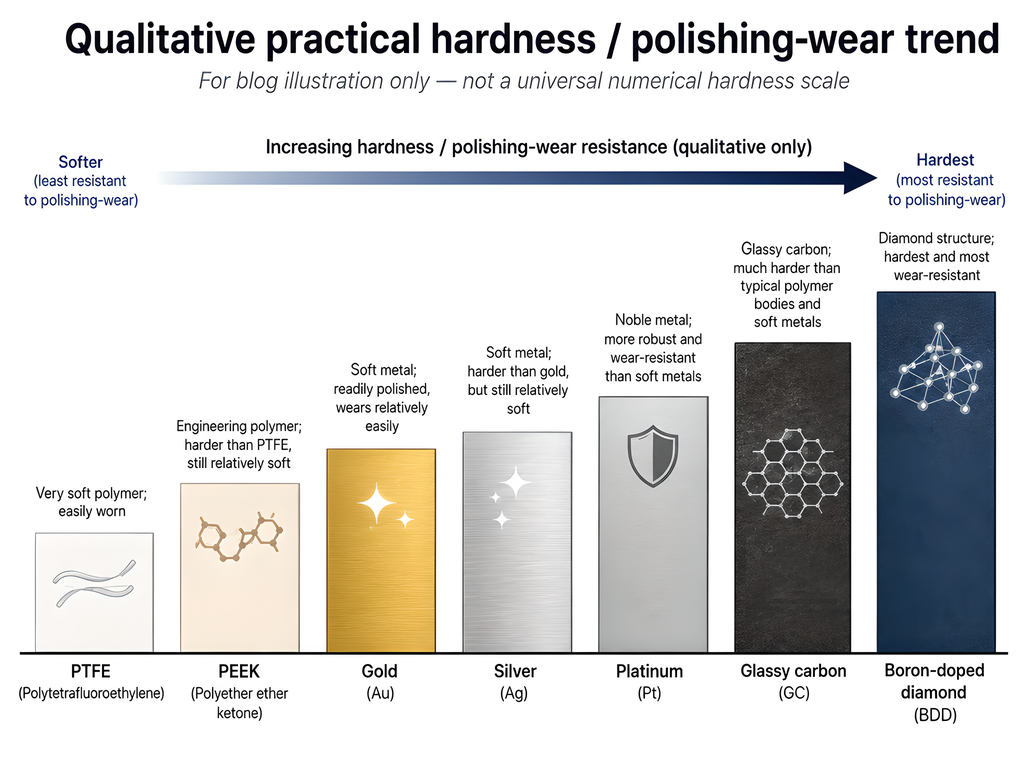
A qualitative practical trend showing why PTFE and PEEK bodies can wear differently from glassy carbon, gold, silver, platinum and boron-doped diamond during repeated polishing.
9 Why Glassy Carbon in PEEK Can Appear Slightly Raised
Glassy carbon is widely used because it has a broad potential window, low background current, good chemical stability and useful electrochemical behaviour for many applications. However, glassy carbon is also much harder than PEEK.
During repeated polishing, especially if the user applies heavy pressure or uses coarse abrasive frequently, the surrounding PEEK body can wear slightly faster than the glassy carbon disc. When this happens, the glassy carbon disc may appear to sit slightly above the PEEK body.
This does not necessarily mean that the glassy carbon has moved outward. More likely, the PEEK around it has been polished down slightly faster.
Practical ExplanationGlassy carbon is more abrasion-resistant than PEEK, so aggressive repeated polishing can leave the glassy carbon disc slightly proud of the body. This is not a reason to avoid PEEK. It is a reason to polish properly.
For glassy carbon electrodes, PEEK is still usually preferred over PTFE because PTFE is even softer and more prone to deformation or wear.
10 Why Gold Electrodes Can Behave Differently
Gold behaves very differently from glassy carbon. Glassy carbon is hard and brittle. Gold is soft and ductile.
During polishing, gold can:
- Scratch;
- Smear;
- Burnish;
- Change roughness;
- Polish along with the surrounding surface.
This may be one reason why a gold disc in a PEEK body can sometimes appear visually flatter than a glassy carbon disc in a PEEK body after repeated polishing.
However, this does not mean gold is immune to polishing damage. Gold surfaces can be very sensitive, especially in:
- Self-assembled monolayer studies;
- Thiol chemistry;
- Biosensors;
- Surface modification;
- Trace analysis;
- Oxide stripping;
- Adsorption studies.
For gold electrodes, the key is gentle, consistent surface preparation.
11 What About Platinum Electrodes?
Platinum is widely used in electrochemistry because of its conductivity, catalytic activity and stability in many aqueous systems.
For platinum disc electrodes used in PEEK-compatible electrolytes, PEEK is generally a very good default body material because it provides:
- Good mechanical stability;
- Good polishing durability;
- Good dimensional stability;
- Good suitability for repeated use.
However, platinum surface chemistry can be complex. Platinum can form oxides, adsorb species and show strong catalytic behaviour. Depending on the experiment, polishing may be combined with electrochemical cleaning or potential cycling.
Platinum Electrode Recommendation
Choose PEEK for most routine applications, but standardise the cleaning protocol based on the experiment.
12 What About Silver Electrodes?
Silver electrodes require more care because silver can form oxides, chlorides, sulfides and other surface films depending on the electrolyte.
PEEK is suitable for many silver disc electrodes, especially when the electrode will be polished and reused. However, PTFE may be preferred if chemical compatibility is the main concern.
Silver Electrode Recommendation
Choose PEEK for routine durability, but consider PTFE if the electrolyte or cleaning chemistry is aggressive. The polishing protocol should be gentle and repeatable.
13 Recommended Body Material by Electrode Type
| Electrode Disc Material | Recommended Body Material | Practical Comment |
|---|---|---|
| Glassy carbon | PEEK | Best general choice, but polish gently because glassy carbon is much harder than PEEK |
| Platinum | PEEK | Good default for routine electrochemistry and electrocatalysis |
| Gold | PEEK or PTFE | PEEK for durability; PTFE if chemical inertness is more important |
| Silver | PEEK or PTFE | Depends strongly on electrolyte and surface chemistry |
| Boron-doped diamond | PEEK | Good mechanical body, but inspect edge/body geometry carefully |
| Nickel | PEEK or PTFE | Choose based on electrolyte, especially alkaline or corrosive media |
| Copper | PEEK or PTFE | Choose based on electrolyte and corrosion risk |
| Palladium | PEEK | Good general-purpose choice |
| Custom harsh-media electrode | PTFE | Preferred when aggressive chemistry dominates |
14 Application-Based Selection Guide
| Application | Suggested Body Material | Reason |
|---|---|---|
| Routine cyclic voltammetry | PEEK | Good durability and repeated-use stability |
| Teaching laboratories | PEEK | More robust for repeated student handling and polishing |
| Glassy carbon electrocatalysis studies | PEEK | Mechanically stable, but polish gently |
| Platinum electrocatalysis | PEEK | Good general-purpose choice |
| Gold biosensor / SAM work | PEEK or PTFE | Choose based on chemistry; polish gently |
| Silver electrochemistry | PEEK or PTFE | Depends on electrolyte and surface film formation |
| RDE/RRDE measurements | PEEK | Better dimensional stability, but inspect flushness |
| Corrosive or aggressive media | PTFE | Chemical inertness may be more important |
| General university research lab | PEEK | Best default for reusable polished electrodes |
| Low-cost demonstration | PTFE may be acceptable | Economical, but mechanically softer |
15 When Should You Choose PEEK?
Choose a PEEK body when:
- the electrode will be polished regularly
- the electrode will be reused many times
- dimensional stability is important
- mechanical durability is important
- the electrode will be used in routine aqueous electrochemistry
- the electrode will be used in teaching labs
- the electrode disc is glassy carbon, platinum, gold, silver or BDD and the electrolyte/cleaning protocol is compatible with PEEK
- the work involves RDE/RRDE or reproducibility-sensitive measurements
- you want a premium reusable electrode body
For most routine reusable disc working-electrode applications in Australian and New Zealand laboratories, PEEK is usually the better default choice, provided the electrolyte and cleaning protocol are compatible with PEEK.
16 When Should You Choose PTFE?
Choose a PTFE body when:
- the electrolyte is highly aggressive
- maximum chemical inertness is required
- the cleaning chemistry is not suitable for PEEK
- the experiment involves aggressive media or cleaning chemistry where PEEK compatibility is uncertain
- the electrode will not be polished heavily or frequently
- lower cost is a priority
- the body material must have very low surface energy
PTFE is an excellent chemical-resistance material, but it is mechanically softer than PEEK.
17 Best-Practice Checklist for Polishing PTFE and PEEK Body Electrodes
Use this checklist for routine reusable disc working electrodes:
- Start with the gentlest polishing method that restores the electrode response
- Use fine alumina slurry, commonly 0.05 μm, for routine final polishing
- Use coarser slurry only when the electrode is heavily fouled or scratched
- Keep the electrode face flat and parallel to the polishing pad
- Use light pressure
- Use a controlled, repeatable polishing motion, such as a figure-eight motion where appropriate
- Rotate the electrode during polishing to reduce directional wear
- Rinse thoroughly with ultrapure water
- Sonicate briefly only when needed to remove trapped polishing particles
- Avoid immersing the whole electrode assembly during sonication unless the electrode design and connector sealing are suitable
- Inspect the electrode surface periodically under a microscope
- Record the polishing method in research notebooks and publications
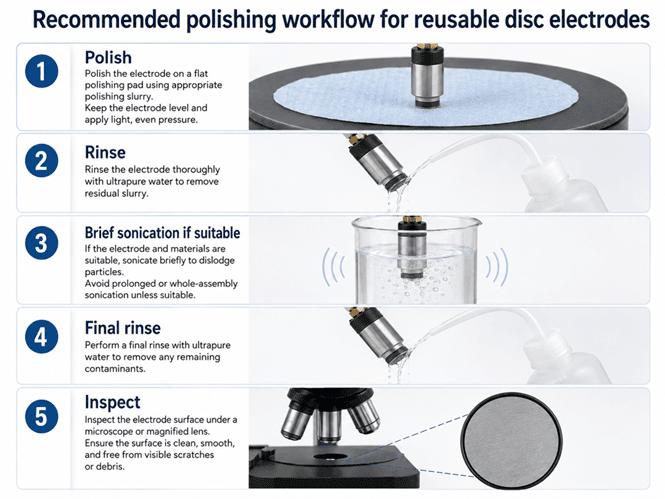 Polishing can improve surface cleanliness, but aggressive polishing can also change the disc/body geometry. Use light pressure and a consistent method
ScienceGears can help laboratories select suitable electrode polishing supplies and cleaning workflows. Shop Electrode Polishing Accessories →
18 Common Mistakes Researchers Make
1. Choosing the Body Material Only Based on Price
PTFE may be cheaper, but PEEK may last longer for frequently polished electrodes. For reusable working electrodes, the lowest initial price may not always give the best long-term value.
2. Assuming PEEK Cannot Wear
PEEK is mechanically stronger than PTFE, but it can still wear during repeated polishing. This is especially noticeable when the disc material is much harder than PEEK, such as glassy carbon.
3. Over-Polishing Glassy Carbon Electrodes
Glassy carbon is hard, but aggressive polishing can still change the surrounding body geometry and shorten electrode life.
4. Treating Gold Like Glassy Carbon
Gold is soft and ductile. It should not be polished with the same aggressive approach used to restore heavily fouled glassy carbon.
5. Ignoring Sonication Time
Short sonication can help remove alumina particles. Prolonged or aggressive sonication may not be suitable for all electrode assemblies.
6. Not Inspecting the Electrode Surface
A quick visual or microscopic inspection can reveal scratches, gaps, protrusion, recession or polishing damage before it affects the data.
7. Not Standardising the Cleaning Protocol
If polishing varies from user to user, the electrochemical response can vary too. This is especially important in shared labs and teaching laboratories.
19 Does a Slightly Raised or Recessed Disc Matter?
It depends on the experiment. For routine cyclic voltammetry with a 2 mm or 3 mm disc electrode, a very small height mismatch may not be a major issue.
However, it can become important for :
- rotating disc electrode measurements;
- rotating ring-disc electrode measurements;
- ORR, HER, OER and CO₂ reduction studies;
- catalyst benchmarking;
- diffusion-controlled limiting-current studies;
- electrochemical sensors;
- microelectrode experiments;
- catalyst ink deposition;
- current-density comparison;
- publication-quality reproducibility.
For these applications, a flat, flush and reproducible surface is strongly preferred.
For rotating disc and rotating ring-disc measurements, electrode geometry and polishing consistency become especially important. See RDE/RRDE Systems →
20 Practical Decision Tree
Choose PEEK if:
You want a mechanically robust reusable electrode for routine electrochemistry, frequent polishing and long-term laboratory use.
Choose PTFE if:
Your experiment involves aggressive chemistry and chemical inertness is more important than polishing durability.
Be Extra Careful if:
You are working with soft metals such as gold or silver, where polishing can scratch, smear or change the active surface.
Inspect Regularly if:
You are using glassy carbon or boron-doped diamond, where the hard disc may remain proud while the surrounding polymer body wears faster.
21 Frequently Asked Questions
Q1 Is PEEK always better than PTFE?
No. PEEK is better for mechanical durability and repeated polishing. PTFE is better when chemical inertness is the main requirement.
Q2 Is PTFE suitable for reusable disc electrodes?
Yes. PTFE can be suitable, especially for chemically aggressive environments. However, because it is softer, it may not be ideal for frequent polishing.
Q3 Why does my glassy carbon disc look slightly raised after polishing?
Glassy carbon is much harder than PEEK. During repeated polishing, the surrounding PEEK can wear faster than the glassy carbon disc, making the disc appear slightly raised.
Q4 Does a slightly raised disc mean the electrode is defective?
Not necessarily. A slight raised appearance can result from differential polishing wear. However, if there is a visible gap, leakage, severe protrusion, recession or unstable response, the electrode should be inspected carefully.
Q5 Should I choose PEEK for gold electrodes?
PEEK is a good choice for many gold disc electrodes, but gold should be polished gently because it is soft and surface-sensitive.
Q6 Should I choose PEEK for platinum electrodes?
Yes, for many routine electrochemistry applications, PEEK is generally a good default body material for platinum disc working electrodes, provided the electrolyte and cleaning protocol are compatible with PEEK.
Q7 When should I choose PTFE?
Choose PTFE when chemical compatibility is the main concern, especially in aggressive media where PEEK compatibility is uncertain.
Q8 Is sonication always required after polishing?
Not always. Short sonication can help remove alumina particles trapped at the disc/body boundary, but excessive sonication should be avoided. The best practice is to use only the cleaning intensity required for the application.
22 Final Recommendation
For most reusable disc working electrodes used in electrochemical experiments: PEEK is the preferred default body material. It typically provides better mechanical strength, dimensional stability and polishing durability than PTFE.
However: PTFE is preferred when maximum chemical inertness is the highest priority.
For glassy carbon electrodes, PEEK is still the recommended default, but users should understand that glassy carbon is much harder than PEEK. Repeated aggressive polishing can gradually make the glassy carbon disc appear slightly raised relative to the body.
For gold and silver electrodes, the issue is different. These metals are softer and more ductile, so polishing should be gentle to avoid scratching, smearing or changing the active surface.
The best electrode choice depends on matching:
- The active disc material;
- The body material;
- The electrolyte;
- The polishing method;
- The cleaning protocol;
- The reproducibility requirement.
A well-selected and well-maintained working electrode gives cleaner, more reproducible and more meaningful electrochemical data.
23 How ScienceGears Can Help
ScienceGears supports researchers across Australia and New Zealand with electrochemical instruments, working electrodes, reference electrodes, counter electrodes, electrochemical cells and custom electrochemical solutions.
Whether you are working with glassy carbon, platinum, gold, silver, boron-doped diamond or custom electrode materials, we can help you select a suitable electrode body material and polishing workflow for your application.
We support applications including:
- cyclic voltammetry;
- electrocatalysis;
- corrosion testing;
- electrochemical sensors;
- batteries and supercapacitors;
- fuel cells and electrolysers;
- RDE/RRDE measurements;
- in-situ spectroelectrochemistry;
- teaching laboratories;
- custom electrochemical cell development.
For battery and supercapacitor research, ScienceGears also supports battery cyclers, test cells and related electrochemical testing systems. Explore Battery Cyclers
For assistance selecting a working electrode or electrode body material, contact the ScienceGears technical team.
Related ScienceGears Guides
- → Introduction to Electrochemical Techniques
- → How to Choose the Right Electrochemical Cell for Your Experiment
- → Nafion 117 vs 212 vs 115 — Which Grade Is Right for Your Experiment?
- → Potentiostat for Biosensors and Electrochemical Sensing: A Lab Guide
- → Membrane Selection Guide for Fuel Cells, Electrolysers and H-Cells
- → Luggin Capillary With Frit vs Without Frit
Scientific Notes and Further Reading
- A. J. Bard and L. R. Faulkner, Electrochemical Methods: Fundamentals and Applications, 2nd edition, Wiley, 2001.
- P. T. Kissinger and W. R. Heineman, Laboratory Techniques in Electroanalytical Chemistry, 2nd edition, Marcel Dekker, 1996.
- R. L. McCreery, “Advanced Carbon Electrode Materials for Molecular Electrochemistry,” Chemical Reviews, 2008, 108, 2646–2687.
- I.-F. Hu, D. H. Karweik and T. Kuwana, “Activation and Deactivation of Glassy Carbon Electrodes,” Journal of Electroanalytical Chemistry, 1985, 188, 59–72.
- Y. Yi, G. Weinberg, M. Prenzel, M. Greiner, S. Heumann, S. Becker and R. Schlögl, “Electrochemical Corrosion of a Glassy Carbon Electrode,” Catalysis Today, 2017, 295, 32–40.
- N. Yoshikawa et al., “Does one need to polish electrodes in an eight pattern? Automation provides the answer,” Digital Discovery, 2025.
- A. M. Bond, D. Luscombe, K. B. Oldham and C. G. Zoski, “A comparison of the chronoamperometric response at inlaid and recessed disc microelectrodes,” Journal of Electroanalytical Chemistry, 1988, 249, 1–14.
- R. Ferrigno, P. F. Brevet and H. H. Girault, “Finite element simulation of the chronoamperometric response of recessed and protruding microdisc electrodes,” Electrochimica Acta, 1997, 42, 1895–1903.
- R. F. Carvalhal, R. S. Freire and L. T. Kubota, “Polycrystalline Gold Electrodes: A Comparative Study of Pretreatment Procedures Used for Cleaning and Thiol Self-Assembly Monolayer Formation,” Electroanalysis, 2005.
- Manufacturer chemical-compatibility and material-property data for the specific PTFE and PEEK grades used in the electrode body.