

In this guide, you will learn how to select a suitable electrode format and working-electrode chemistry for your analyte and measurement method—carbon, gold, Prussian Blue–mediated carbon, graphene or thin-film interdigitated electrodes—with manufacturer-listed specifications, connector and sample-volume guidance, surface-modification options and a practical framework for disposable or validated reuse workflows.
Table of contents
- Why electrode chemistry matters more than it first appears
- The MicruX SPE platform — physical format and specifications
- Carbon SPEs — the versatile baseline
- Gold SPEs — for surface chemistry and immunosensors
- Prussian Blue–mediated SPEs — for H₂O₂ and enzyme-based biosensors
- Interdigitated electrodes — for impedance and conductivity
- Graphene SPEs — low resistance and high surface area
- Sample volume, connectors, and cell configuration
- SPE cleaning, modification, and disposable workflow decisions
- Application decision matrix — which SPE chemistry for which experiment
- Frequently asked questions
- Expert support — how ScienceGears works alongside your research
1. Why electrode chemistry matters more than it first appears
Within the S1PE and D2PE screen-printed families, the devices share a compact planar strip and printed contact pads; however, the working, reference and auxiliary (counter) electrode materials vary by model. Thin-film interdigitated electrodes use a separate two-array geometry and connector system and are considered separately in Section 6.
The selected electrode surface influences background response, usable potential range, surface-modification chemistry, mediator compatibility and suitability for enzymatic, affinity-based or direct electrochemical detection. A mismatch between the electrode and the intended recognition or transduction chemistry can require substantial method redevelopment.
Thick-film screen-printed electrodes are widely used for portable and low-volume electroanalysis in areas such as point-of-care research, environmental monitoring, food analysis and biosensor development. Electrode selection is an early design decision that should be made alongside the detection method and sample matrix.
The electrode formats discussed are available through ScienceGears; local AU/NZ stock and dispatch timing are subject to availability.
2. The MicruX SPE platform — physical format and specifications
Within each MicruX S1PE or D2PE family, external dimensions and contact layout are standardised, but available substrate and electrode-material combinations vary by SKU. Thin-film IDEs use a separate format and connection system.
2.1 Single electrode format (S1PE)
Single Electrodes (S1PE) are disposable electrochemical sensor chips with external dimensions of 27.5 × 10.1 mm, available on PET (white, 250 µm) or ceramic (Al₂O₃, 380 µm) substrates, with a working electrode diameter of 3 mm (7.1 mm²).
The 3 mm working electrode is the active sensing area. A 20–50 µL drop is intended to cover the working, reference and auxiliary electrodes simultaneously. The reference electrode is model-dependent—silver or Ag/AgCl—and the auxiliary electrode material also varies by chemistry; confirm the WE/RE/AE configuration for the selected SKU.
Substrate choice — PET vs ceramic:- PET (250 µm): Flexible substrate. Select it where conformability or a flexible coating workflow is useful, and verify compatibility with the fixture, solvent system and mechanical loading.
- Ceramic Al₂O₃ (380 µm): Rigid substrate. Select it where flatness or dimensional stability is useful; chemical compatibility still depends on the full printed device, including its inks, reference electrode and dielectric layers.
2.2 Dual electrode format (D2PE)
Dual Electrodes (D2PE) have external dimensions of 27.5 × 10.1 mm on a PET white substrate (250 µm), with two working electrode dimensions of 1.0 × 2.5 mm (2.3 mm² each).
The D2PE format places two working electrodes on one strip, sharing a reference and auxiliary electrode. A bipotentiostat is required when both working electrodes must be controlled or measured independently at the same time; otherwise, the connection strategy depends on the method and instrument. Common uses include generator–collector measurements, differential sensing and dual-analyte methods.
2.3 Intra- and inter-electrode reproducibility
MicruX describes selected thick-film models as designed for good intra- and inter-electrode precision. Actual variation remains SKU-, batch-, storage- and protocol-dependent, so include blank and batch controls and verify reproducibility under the intended measurement conditions. SPEs can reduce the manual polishing burden associated with conventional solid electrodes, but they do not remove the need for method-specific conditioning or quality control.
3. Carbon SPEs — the versatile baseline
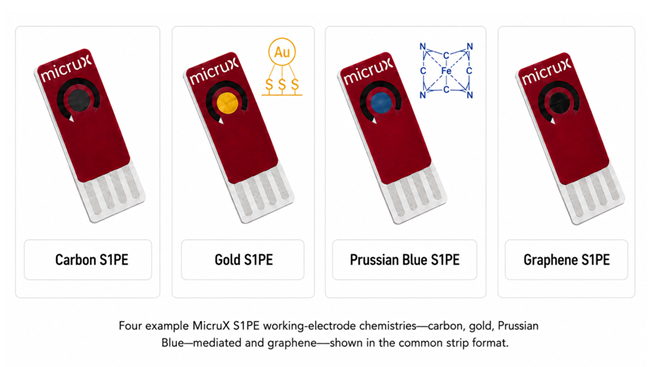
Caption: The four principal SPE chemistries in the MicruX S1PE range — carbon, gold, Prussian Blue–mediated, and graphene — share the same 27.5 × 10.1 mm physical format and 3 mm working electrode diameter, but differ fundamentally in working potential window, surface chemistry, and analytical application. The full range at ScienceGears →
3.1 What carbon SPEs offer
Carbon is a common starting material for a broad range of electroanalytical applications. Its practical performance depends on the ink formulation, electrolyte, pH, reference electrode, surface treatment and measurement conditions.
- A comparatively broad usable potential range in many aqueous systems; establish the actual limits for the selected electrode, electrolyte, pH, reference electrode and scan conditions
- Background current and signal-to-noise that must be established from method-specific blanks
- A carbon surface that is straightforwardly modifiable by drop-casting, electrodeposition, covalent attachment via diazonium chemistry, and adsorption of polymers, nanomaterials, and redox mediators
- Compatibility with many aqueous electroanalytical workflows, subject to validation of the electrolyte, pH, solvent and analyte
Thick-film carbon electrodes are printed on flexible PET or rigid ceramic substrates. Their practical advantages can include low sample and reagent use, disposable operation and reduced need for polishing; conditioning requirements remain method- and model-dependent.
3.2 Carbon SPE variants — high-performance vs low-cost
Within the carbon S1PE category, MicruX offers two tiers:
High-performance carbon S1PE: Manufacturer-designated HP variant. Use it where supplier data or in-house validation support the required precision and analytical performance.
Low-cost carbon S1PE: Manufacturer-designated LC variant for cost-sensitive screening, teaching or early feasibility work. Validate it separately before quantitative use.
3.3 Carbon SPE applications
- Cyclic voltammetry characterisation of redox couples in aqueous and mixed electrolyte systems
- DPV and SWV heavy-metal analysis after a validated, analyte-specific surface-modification and stripping protocol
- Drop-casting of carbon nanotube or graphene oxide composites for enhanced electron transfer kinetics
- Enzyme immobilisation by cross-linking (glutaraldehyde/BSA method) for glucose, lactate, or cholesterol detection with oxidase enzymes
- Substrate for electrodeposition of metal nanoparticles (Au, Pt) for subsequent surface functionalisation
4. Gold SPEs — for surface chemistry and immunosensors
4.1 What gold SPEs offer
Gold is widely used when thiol-based self-assembled monolayer (SAM) chemistry is required. Thiol-terminated molecules can bind strongly to gold, enabling controlled immobilisation of aptamers, DNA probes and suitably thiolated proteins.
- Attachment of alkanethiol SAMs as blocking and orientation layers
- Immobilisation of thiol-terminated aptamers and DNA probes, and suitably thiolated proteins, on the gold surface
- Self-assembled monolayer-based impedance biosensors (EIS-based, label-free affinity detection)
Gold’s usable potential range depends on the electrolyte and surface condition. Its principal advantage in affinity sensors is well-established thiol-based surface functionalisation—not an inherently lower EIS background than carbon. Baseline impedance and signal-to-noise must be measured for the exact electrode, electrolyte and modification layer.
4.2 Gold SPE surface preparation
Gold SPEs may require activation before SAM formation, but the procedure must be validated for the exact printed electrode and reference configuration. Use a current manufacturer or application-note protocol where available.
If electrochemical cleaning is used, select potential limits and electrolyte conditions that are compatible with the printed gold, reference and insulating layers. Rinse with deionised water and verify the prepared surface using an appropriate blank or redox-probe control. Do not treat a gold-oxide reduction peak alone as proof that the final surface is oxide-free or suitable for SAM formation.
4.3 Gold SPE applications
- Self-assembled monolayer formation for affinity-based biosensor development
- Antibody or aptamer functionalisation for electrochemical immunosensor research
- Thiol-modified DNA probe immobilisation for nucleic acid hybridisation sensors
- Label-free impedimetric detection (EIS at open-circuit potential) after SAM and biorecognition layer formation
- Nanoparticle electrocatalysis studies where a gold substrate is required for specific surface reaction mechanisms
5. Prussian Blue–mediated SPEs — for H₂O₂ and enzyme-based biosensors
5.1 What Prussian Blue–mediated SPEs offer
Prussian Blue (PB) is a mixed-valence iron hexacyanoferrate coordination solid that acts as a low-potential electrocatalyst for hydrogen peroxide reduction. When incorporated into or deposited on a carbon working electrode, it can enable H₂O₂ detection at lower applied potentials than direct oxidation at bare carbon.
MicruX describes its mediated carbon electrodes as intended to improve hydrogen peroxide or NADH detection when paired with suitable enzyme systems. Performance remains mediator-, enzyme- and method-dependent.
Oxidase enzymes such as glucose oxidase, lactate oxidase, cholesterol oxidase and alcohol oxidase generate H₂O₂ during analyte conversion. A PB-mediated electrode can detect that H₂O₂ at a lower applied potential than direct oxidation at bare carbon. The exact potential depends on the electrode, reference, buffer and matrix. Lower-potential operation can reduce—rather than eliminate—responses from co-oxidisable species such as ascorbate, urate and paracetamol.
5.2 Prussian Blue SPE variants available
Prussian Blue–mediated electrodes are available as ED-S1PE-C20/PB, alongside ED-S1PE-C20/CoPc and ED-S1PE-C20/FeCN. MicruX identifies ED-S1PE-C20/FeCN as a carbon/potassium ferrocyanide electrode.
Each mediator addresses a different catalytic need:
|
Mediator |
Principal use |
Applied potential range |
|
Prussian Blue (PB) |
Low-potential H₂O₂ reduction; oxidase-enzyme biosensors |
Method-dependent; optimise for the exact electrode, reference, buffer and matrix |
|
Cobalt phthalocyanine (CoPc) |
Electrocatalytic mediator; intended analyte and bias depend on the validated method |
Method-dependent |
|
Potassium ferrocyanide (FeCN) |
Redox mediator/electron shuttle |
Method-dependent; use the cyanoferrate redox couple [Fe(CN)₆]³⁻/[Fe(CN)₆]⁴⁻ in mechanistic descriptions. |
Note: Operating potential depends on the electrode, reference, electrolyte, enzyme system and sample matrix.
5.3 Critical considerations for Prussian Blue SPEs
Electrolyte and pH: PB response and stability are electrolyte- and pH-dependent. Avoid strongly alkaline conditions unless the exact electrode has been validated there, and use current manufacturer test conditions as a starting point rather than imposing a universal pH 5–7 requirement.
Cation dependence: PB charge compensation and catalytic response depend on electrolyte composition. Verify the actual buffer formulation; do not assume all PBS recipes are equivalent or publish an unsupported potassium threshold.
Storage: MicruX specifies room-temperature dry storage for mediated S1PEs. Follow the labelled lot, shelf-life and handling information; room-temperature storage alone should not be presented as proof of unchanged catalytic activity.
5.4 Prussian Blue SPE applications
- Glucose biosensors via glucose oxidase immobilisation (the most widely published SPE biosensor format)
- Lactate biosensors for food fermentation monitoring and clinical exercise physiology
- Cholesterol and alcohol detection with the corresponding oxidase enzyme
- Hydrogen peroxide quantification in environmental or industrial sample matrices
- Biomarker detection in whole blood or saliva matrices where low-potential amperometry minimises matrix interference
6. Interdigitated electrodes — for impedance and conductivity
6.1 What interdigitated electrodes offer
Interdigitated electrodes (IDEs) are a categorically different sensor geometry from the single-working-electrode SPE formats above. Rather than one working electrode, one reference electrode, and one auxiliary electrode, an IDE consists of two interlocking comb-like arrays of microelectrodes — two independent electrode sets whose fingers interleave like two hands with fingers clasped together. This geometry produces an extremely large electrode/electrolyte interface area relative to the device footprint, and allows measurement in two-electrode mode (no separate reference or auxiliary electrode required) for specific measurement types.
The MicruX thin-film interdigitated-electrode (ED-IDE) series has external dimensions of 10 × 6 × 0.7 mm on glass, with an SU8/PI protective layer or no protective layer. The 3.5 mm electrochemical cell contains Ti/Au or Ti/Pt structures specified as 50/150 nm. Current configurations are 10/10 µm with 90 pairs, 10/5 µm with 120 pairs and 5/5 µm with 180 pairs.
Thin-film interdigitated electrodes are available in both gold and platinum. Each electrode is coated with a protective SU8/PI resin layer that precisely defines the electrochemical cell, allowing efficient usage of minimal sample volumes. For applications requiring direct surface access, IDEs can also be supplied without the standard passivation layer upon request.
6.2 Choosing the right IDE finger geometry
The width/gap geometry influences electric-field distribution, impedance magnitude and sensitivity. The useful frequency range is not determined by geometry alone; it also depends on the sample, interface, equivalent circuit and instrument.
|
Configuration |
Finger width / gap |
Electrode pairs |
Typical starting use |
|
10/10 µm |
10 µm / 10 µm |
90 pairs |
Broad impedance range; optical and electrochemical (impedance) studies; spectroelectrochemistry |
|
10/5 µm |
10 µm / 5 µm |
120 pairs |
surface-confined reactions |
|
5/5 µm |
5 µm / 5 µm |
180 pairs |
Smallest listed gap; evaluate where stronger field gradients or a higher finger density may be useful; nanomaterial studies; dielectrophoresis |
For general screening, 10/10 µm can be a practical starting geometry, but select the configuration against the expected impedance range, surface-modification strategy and instrument limits rather than treating one geometry as universally best.
6.3 IDE measurement modes
Two-electrode impedance: One IDE array is connected as the working or sense electrode and the other as the current-carrying counter electrode. No separate reference is used in this configuration.
Generator–collector amperometry: One IDE array is held at an oxidising potential (generator) and the other at a reducing potential (collector). Electrogenerated species from the generator may be detected at the collector in the same solution volume. Collection efficiency and any signal enhancement depend on geometry, mass transport, reaction kinetics and the selected potentials.
Capacitance measurement: The IDE geometry's large interface area and defined gap width make it highly sensitive to changes in the dielectric properties of material deposited in the gap — thin film deposition monitoring, polymer swelling studies, and biological cell adhesion monitoring are all routinely performed with IDEs in capacitance mode.
6.4 IDE platform compatibility
Thin-film interdigitated electrodes are compatible with Drop, AIO, and Multi8x AIO cell platforms.
Thin-film IDEs use dedicated thin-film interfaces. They can connect directly through an IDE-CABLE or be used with Drop, AIO and Multi8x AIO platforms and their supplied cabling. They are not connected with the standard thick-film SPE-CABLE or SPE-BOX.
Browse interdigitated electrodes →
7. Graphene SPEs — low resistance and high surface area
7.1 What graphene SPEs offer
Graphene-based SPEs use a graphene-containing carbon ink. MicruX describes these models as having low electrical resistance and good scratch resistance, but electrochemical performance relative to standard carbon depends on the formulation, activation, redox probe, electrolyte and scan conditions.
Potential advantages such as lower resistance, altered electroactive area, smaller ΔEp or faster apparent electron transfer should be demonstrated by side-by-side measurements under identical conditions rather than treated as universal.
7.2 Graphene SPE applications
- Surface modification and nanocomposite deposition (graphene's surface chemistry is compatible with the same modification approaches as carbon — drop-casting, electrodeposition, covalent attachment)
- Detection studies where graphene performance is validated against the relevant carbon control
- Flexible PET-based sensing where the complete device has been validated under mechanical deformation
- Electron-transfer studies that compare graphene and standard carbon under identical conditions
8. Sample volume, connectors, and cell configuration
8.1 The 20–50 µL standard — what it means for experiment design
MicruX lists 20–50 µL for thick-film S1PE drop measurements. Use a volume that fully covers the working, reference and auxiliary electrodes without wetting the contact pads; the practical minimum depends on wetting, surface treatment and fixture geometry.
In immersion mode, the bulk solution volume is not critical provided the sensing area is submerged and the contact pads remain dry. For small droplets, minimise evaporation or use humidity control where concentration or impedance drift would affect the result.
8.2 Connector selection summary
The complete connector selection guidance is covered in our companion article on SPE connectors and adapters. For quick reference:
|
SPE format |
Compatible connector |
Terminal options |
Notes |
|
S1PE (carbon, gold, PB, graphene) |
2 mm female or male banana plugs |
Most versatile; both drop-cell and immersion compatible |
|
|
S1PE (drop-cell, stable position) |
2 mm banana plugs |
Better for repetitive sampling; electrode held stably |
|
|
MicruX SPE + 3-pin third-party connector |
— |
Bridges 3-pin connector to 4-pad MicruX format |
|
|
D2PE (dual working electrode) |
SPE-CABLE to bipotentiostat |
2 mm banana plugs |
Requires bipotentiostat for WE1/WE2 independent addressing |
|
Thin-film IDE |
2 mm banana plugs or platform cable, as supplied |
Separate interface from thick-film S1PE/D2PE connectors |
Note: Drop, AIO and Multi8x AIO platforms may use platform-specific cables supplied with the system.
9. SPE cleaning, modification, and disposable workflow decisions
This section addresses the most frequently misunderstood aspect of SPE-based research: whether to use an SPE as fully disposable (one electrode per measurement, no cleaning) or as a reusable substrate (cleaned and re-measured). The answer depends on the chemistry type and the measurement purpose, not on cost alone.
9.1 When to use SPEs as fully disposable
Bare carbon, gold, or graphene SPEs for single analyte measurements in complex matrices: The primary advantage of using SPEs disposably — one electrode per sample — is eliminating carryover between measurements. Using a fresh SPE for each complex-matrix sample reduces carryover and improves comparability, but it does not guarantee an identical surface state. Define acceptable electrode-to-electrode variation and fouling controls during method validation. Attempting to re-use these electrodes after matrix exposure typically produces a drifting baseline and lower response than the first measurement.
Prussian Blue–mediated SPEs: For quantitative work, treat these electrodes as single-use unless a validated reuse or regeneration protocol demonstrates acceptable drift, retained sensitivity and low carryover.
9.2 When SPE reuse is acceptable — and how to clean them
Reuse of bare carbon or gold SPEs should be treated as a validated method choice, not a default. Define the permitted matrix, cleaning method, number of cycles and acceptance criteria for the exact SKU and assay.
Electrochemical cleaning for carbon SPEs: Do not prescribe a universal full-window cycling protocol or a ±5% acceptance threshold. Aggressive cycling can change the carbon surface. Use a product- and analyte-specific conditioning method and define reuse criteria during validation.
Electrochemical cleaning for gold SPEs: Use only a validated, product-specific gold activation or regeneration protocol; do not automatically apply the sulfuric-acid procedure previously stated in Section 4.2.
Rinsing protocol between measurements: Regardless of electrode chemistry, rinse the working electrode area with deionised water using a wash bottle between measurements. Apply the rinse water as a gentle stream directed at the electrode surface at low pressure — do not immerse the electrode's connector end in rinse water, and do not rub the printed electrode surface with tissue or swab. Mechanical contact removes printed ink layers from the electrode surface and should be completely avoided.
9.3 Surface modification — the one-way decision
Surface modification converts a general-purpose SPE into a method-specific sensor. Whether the device can be reused, regenerated or stored depends on fouling, binding reversibility, recognition chemistry and validated performance criteria.
For biosensor development, predefine whether the sensor is single-use or reusable; include fresh-electrode controls; verify modification using appropriate electrochemical and, where needed, surface-characterisation methods; and discard or regenerate only according to the validated protocol. A redox-probe CV can indicate changes in charge transfer but does not by itself prove surface coverage.
10. Application decision matrix — which SPE chemistry for which experiment
|
Application |
Typical starting chemistry |
Format |
Key selection rationale |
|
Glucose detection (enzymatic, amperometric) |
Prussian Blue–mediated carbon |
S1PE |
PB enables low-potential H₂O₂ detection; can reduce interference from ascorbate and urate |
|
Lactate, cholesterol, alcohol biosensors |
Prussian Blue–mediated carbon |
S1PE |
Same oxidase/PB principle as glucose; optimise the operating potential for the exact assay |
|
Heavy metal ion detection (Pb²⁺, Cd²⁺, Hg²⁺) |
Carbon (high-performance) |
S1PE |
Broad cathodic window; supports bismuth film electrodeposition for stripping voltammetry |
|
DNA hybridisation / nucleic acid sensor |
Gold |
S1PE |
Thiol-modified probe oligonucleotides attach via Au-S bond; label-free EIS detection |
|
Antibody-based immunosensor |
Gold |
S1PE |
SAM-based antibody immobilisation using a validated coupling chemistry; EIS or voltammetric readout as designed |
|
Aptamer-based biosensor |
Gold |
S1PE |
Thiol-modified aptamers; optimise the SAM and blocking layer to control non-specific adsorption |
|
H₂O₂ quantification |
Prussian Blue–mediated |
S1PE |
Low-potential H₂O₂ amperometry; can reduce co-oxidation interference |
|
Cyclic voltammetry characterisation of redox couples |
Carbon |
S1PE ceramic |
Rigid substrate; establish the potential range and background experimentally |
|
Nanoparticle electrodeposition and characterisation |
Carbon or graphene |
S1PE |
Both can support electrodeposition; compare carbon and graphene under identical deposition and measurement conditions |
|
Dual-analyte simultaneous detection |
Carbon (dual format) |
D2PE |
Independent WE addressable at different potentials; requires bipotentiostat |
|
Generator–collector amperometry |
Electrode material compatible with the redox chemistry |
D2PE or IDE |
Two independently addressable electrodes in close proximity; collection efficiency is method-dependent |
|
Impedance-based biosensing |
Gold S1PE or gold IDE |
S1PE or ED-IDE |
Select according to functionalisation, cell geometry, reference requirements and impedance range |
|
Conductivity measurement |
Gold or platinum IDE |
ED-IDE |
Geometry strongly influences the effective cell constant; calibrate with standards |
|
Dielectrophoresis and cell manipulation |
Gold or platinum IDE (5/5 µm) |
ED-IDE |
A smaller gap can increase the field gradient at a given voltage; optimise frequency, voltage and medium |
|
Environmental monitoring in field |
Carbon (low-cost) |
S1PE PET |
Disposable operation can reduce carryover; validate matrix compatibility and field handling |
|
Teaching and educational electrochemistry |
Carbon (low-cost, ceramic) |
S1PE ceramic |
Rigid, low-cost format; confirm the selected SKU and supervision requirements |
Note: Final selection should be confirmed against the exact SKU, electrolyte, matrix, instrument and validation requirements.
The electrode formats discussed are available through ScienceGears; local AU/NZ stock and dispatch timing are subject to availability.
11. Frequently asked questions
For broader questions about ScienceGears products, ordering, and shipping, visit our main FAQ page.
Q1. Can I use the same SPE for multiple measurements if I rinse between runs?
For bare carbon or gold SPEs, reuse should be treated as a validated method choice rather than a default. Use a fresh electrode for complex biological or environmental matrices unless regeneration data demonstrate acceptable carryover, baseline stability and retained sensitivity. For PB-mediated SPEs, use single-use operation for quantitative work unless the exact product and assay have a validated reuse protocol.
Q2. What is the shelf life of MicruX SPEs, and how should I store them?
Follow the current manufacturer storage instructions and the labelled lot or expiry information for the exact SKU. MicruX specifies room-temperature dry storage for mediated S1PEs, but the draft does not substantiate a universal 12–24-month shelf life, a refrigeration prohibition or the claimed batch-coding system.
Q3. Can I modify an SPE surface and then store the modified electrode for later use?
Storage stability depends on the modification, packaging, humidity, temperature and assay. Define storage conditions and shelf life experimentally for the specific sensor, and verify retained response with appropriate controls before analysing unknown samples. Do not publish universal ‘days to weeks’ or ‘1–2 weeks at 4 °C’ limits without method-specific stability data.
Q4. What techniques are compatible with SPE format — can I run EIS on an SPE?
EIS can be performed with suitable SPEs, but reference stability, counter-electrode polarisation, cell geometry, bias and measurement duration must be checked for the actual system. Use an external reference where the printed reference is not sufficiently stable for the required method. Instrument capability is model-dependent: MicruX ECStat includes EIS/FRA capability, whereas ECSens is specified for voltammetric, amperometric and potentiometric methods and does not list EIS.
Q5. Is there a performance difference between PET and ceramic substrate SPEs?
Ceramic is more rigid than PET and can be useful where dimensional stability is important. Chemical compatibility must be assessed for the complete printed device—including inks, reference electrode, dielectric layers and adhesives—not inferred from the substrate alone. Confirm compatibility before using organic co-solvents or concentrated acids.
Q6. What is the difference between MicruX graphene SPEs and standard carbon SPEs in practical terms?
The manufacturer describes graphene SPEs as having low electrical resistance and good scratch resistance. Do not assume they will always show smaller ΔEp or higher peak current than standard carbon. Compare the exact models under identical pretreatment, electrolyte, probe, scan-rate and geometric-area conditions and report the result as method-specific.
12. Expert support — how ScienceGears works alongside your research
Selecting an appropriate electrode is an early design decision in sensor development and can reduce avoidable method redevelopment. ScienceGears distributes the complete MicruX SPE range across Australia and New Zealand, and our technical team has hands-on experience developing electrochemical sensors across all the chemistry types covered in this guide — carbon, gold, Prussian Blue, graphene, and interdigitated formats.
What expert support looks like in practice
Pre-order chemistry selection consultation If you know your target analyte but are unsure whether a carbon, gold, Prussian Blue, or graphene SPE is the right starting point — or whether S1PE single-electrode or D2PE dual-electrode format is appropriate — contact us before ordering. Describing the analyte, the detection method you are considering (amperometric, impedimetric, voltammetric), and the sample matrix provides a basis for an initial recommendation, subject to method and matrix validation.
Talk to our technical team before ordering →
Modification protocol guidance: Contact the technical team to confirm whether method-specific protocol support is available for the selected chemistry and SKU.
Complete SPE system supply ScienceGears supplies the complete measurement chain from a single source:
- Thick-film screen-printed electrodes — carbon, gold, Prussian Blue, graphene, platinum
- Mediated single electrodes — Prussian Blue, CoPc, FeCN
- Dual working electrode SPEs (D2PE)
- Thin-film interdigitated electrodes — gold and platinum
- 3D Porous Graphene Sensing Strip electrodes
- SPE connectors — SPE-CABLE, SPE-BOX, SPE-ADAPTOR
- Thin-film connectors for IDE and AIO platforms
- MicruX ECStat — bipotentiostat/galvanostat/EIS, SPE-direct
- MicruX ECSens — compact sensing bipotentiostat
- Potentiostats and galvanostats — full research-grade range
- Application notes
Local AU/NZ availability: Selected SPE formats and accessories may be held in Australian stock. Confirm current availability and dispatch lead time before ordering.
Further reading
Related ScienceGears blog:
- Disposable sensor connector and adapter setup — making SPEs work with any potentiostat
Related ScienceGears resources:
- Thick-film screen-printed electrodes
- Single electrodes S1PE
- Mediated single electrodes — Prussian Blue, CoPc, FeCN
- Dual electrodes D2PE
- Interdigitated electrodes IDE
- 3D Porous Graphene Sensing Strip
- SPE connectors
- Thin-film connectors
- MicruX ECStat
- MicruX ECSens
- Application notes
Get in touch
Need help selecting the right SPE chemistry for your analyte, or guidance on surface modification protocols? Contact our technical team for current response times.
Request a quote → | Disposable sensors → | About ScienceGears →