

By the end of this guide, you will be able to look at your next experiment a CV screen, an EIS corrosion study, a CO₂RR selectivity test, a temperature-dependent kinetics run, or an operando gas-evolution measurement and identify the most suitable cell geometry, port configuration, and seal type for the protocol, together with the main experimental risks that each format helps control.
1. When to Reach for an Open Beaker Cell
You have a new material, a fresh electrolyte, and a question that is really just: does this couple do anything interesting? At this stage you do not want a cell that fights you. You want fast electrode swaps, easy visual inspection of gas evolution or film formation, and no assembly overhead between runs.
This is the point at which most researchers default to an open, three-electrode glass cell the electrochemical equivalent of a beaker- but purpose-built with a lid that holds your working, reference, and counter electrodes in fixed, repeatable positions. The open top means you can bubble N₂ or Ar through the electrolyte, adjust electrode height without breaking a seal, and see exactly what is happening at the electrode surface, which matters more than it sounds when you are trying to catch the first sign of a passivating film or a gas bubble sticking to a mesh electrode.
The trade-off is atmosphere control: an open cell exchanges gas with the room, so it is unsuitable for anything that needs a truly inert or air-free environment, and evaporation over long runs will slowly concentrate your electrolyte.
ScienceGears' equivalent product is the Glass Electrochemical Cell, unsealed (model SEC002) a borosilicate glass vessel with a PTFE lid carrying gas inlet/outlet ports, available in eight capacities from 15 mL up to 500 mL. For general electrocatalysis screening, cyclic voltammetry, and routine solution-phase measurements, start here.
At the bench: prepare the working electrode using a cleaning and conditioning procedure appropriate to the electrode material and electrolyte. After mechanical polishing, rinse the electrode thoroughly and remove residual polishing particles. Where electrochemical cycling is appropriate, report the reference electrode and use potential limits validated for that electrode–electrolyte system. A single sulfuric-acid cycling window should not be applied universally to both glassy carbon and platinum. Choose the cell volume to suit the required electrolyte volume, electrode immersion depth and headspace. Uncompensated resistance is governed mainly by electrolyte conductivity and the geometry between the working electrode and the reference-electrode sensing point. A correctly positioned Luggin capillary can reduce this distance in either a small or large cell.
If your next step after screening is a controlled-atmosphere or corrosion-specific setup, see the sealed cell and corrosion cell sections below.
2. When You Need a Sealed Environment
Air-sensitive electrolyte. A catalyst that oxidises on contact with O₂. A multi-day chronoamperometry run where evaporation would drift your concentration by the end of week one. In each of these cases, an open beaker cell is actively working against your data quality, because every trace of dissolved oxygen you fail to exclude shows up later as a spurious reduction wave or an inflated onset overpotential.
The practical solution is a gas-tight cell with a PTFE-sealed lid, chemically compatible O-ring seals, and gas inlet/outlet connections that allow the headspace atmosphere to be controlled for the duration of the experiment. For many aqueous measurements, the electrolyte is purged with N₂ or Ar before data collection and an inert-gas blanket is then maintained above the solution. Purge duration and gas-flow conditions should follow the relevant method, cell volume and oxygen-sensitivity requirements rather than being treated as universal. ASTM G5 is a reference test method for checking potentiodynamic anodic-polarisation technique and equipment; it should not be presented as a general corrosion or Tafel-analysis protocol.
A sealed cell is appropriate when atmosphere or evaporation control is required, including selected three-electrode studies of air- or moisture-sensitive battery electrolytes and controlled-atmosphere corrosion or redox experiments. A sealed single-compartment cell does not isolate counter-electrode products; use a divided cell or H-cell when anodic and cathodic products must remain separated.
ScienceGears' Sealed Electrochemical Cell is built from borosilicate glass with PTFE components and O-ring seals for gas-tight operation, supporting a standard three-electrode configuration in a fully enclosed chamber. Available chamber volumes and port configurations are model-dependent. Confirm the required electrolyte volume, port count, seal materials and electrode fit with the technical team at the quotation stage.
At the bench: for an aqueous electrolyte, sparge with high-purity N₂ or Ar at a gentle, controlled rate for the period required by the protocol. For measurements requiring a quiescent solution, raise the sparging tube above the liquid before data collection and maintain a low-flow inert-gas blanket over the headspace; continued bubbling can introduce convection and current noise. In reactant-gas studies, controlled bubbling or flow may instead be part of the measurement protocol. Record the purge and run-start times and check all fittings for leaks.
For work that also needs thermal control alongside the seal, move to the jacketed cell below; for work that needs compartment separation as well as a seal, see the H-cell.
3. When Temperature Is the Variable You Cannot Leave Uncontrolled
A rate constant measured at 25 °C cannot by itself establish behaviour at 60 °C, and if your eventual application a fuel cell stack, a corroding pipeline, or an industrial electrolyser that runs hot, then room-temperature kinetics from a beaker cell are, at best, a rough starting point. Activation energies, exchange current densities, and diffusion coefficients are all temperature-dependent, and Arrhenius-type analysis requires clean, reproducible temperature steps, not "roughly the temperature of the room that day."
The practical answer is a double-walled cell with a jacket for circulating thermostated fluid water, oil, or a glycol mix around the reaction chamber, decoupling electrolyte temperature from ambient conditions. When atmosphere control is also required, a sealed lid can combine thermal and gas-environment control in the same vessel.
ScienceGears Jacketed Sealed Glass Cell pairs a double-wall borosilicate body with PTFE-sealed lids and O-ring gaskets, supporting standard three-electrode setups under both thermal and gas-tight constraints. As with the unjacketed sealed cell, exact volume and maximum-temperature figures are not listed on the live page request these against your protocol before ordering, particularly if you need to match a specific electrode-to-electrolyte ratio across a temperature series.
At the bench: verify the electrolyte temperature directly rather than relying only on the circulator set point or open-circuit-potential stability. Use a defined temperature-stability criterion and sufficient equilibration time for the selected cell volume and circulation rate. Apply a predefined temperature sequence and include return points or replicate measurements so that temperature effects can be separated from time-dependent electrode drift or fouling.
If your temperature-dependent work is specifically corrosion testing on a flat coupon rather than a bulk electrolyte study, the purpose-built Jacketed Flat Corrosion Cell below has confirmed volumes and a defined working area that make it a better fit than a general jacketed cell.
4. When Anodic and Cathodic Products Need Physical Separation
Run CO₂ reduction in a single, undivided compartment and you invite a specific, well-documented problem: the products forming at your cathode (CO, formate, hydrocarbons) can diffuse or migrate to the anode and re-oxidise, while O₂ generated at the anode can diffuse back and interfere with your reduction chemistry. The same logic applies to membrane-selectivity studies, HER/OER catalyst benchmarking where you want to isolate the reaction you are actually measuring, and any redox-couple work where cross-contamination between half-reactions would corrupt the Faradaic efficiency calculation.
The standard solution is a dual-compartment H-cell: two chambers connected through a membrane or separator that permits ionic conduction while reducing bulk mixing of anodic and cathodic products. Membrane selection depends on the electrolyte chemistry and the ion required to carry charge. Cation-exchange membranes conduct cations and are commonly used in acidic or near-neutral systems, whereas anion-exchange membranes conduct anions and are commonly used in alkaline systems. Neither format eliminates crossover: membrane resistance, water transport, product crossover and, in CO₂RR, carbonate or bicarbonate transport can affect cell voltage, carbon balance and Faradaic efficiency.
Conventional H-cells feed CO₂ through the liquid phase, so dissolved-CO₂ mass transport often limits current density relative to gas-diffusion-electrode or membrane-electrode-assembly reactors. The frequently quoted value of approximately 33 mM applies to CO₂ in water near 25 °C and 1 bar; the actual concentration depends on electrolyte composition, temperature, pressure and gas composition. H-cells remain useful for catalyst screening and mechanistic or selectivity studies, but higher-current work may require a flow-cell, gas-diffusion-electrode or MEA configuration — see Membrane Electrode Assembly (MEA) Test Cells.
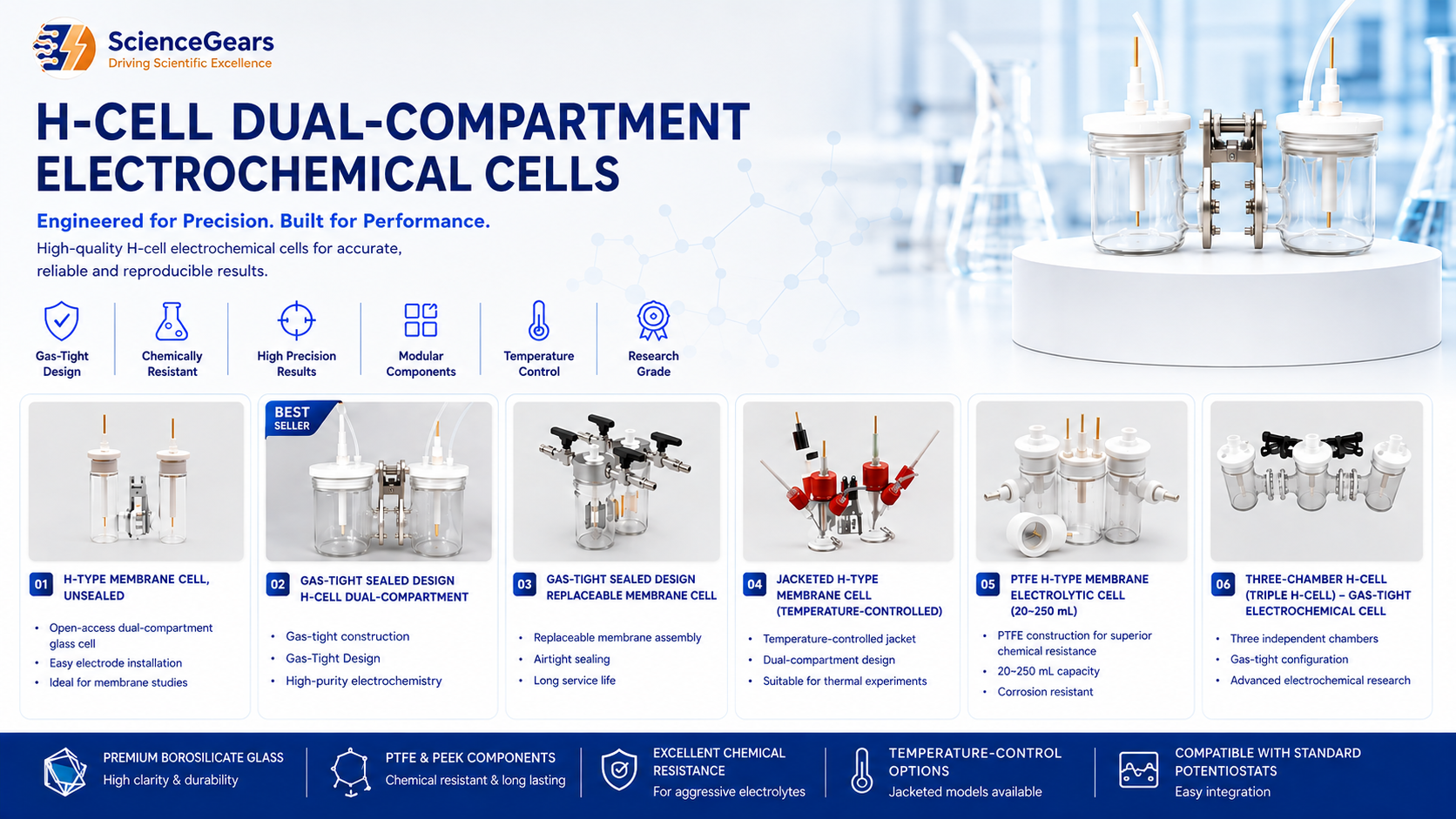
ScienceGears' H-cell range covers this spectrum by seal type and temperature need: the Sealed H-Cell is a gas-tight, dual-compartment design available in 20, 30, 50, 100, 150, 200, and 250 mL capacities per chamber, compatible with standard three-electrode setups and a user-supplied membrane. Where thermal control matters alongside compartment separation, the Jacketed H-type Membrane Cell adds a temperature-controlled jacket in the same capacity range. For chemically aggressive electrolytes or halide-rich media, the PTFE H-Type Membrane Electrolytic Cell (20–250 mL) trades optical access for broader chemical resistance, and for rapid sampling or open-access work, the H-type Membrane Cell, unsealed, drops the gas-tight seal. In every case, the ion-exchange membrane itself is supplied separately — see Ion-Exchange Membranes — and membrane selection should be treated as an experimental variable in its own right, not an afterthought.
At the bench: condition each ion-exchange membrane according to the membrane manufacturer's instructions and the required counter-ion form. A KOH soak converts a compatible AEM towards the hydroxide form; it does not prepare the membrane in bicarbonate form. Some membranes are supplied in bicarbonate, chloride, bromide or another form and require different exchange solutions and conditioning times. Document the catholyte and anolyte composition, volume and starting ionic strength because osmotic and electro-osmotic water transport can change compartment volumes and cell voltage during long experiments.
Where an H-cell's batch-mode current-density ceiling becomes a limiting factor, or where you need to sample the gas phase directly during the reaction rather than inferring it from bulk electrolyte analysis, the flow cell is the next step.
5. When You Need to See the Gas the Reaction Is Making
Faradaic efficiency calculated purely from charge passed and post-reaction electrolyte analysis leaves a gap: it tells you how much current flowed, and it tells you what ended up dissolved in solution, but it does not provide a continuous record of which volatile or gaseous products were forming or when the gas-phase product distribution changed. Detection of short-lived intermediates depends on whether the species reaches the analytical interface, produces an identifiable mass signal and can be distinguished from fragmentation products. For CO₂RR mechanism studies, HER/OER bubble-formation analysis, fuel-oxidation Faradaic efficiency work, and battery vent-gas studies, that real-time gas-phase picture is often the actual measurement you need, not a proxy for it.
This is the job of a flow electrochemical cell coupled to mass spectrometry — differential electrochemical mass spectrometry (DEMS) or membrane-inlet mass spectrometry (MIMS). Electrolyte and reaction gases move continuously through a micro-channel body toward an MS inlet or membrane interface, so gas-phase species composition is tracked alongside current and potential, in operando, rather than reconstructed afterwards.
ScienceGears' In-Situ/Operando Mass Spectrometry Flow Electrochemical Cell is built from PEEK or PTFE, with a customisable 1–10 mL flow-channel volume and a standard three-electrode configuration. Depending on the configuration, it supports planar, disc or mesh electrodes and optional thermostatic control up to 80 °C. It is intended for DEMS/MIMS sampling through a direct, capillary or membrane interface. Gaseous products such as CO, CH₄ and H₂ may be quantified after suitable calibration and correction for fragmentation, background signals and transfer delay. Include claims relating to dissolved products such as formate, transient intermediates, or bubble nucleation only where the exact interface, complementary analytical method, and validation procedure are documented. Describe gas-chromatography coupling as an alternative or complementary analytical configuration rather than as DEMS/MIMS itself.
Because this is a specialised, lower-throughput format built around an MS interface rather than a general-purpose reaction vessel, it earns its place in a workflow at the point where you specifically need operando gas-phase data — not as a default replacement for the beaker, sealed, jacketed, or H-cell formats covered above.
At the bench: calibrate the analytical response at the intended gas and liquid flow conditions, using standards appropriate to the target species, and check calibration stability over the run. Use a stable, validated flow rate and characterise the residence time and delay between the electrochemical event and the analytical signal. Changing the flow rate alters transport, dilution and response time, so it should be treated as a controlled experimental parameter.
6. When Corrosion Is the Question, Not Electrocatalysis
Corrosion testing has its own constraints that general electrocatalysis cells are not built around: a flat metal coupon rather than a wire or mesh working electrode, a precisely defined exposed surface area so that current density is reproducible between coupons, and — for coating and inhibitor studies — the ability to test multiple, small, localised regions on a single panel without wasting a full-size sample on each measurement.
Two common electrochemical techniques in this area are potentiodynamic polarisation and electrochemical impedance spectroscopy. Potentiodynamic polarisation can characterise active dissolution, passivation and breakdown behaviour, while EIS can monitor coating and interface changes under small-signal conditions, and both benefit from a fixed, known working-electrode area. Current density and impedance magnitude depend on the exposed area, so area must be controlled, reported and correctly normalised. Tafel slopes should not be described as directly area-dependent. ASTM G5 is a reference test method for checking potentiodynamic anodic-polarisation technique and equipment; it is not a universal Tafel-analysis method or a general materials-performance standard. Select the applicable ASTM, ISO or other recognised method for the material, environment and quantity being reported.
ScienceGears' corrosion-specific range builds this in directly. The Jacketed Flat Corrosion Cell is available in 250 mL, 500 mL, and 1000 mL capacities with a defined 1 cm² working area, a complete Ag/AgCl reference and platinum-mesh (20 × 20 mm) counter electrode set, thermostatic jacket circulation, and an indented-bottom design intended to accommodate a magnetic stirrer for consistent mass-transport conditions. Where temperature control is not part of the protocol, the Flat Corrosion Cell provides a non-jacketed option for ambient or externally controlled-temperature studies. Confirm the chamber volume, seal materials and allowable operating temperature for the selected configuration. For rapid, localised testing of coatings or inhibitors across multiple sites on one panel, the Coating Evaluation Cell uses a compact reservoir clamped onto a defined circular area of the sample. Confirm the available reservoir sizes against the current product configuration. For setups requiring multiple simultaneous connections, the 5-Port Corrosion Cell provides a 500 mL configuration with dedicated access for the working electrode, counter electrode, reference electrode and gas handling. Confirm the exact port allocation and temperature-accessory arrangement for the quoted configuration.
Note that these are a distinct sub-family from the general-purpose sealed and jacketed cells in Sections 2 and 3: they are built around a flat coupon and a defined exposed area rather than an immersed wire, foil, or mesh electrode, so treat "corrosion cell" as its own selection decision rather than a variant of the general jacketed cell.
At the bench: allow the specimen to reach a stable open-circuit potential using a documented stability criterion before polarisation or EIS. Select the potential limits and scan rate from the applicable standard and the expected corrosion behaviour; do not assume that a fixed ±250 mV window will always contain valid linear Tafel regions. For EIS, use a small perturbation verified to remain within the linear regime and select a frequency range appropriate to the processes of interest. Where EIS and polarisation are performed on the same specimen, collect EIS first when the response of the initially undisturbed surface is required.
7. Decision Matrix: Matching Cell to Experiment
| Application | Recommended cell format | Specific product | Key rationale | Key constraint |
|---|---|---|---|---|
| General CV screening, new material/electrolyte | Open beaker-style cell | Glass Electrochemical Cell, unsealed | Fast electrode swaps, visual access, no assembly overhead | No atmosphere control; not for air-sensitive systems |
| Air-sensitive electrolyte / long-duration run | Sealed cell | Sealed Electrochemical Cell | Gas-tight PTFE/O-ring sealing helps minimise atmospheric contamination and evaporation | Exact chamber volumes not published; confirm at quote stage |
| Temperature-dependent kinetics (Arrhenius series) | Jacketed sealed cell | Jacketed Sealed Glass Cell | Thermostated jacket decouples electrolyte temperature from ambient | Volume/max-temperature not published; confirm before ordering |
| CO₂RR selectivity/product separation | Sealed H-cell | Sealed H-Cell | Membrane isolates anodic and cathodic products | Liquid-phase CO₂ mass transport limits current density; approximately 33 mM applies to CO₂ in water near 25 °C and 1 bar |
| CO₂RR or HER/OER with temperature control | Jacketed H-cell | Jacketed H-type Membrane Cell | Combines compartment separation with thermal regulation | User must supply and select the ion-exchange membrane |
| Halide-rich or highly corrosive electrolytes | PTFE H-cell | PTFE H-Type Membrane Electrolytic Cell | All-PTFE body resists aggressive media | Opaque body — no optical/visual access |
| Rapid sampling, open dual-compartment access | Unsealed H-cell | H-type Membrane Cell, unsealed | Open access for frequent aliquot removal | No gas-tight seal; not for air-free work |
| Operando CO₂RR / HER / OER gas analysis | DEMS/MIMS flow cell | In-Situ/Operando MS Flow Electrochemical Cell | Real-time gas-phase detection alongside current/potential | 1–10 mL flow volume; specialised, lower-throughput format |
| Fuel oxidation Faradaic efficiency studies | DEMS/MIMS flow cell | In-Situ/Operando MS Flow Electrochemical Cell | Correlates gaseous yield with charge passed in real time | Temperature limited to 80 °C even with jacket option |
| Potentiodynamic anodic polarisation or corrosion testing on flat coupons | Jacketed flat corrosion cell | Jacketed Flat Corrosion Cell | Defined 1 cm² working area with temperature control | Requires flat coupon geometry, not wire/mesh electrodes |
| Room-temperature EIS / Tafel on coupons | Flat corrosion cell | Flat Corrosion Cell | Reproducible current path geometry; allowable temperature is configuration-dependent; confirm before ordering | No active temperature control |
| Coating/inhibitor screening across one panel | Coating evaluation cell | Coating Evaluation Cell | Small 5–50 mL reservoir tests multiple sites per sample | Not suited to bulk-solution corrosion kinetics |
| Multi-electrode / gas-purge corrosion setups | 5-port corrosion cell | 5-Port Corrosion Cell | Dedicated access for electrode and gas-handling connections; confirm exact port allocation | Fixed 500 mL capacity |
| Multi-electrode electrocatalysis (non-corrosion) | 5-port electrolytic cell | 5-Port Electrolytic Cell | Simultaneous electrode and gas-line access for complex setups | Not jacketed; add Jacketed 5-Port Electrolytic Cell if temperature control is needed |
8. Frequently asked questions
What is the difference between a beaker cell and a sealed cell?
An unsealed (beaker-style) cell has an open or loosely fitted lid that exchanges gas with the room, making it easy to swap electrodes and observe the reaction, but unsuitable for air-sensitive work. A sealed cell uses PTFE and O-ring seals to hold a gas-tight atmosphere for the full experiment duration, which matters for air-sensitive electrolytes, long-duration runs, and any protocol requiring a maintained inert-gas blanket.
Can I use a standard H-cell for CO₂ reduction studies?
Yes, the H-cell is the standard format for CO₂RR selectivity screening because the membrane reduces product crossover and the associated risk of re-oxidation at the anode. Be aware that batch-mode CO₂ delivery by bubbling limits aqueous CO₂ solubility to roughly 33 mM, which in turn caps the current density achievable compared with a flow or gas-diffusion-electrode format, fine for mechanism and selectivity work, a real constraint if you are chasing industrially relevant current densities.
Do I need a jacketed cell for room-temperature CV?
Generally no. If your protocol runs at ambient temperature and does not require a defined thermal set point, an unsealed or sealed cell (depending on atmosphere needs) is sufficient, and a jacketed cell adds cost and setup complexity without a corresponding benefit. Reach for a jacketed cell specifically when you need a reproducible, controlled temperature series, for example, an Arrhenius analysis or a temperature-dependent corrosion-rate study.
What size ion-exchange membrane fits a sealed H-cell?
Membrane dimensions depend on the specific H-cell model and its bridge/port geometry, and ScienceGears' H-cell range is supplied without a membrane so the correct chemistry (proton-exchange, anion-exchange, or bipolar) can be matched to the experiment. Confirm membrane dimensions against your chosen H-cell model with the technical team before ordering; see Ion-Exchange Membranes and Talk to our technical team.
How do I make an electrochemical cell oxygen-free?
Purge the electrolyte with high-purity N₂ or Ar for around twenty to thirty minutes before starting (longer for reference protocols such as ASTM G5, which specifies roughly one hour), then maintain a continuous inert-gas blanket above the solution for the full duration of the experiment rather than relying on a single pre-purge. This requires a sealed cell with gas inlet/outlet ports; an open beaker-style cell cannot reliably maintain a gas-tight inert atmosphere.
Can I run EIS in a jacketed corrosion cell?
Yes, the Jacketed Flat Corrosion Cell is specifically built for temperature-dependent EIS and DC polarisation work, with a defined 1 cm² working area and a complete Ag/AgCl reference / platinum-mesh counter electrode set, supporting controlled comparisons when the exposed area, cell geometry, electrolyte composition, temperature and measurement protocol are held constant. Run EIS at open-circuit potential before any polarisation step on the same coupon, and hold the temperature set point stable for the full frequency sweep. Low-frequency points can take several minutes each to acquire, and a drifting jacket temperature partway through the sweep will distort the low-frequency end of the spectrum in ways that are easy to misread as a genuine change in coating or diffusion behaviour.
9. Expert Support: How ScienceGears Works Alongside Your Research
Our technical team has practical experience matching electrochemical cells to membrane type, coupon geometry and gas-handling requirements. In practice, the difference between a suitable cell on paper and a configuration that produces reproducible data often comes down to port placement, seal compatibility, reference-electrode position, and membrane preparation. Common avoidable problems include incompatible seal materials, excessive reference-to-working-electrode distance, and incorrect membrane conditioning.
Cell and Membrane Configuration
Before you order, our technical team will work through your electrolyte chemistry, temperature range, and target technique with you to confirm port count, seal material, and, for H-cell and flow-cell work, the correct ion-exchange membrane chemistry for your reaction. Talk to our technical team →
Contamination and Crossover Diagnosis
If your Faradaic efficiency numbers are drifting, your Tafel slopes look noisier than they should, or you suspect membrane crossover is contaminating one compartment of an H-cell, we can help you work through likely causes seal integrity, membrane conditioning, electrolyte purity, or reference-electrode placement, before consuming additional electrolyte and test time while troubleshooting the wrong variable.
Complete System Supply
- Electrochemical Cell range
- H-cell range
- Corrosion Test Electrochemical Cell range
- In-Situ & Operando Electrochemical Cells
- Reference Electrodes
- Counter Electrodes
- Working Electrode
- Ion-Exchange Membranes
- Electrode Clamp/Holder
- Potentiostats / Galvanostats
Local AU/NZ Stock Same-Day Dispatch
Selected standard cell configurations may be held in local AU/NZ stock and may be available for same-day dispatch, subject to stock confirmation. Custom port configurations, volumes, and membrane pairings are quoted and built to order.
"Cell selection is not only a choice of container; it is one of the experimental assumptions reflected in the data reported by the potentiostat." — ScienceGears Technical Team
10. Further Reading
- ASTM Electrochemical Corrosion Test Methods: Complete Guide — ScienceGears blog
- Electrochemical Cells for Lab Research: Complete Guide — ScienceGears product hub
- H-Cell Electrochemical Reactors — ScienceGears product hub
- Corrosion Test Electrochemical Cells — ScienceGears product hub
Related but outside this guide's scope: if your work involves membrane-electrode-assembly (MEA) fuel-cell or electrolyser testing, spectro- or photo-electrochemical cells, in-situ Raman/XAS/XRD cells, or coin/pouch battery cell formats, these use purpose-built cell families rather than the general-purpose formats covered here see Membrane Electrode Assembly (MEA) Test Cells, Photoelectrochemical Cells, In-Situ & Operando Electrochemical Cells, and Battery Test Cell options.
11. Get in Touch
If you are midway through specifying a cell for a new protocol — or troubleshooting one that is not giving you clean data — our technical team can talk through the configuration with you directly.