


In-situ/Operando Raman Battery Test Cell (3-electrode, compact titanium split cell) – REC 11
In-situ/Operando Raman Battery Test Cell (3-electrode, Compact Titanium Split Cell) – REC 11
Three-electrode operando Raman cell for decoupled potential tracking
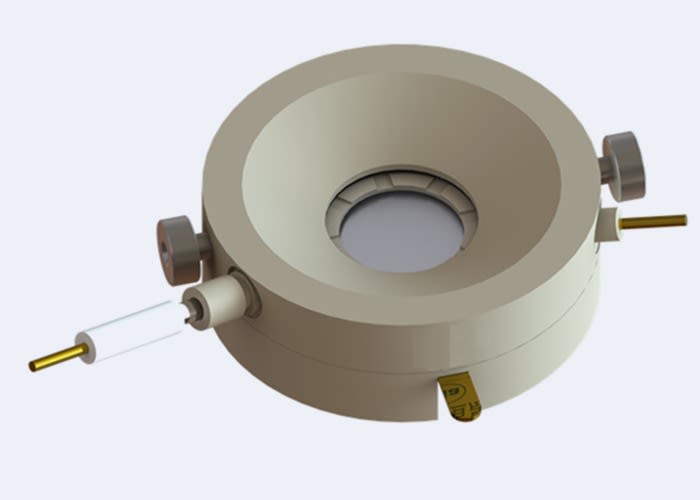
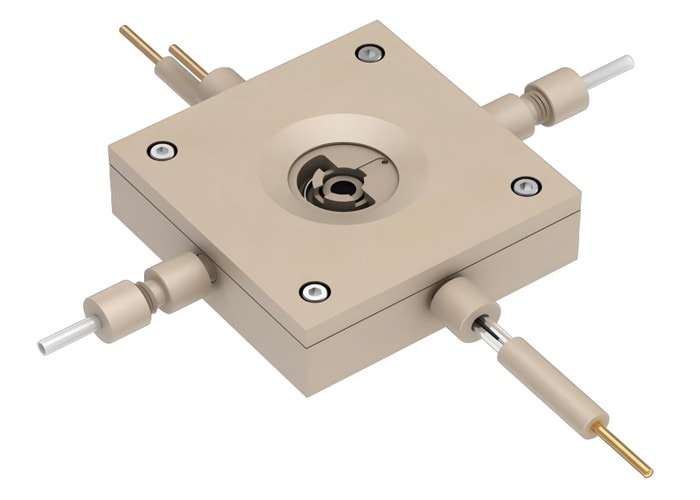
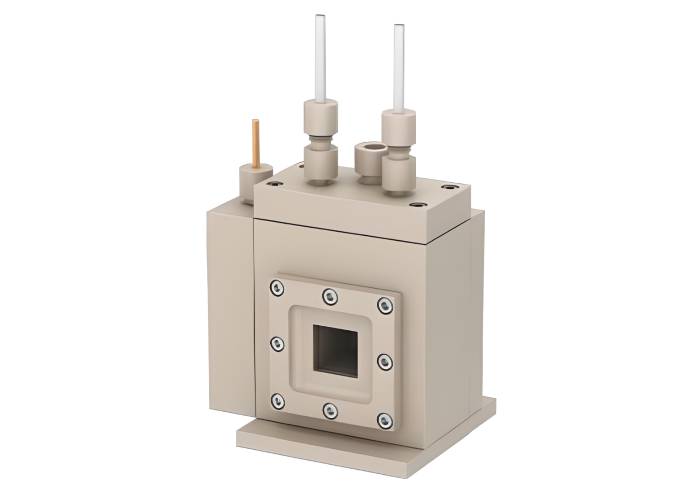
The REC 11 In-situ/Operando Raman Battery Test Cell (3-electrode) extends operando Raman battery testing by adding a reference electrode connection, allowing researchers to monitor the working electrode potential independently while collecting Raman spectra during cycling. This is valuable for mechanistic studies where separating cathode/anode polarisation, interphase growth, or reaction onset potentials is essential.
Working principle
Raman spectra are collected through an Ø8 mm optical window positioned close to the working electrode (<2 mm distance). The cell compresses a layered battery stack, with cathode and anode separated by a user-supplied membrane/separator, while a cycler/potentiostat drives the electrochemical protocol. Raman and electrochemical data are then correlated to link structural/chemical evolution with performance.
Key features and specifications
- High purity titanium body for robustness in common battery electrolytes
- Cell body size: 50 × 50 × 20 mm
- Optical window: Ø8 mm aperture; WE-to-window distance <2 mm
- O-ring sealing + screw tightening for consistent, repeatable assembly
- Spring-loaded stack compression to adjust load and reduce contact instability
- Quick disassembly for post-mortem inspection without damaging the electrode stack
Typical applications
- Potential-resolved operando Raman studies (cathodes, anodes, conversion materials)
- SEI/CEI growth tracking vs electrode potential
- Additive and electrolyte formulation screening
- Degradation pathways and failure-mode diagnostics
Why ScienceGears
ScienceGears provides local support for selecting the right potentiostat, battery cycler, and Raman-compatible in-situ/operando cell for battery research teams across Australia and New Zealand.
Resources & Downloads
Everything you need to get started
Electrochemical Impedance Spectroscopy (EIS): Core Concepts for Confident Understanding
Squidstat - Admiral
Customer Reviews
Related Product
Explore our precision instruments designed for electrochemical research and energy applications









Still Wondering About Something?
Explore our FAQ for fast, clear answers to the most common questions—available 24/7.