
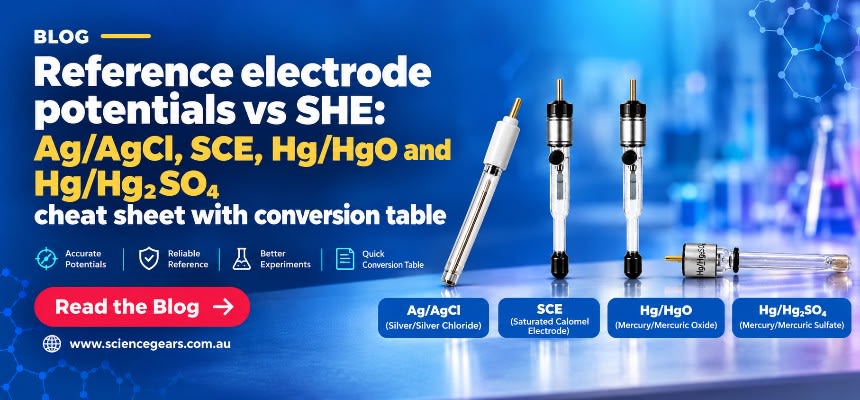
By the end of this guide, you will be able to convert reported Ag/AgCl, SCE, Hg/HgO and Hg/Hg₂SO₄ potentials to SHE or RHE and estimate their vacuum energy equivalents using clearly stated assumptions, choose the reference and filling solution that suits your electrolyte, and check at the bench whether the number on your electrode's datasheet can be trusted.
1. Why the same peak appears at three different potentials
A reviewer asks you to re-plot every voltammogram against SHE. Your own data were recorded against Ag/AgCl in 3 M KCl, the benchmark paper you are comparing with used Hg/Hg₂SO₄, and the catalyst study you are citing used Hg/HgO in KOH. Three numbers, three references, and no obvious way to put them on one axis without a sign error.
The references are not the problem. Each reference electrode is based on a defined electrochemical equilibrium, but its actual potential also depends on the filling solution, temperature, electrode condition and liquid junction. The problem is that a potential means nothing until you state what it was measured against, in which solution, and at what temperature. The standard hydrogen electrode (SHE) is the common scale because it is defined as 0 V at unit hydrogen-ion activity and 1 bar H₂ at every temperature, yet almost nobody runs one. Practical electrode scales are related to SHE through measured or tabulated offsets; a numerical conversion is only as reliable as the offset, fill, temperature and junction conditions used.
Two ideas carry through the rest of this guide. First, a reading is a difference: E(measured) = E(working) − E(reference). A reference that sits higher on the SHE scale gives a smaller number for the same working-electrode potential, and that single fact causes most sign errors. Second, the filling solution is part of the electrode's identity. "Ag/AgCl" is not a complete description; "Ag/AgCl, saturated KCl, 25 °C" is.
This guide gives you the cheat-sheet values, a conversion table for selected references, and the reasoning behind each electrode, so you can judge when a tabulated number is safe and when it must be measured. All potentials are at 25 °C unless stated. For the wider question of which reference suits which system, see How to choose the right reference electrodes, and for upkeep see Reference electrode storage, refilling and maintenance.
2. The cheat sheet: reference potentials vs SHE at 25 °C
The most common error with a datasheet potential is using it for the wrong filling solution. Table 1 gives illustrative 25 °C literature values, not certified offsets for every product. Verify the actual fill and potential for precision work.
| Reference | Filling solution | Nominal E vs SHE at 25 °C (V) | Literature spread / note | Typical medium |
|---|---|---|---|---|
| Ag/AgCl | Saturated KCl | +0.197 | 0.195 to 0.199 | Neutral to acidic, chloride tolerant |
| Ag/AgCl | 3 M KCl | +0.210 | 0.207 to 0.210 | As above |
| Ag/AgCl | 1 M KCl | +0.235 | Approx. +0.235 to +0.237 | As above |
| SCE (Hg/Hg₂Cl₂) | Saturated KCl | +0.241 | Approx. +0.241 to +0.244 at 25 °C | Aqueous chloride, below about 50 °C |
| Hg/HgO | 1 M KOH | +0.098 (E° convention) | E° +0.0983; calculated ~+0.105 | Strongly alkaline |
| Hg/HgO | 1 M NaOH | +0.108 (calculated) | Older sources: ~+0.140 | Strongly alkaline |
| Hg/HgO | 0.1 M NaOH | +0.163 (reported example) | ~+0.162 to +0.165 | Alkaline |
| Hg/Hg₂SO₄ | Saturated K₂SO₄ | +0.640 | ~+0.640 to +0.650 | Sulfate, chloride-free acid |
| Hg/Hg₂SO₄ | 0.5 M H₂SO₄ | +0.680 | ~+0.680 to +0.682 | Sulfuric acid |
| RHE | Test electrolyte, H₂-saturated Pt | −0.0592 × pH | At 25 °C; activity-based pH | Any pH |
Three points from the table matter before you convert anything.
SCE values at 25 °C vary between compilations: for saturated KCl, +0.241 to approximately +0.244 V vs SHE is commonly quoted. These differences matter when millivolt accuracy is required and should not be dismissed as smaller than every liquid-junction error. The calculation tables in this guide use +0.241 V consistently; report the value and source selected.
Hg/HgO is where tabulated offsets disagree most. Section 5 explains why, and why calibration against RHE beats any table.
Standard and filled-electrode potentials are different. The Hg/Hg₂SO₄/Hg equilibrium has a standard potential near +0.616 V vs SHE at unit sulfate-ion activity. Representative filled-electrode values at 25 °C are around +0.640 to +0.650 V for saturated K₂SO₄ and +0.680 to +0.682 V for 0.5 M H₂SO₄. These are literature or supplier examples, not a unique potential for every junction or product. Confirm the exact fill and offset before precision measurements.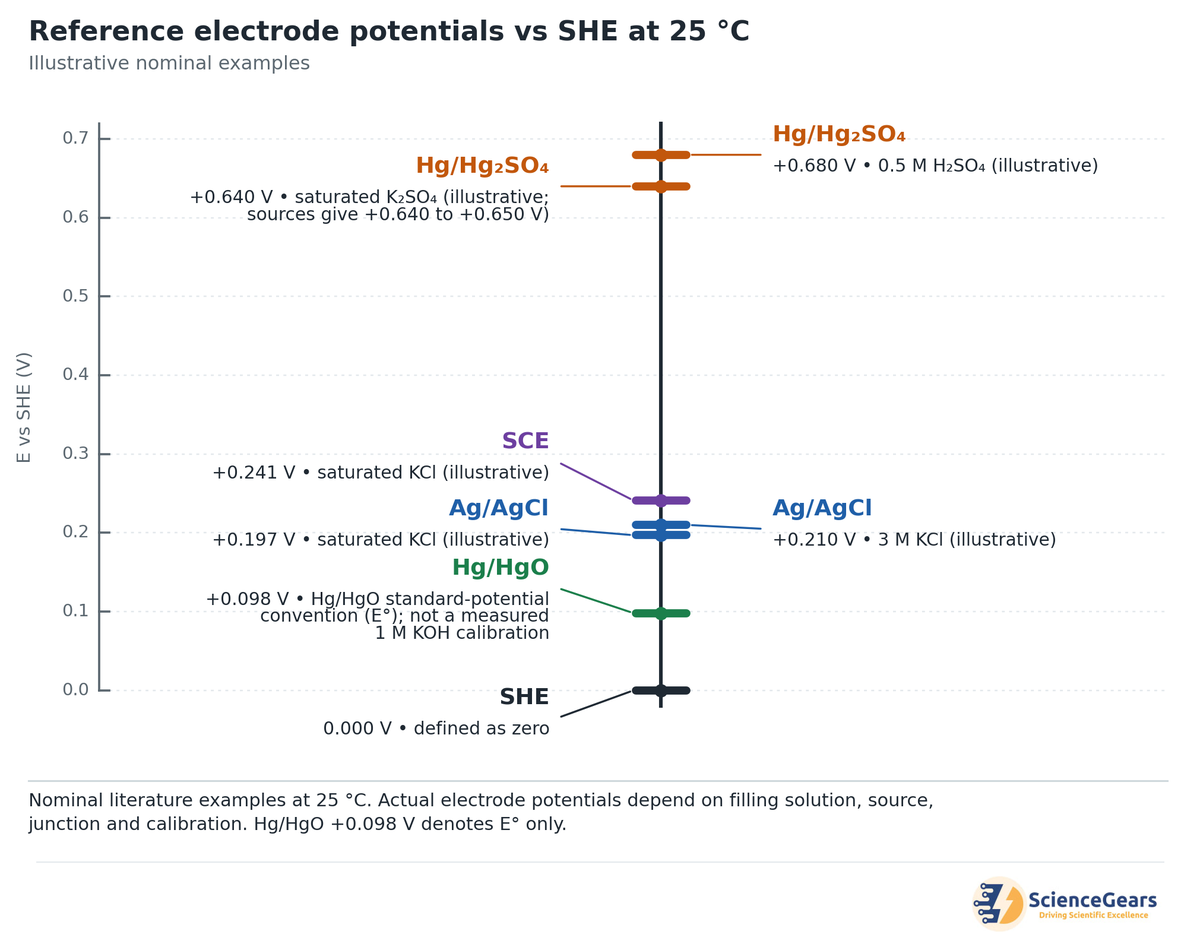
ScienceGears product pages describe electrode types and advertised configurations, but their listed numerical specifications must not be treated as independent calibration certificates. Use the actual supplier/model documentation and a measured offset where the uncertainty affects the scientific conclusion. The Ag/AgCl reference electrode page lists saturated, 3 M and 1 M KCl options. The +0.197 V vs SHE saturated-KCl example is also independently reported by Metrohm Autolab. The Hg/HgO reference electrode page advertises a 1 M KOH-filled configuration. The quoted +0.098 V is the conventional standard-potential figure and should not be presented as a verified in-use calibration; model-specific impedance or flow-rate figures are omitted here. The Hg/Hg₂SO₄ reference electrode page describes sulfate-based filling options. Temperature rating, junction configuration and the actual potential must be checked for the selected instrument rather than inferred from broad website specifications. The saturated calomel electrode page describes the Hg/Hg₂Cl₂ system in saturated KCl. All of them sit within the reference electrodes range, alongside the reversible hydrogen electrode.
3. The conversion rule and selected-reference conversion table
A potential that is 0.4 V off looks like chemistry. It is usually arithmetic.
The rule fits on one line: E(vs B) = E(vs A) + E_A − E_B, where E_A and E_B are the potentials of electrodes A and B on the SHE scale. In words, add the offset of the electrode you are leaving and subtract the offset of the electrode you are going to. Then run the sanity check: the electrode with the higher SHE offset must give the smaller number. SCE (+0.241 V) sits above Ag/AgCl (+0.197 V), so a potential read against SCE is 0.044 V lower than the same potential read against Ag/AgCl.
Table 2 applies the arithmetic conversion rule to selected 25 °C reference scales. Its Hg/HgO (1 M KOH) row deliberately uses +0.098 V vs SHE as a historical standard-potential convention, not as a verified in-use potential of a 1 M KOH-filled electrode; activity-based calculations give approximately +0.105 V vs SHE, while junction conditions can change the measured offset. For quantitative Hg/HgO-to-RHE work, determine or validate the applicable in-electrolyte offset (including junction effects) rather than relying on the illustrative matrix alone. Find the reported scale in the left column and add the value shown under the target scale.
| From (reported vs) | To SHE | To Ag/AgCl (sat. KCl) | To Ag/AgCl (3 M KCl) | To SCE | To Hg/HgO (E° convention) | To Hg/Hg₂SO₄ (sat. K₂SO₄) |
|---|---|---|---|---|---|---|
| Ag/AgCl (sat. KCl) | +0.197 | 0 | −0.013 | −0.044 | +0.099 | −0.443 |
| Ag/AgCl (3 M KCl) | +0.210 | +0.013 | 0 | −0.031 | +0.112 | −0.430 |
| SCE | +0.241 | +0.044 | +0.031 | 0 | +0.143 | −0.399 |
| Hg/HgO (1 M KOH) | +0.098 | −0.099 | −0.112 | −0.143 | 0 | −0.542 |
| Hg/Hg₂SO₄ (sat. K₂SO₄) | +0.640 | +0.443 | +0.430 | +0.399 | +0.542 | 0 |
The Hg/HgO entries in Table 2 use +0.098 V as a clearly labelled standard-potential convention. An activity-based calculation in the cited 2023 analysis gives approximately +0.105 V for a 1 M KOH-filled Hg/HgO reference and approximately +0.108 V for 1 M NaOH under its stated assumptions; some older references list about +0.140 V for 1 M NaOH. These numbers describe different assumptions and are not interchangeable calibration results. For a 25 °C RHE conversion, E(vs RHE) = E(vs reference) + E_ref(vs SHE) + 0.05916 × pH, provided pH denotes the thermodynamic activity-based value and junction terms are appropriately accounted for. You can instead apply an experimentally determined reference-to-RHE offset directly.
Worked example 1: Ag/AgCl to SHE and SCE. A peak sits at +0.350 V vs Ag/AgCl (saturated KCl). On the SHE scale it is 0.350 + 0.197 = +0.547 V. On the SCE scale it is 0.350 − 0.044 = +0.306 V. The SCE number is smaller, as the sanity check demands.
Worked example 2: Hg/Hg₂SO₄ to SCE. A corrosion potential is reported as −0.900 V vs Hg/Hg₂SO₄ (saturated K₂SO₄). To compare it with older SCE-referenced data, add 0.399 V from Table 2: −0.900 + 0.399 = −0.501 V. Check by the long route: −0.900 + 0.640 − 0.241 = −0.501 V.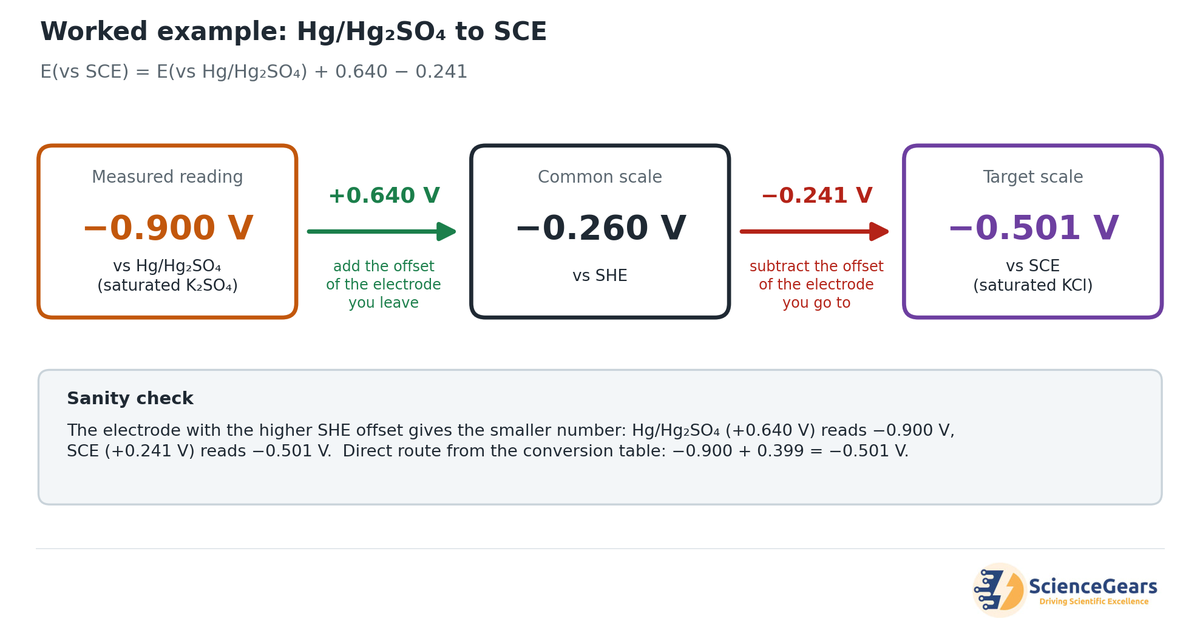
Worked example 3: Hg/HgO to RHE. Suppose an OER-related feature is measured at +0.620 V vs Hg/HgO in nominal 1 M KOH at 25 °C. Using the illustrative assumptions pH = 14 and E(Hg/HgO) = +0.098 V vs SHE, E(vs RHE) = 0.620 + 0.098 + 0.0592 × 14 = +1.547 V. This is +0.318 V above the 1.229 V thermodynamic OER potential at 25 °C; it is not necessarily a fully iR-corrected kinetic overpotential. If an actual in-situ calibration instead gave a total Hg/HgO-to-RHE offset of +0.926 V, the result would be 0.620 + 0.926 = +1.546 V vs RHE. Both calculations are examples, not measured calibration data.
An RHE established in the same electrolyte inherently references the local hydrogen equilibrium, avoiding the separate numerical pH conversion used for a different reference electrode. Its use still depends on a suitable, properly maintained hydrogen electrode, gas-handling approval where applicable, and verification of the measurement setup.
Linking the electrochemical scale to spectroscopic energies
Spectroscopists often need electrode potentials as energies: a flat-band potential beside a UV-vis band gap, a Fermi level beside a UPS work function, or a redox potential beside an orbital energy. The bridge is the absolute potential of the SHE, which IUPAC (Trasatti, 1986) recommends as 4.44 ± 0.02 V at 298.15 K. The electron energy relative to vacuum is then E(vac, eV) = −(4.44 + E vs SHE in volts). Table 3 lists approximate vacuum conversions based on those nominal offsets. Their uncertainty exceeds the ±0.02 V uncertainty of the SHE anchor if the reference, junction and experimental potential uncertainties are significant.
| Reference | E vs SHE (V) | Absolute potential (V) | Absolute potential from nominal offset (V) |
|---|---|---|---|
| SHE | 0.000 | 4.44 | −4.44 |
| Ag/AgCl (saturated KCl) | +0.197 | 4.64 | −4.64 |
| Ag/AgCl (3 M KCl) | +0.210 | 4.65 | −4.65 |
| SCE | +0.241 | 4.68 | −4.68 |
| Hg/HgO (1 M KOH, convention) | +0.098 | 4.54 | −4.54 |
| Hg/Hg₂SO₄ (saturated K₂SO₄) | +0.640 | 5.08 | −5.08 |
Worked example 4: potential to a vacuum-referenced electron energy. If a material has a reported flat-band potential of −0.300 V vs Ag/AgCl (saturated KCl) at 25 °C, the nominal conversion gives −0.300 + 0.197 = −0.103 V vs SHE. Using the IUPAC-recommended 4.44 V anchor, the corresponding electron electrochemical-energy estimate is −(4.44 − 0.103) = approximately −4.34 eV relative to vacuum. This conversion alone does not establish a conduction-band edge, valence-band edge or independently measured Fermi level.
Two cautions apply. Some publications adopt a different absolute-SHE reference value (for example, 4.5 V), so state the convention and uncertainty used. A flat-band potential inferred from Mott–Schottky analysis may be model- and frequency-dependent, especially in highly doped or nanostructured materials; it should not automatically be equated to a band-edge energy (Hankin et al., J. Mater. Chem. A, 2019).
4. Ag/AgCl and SCE in chloride media: fill, temperature and junction
The datasheet says +0.197 V, your electrode is filled with 3 M KCl, and the laboratory is at 32 °C. Each of those facts moves the real potential, and none of them appears in the sentence "we used an Ag/AgCl reference".
Fill. The Ag/AgCl potential follows chloride activity: E = E° − 0.0592 log a(Cl⁻), with E° = +0.222 V vs SHE at 25 °C. Saturated KCl gives +0.197 V, 3 M gives +0.210 V, and 1 M gives +0.235 V. Swapping a saturated electrode for a 3 M one therefore moves every potential by 13 mV without any change in chemistry, enough to blur a peak assignment in a close comparison. The ScienceGears page lists all three fills for its Ag/AgCl reference electrode and is blunt about storage: "Do not store the electrode dry." Keep it immersed in KCl of the same concentration as the fill.
Temperature. Ag/AgCl, SCE and sulfate-based reference potentials vary with temperature through equilibrium thermodynamics, electrolyte activity and, in some designs, temperature-dependent salt solubility. Table 4 summarises the appropriate precautions rather than assuming that a single linear coefficient applies to all reference designs. Uniform-temperature and temperature-gradient arrangements are different because thermal and liquid-junction contributions can also change. Record the temperature and, when precision matters, verify the actual reference offset under the measurement conditions.
| Reference / fill | Temperature dependence (qualitative) | Verification / use restriction |
|---|---|---|
| Ag/AgCl, saturated KCl | Potential depends on chloride activity and KCl solubility | Check rated range; calibrate or use source-specific data at measurement temperature |
| Ag/AgCl, concentrated KCl (e.g. 3–3.5 M) | Potential depends on fill concentration and temperature | Use the specified concentration; do not transfer another fill’s correction |
| SCE, saturated KCl | Potential changes with temperature; Hg₂Cl₂ stability matters | Metrohm Autolab advises against general SCE use above 50 °C; check model rating |
| Hg/Hg₂SO₄, sulfate-based fill | Potential depends on sulfate activity, temperature and construction | Confirm supplier-rated temperature range; verify in-use offset |
| Hg/HgO, hydroxide fill | Hydroxide/water activities and junction conditions vary with temperature | Calibrate or validate against RHE in the actual electrolyte and temperature |
The ideal hydrogen-equilibrium conversion factor 2.303RT/F is 0.05916 V per pH unit at 25 °C and approximately 0.0661 V at 60 °C. These factors describe thermodynamics; they do not establish that a particular commercial reference can safely operate at 60 °C. The electrolyte activities and any junction potential also change. Determine reference offsets at the working temperature whenever quantitative accuracy is required.
SCE limits. Saturated calomel electrodes contain mercury and have temperature-dependent potentials. Metrohm Autolab advises against using its general SCE above 50 °C because of Hg₂Cl₂ stability. The safe temperature limit is model-specific; do not assume an SCE can be used up to 80 °C merely because a coefficient has been reported there. For legacy comparisons, state both the original reference and any converted scale.
Junction and chloride. Ag/AgCl and SCE electrodes leak chloride by design, which makes them unsuitable for chloride-sensitive systems such as certain plating baths or halide-free redox mediators. An approved double-junction arrangement with a chemically compatible outer electrolyte can reduce chloride crossover, although it cannot guarantee zero crossover and may introduce an additional junction potential. A double-bridge SCE also introduces mercury-handling requirements. Silver chloride is also photosensitive, so keep Ag/AgCl electrodes out of strong light. For refilling and junction care, the maintenance guide covers the routine in detail.
For corrosion work in chloride media, Ag/AgCl with a Luggin capillary is the usual pairing; see the corrosion test electrochemical cell range for compatible cell hardware.
5. Hg/HgO in alkaline media: calibrate, do not look up
You run OER in 1 M KOH. One paper converts with +0.098 V, a compilation lists +0.140 V for 1 M NaOH, and another table gives +0.108 V. Depending on whom you cite, your overpotential moves by up to 42 mV, and none of them is obviously wrong.
Why Hg/HgO exists. In strongly alkaline media, the chemistry and potential of a conventional Ag/AgCl reference may change, depending on its construction and liquid-junction arrangement. Hg/HgO is a common alternative because its reference reaction explicitly involves hydroxide: HgO(s) + H₂O(l) + 2e⁻ ⇌ Hg(l) + 2OH⁻(aq). Its potential depends on hydroxide activity, so filling-solution composition, the test electrolyte, temperature and any liquid junction must be considered.
Why the tables disagree. The often-quoted +0.098 V (approximately +0.0983 V) refers to a standard-potential convention at unit hydroxide activity, not a certified in-use offset for every Hg/HgO electrode. A 2023 ACS Catalysis analysis computed real potentials from hydroxide activity and found them 9.6 mV higher for 1 M NaOH (about +0.108 V) and 7.0 mV higher for 1 M KOH (about +0.105 V). Older compilations and some supplier notes list +0.140 V for 1 M NaOH, which would add a further 32 mV. Electrolyte identity, concentration, activities, water activity, temperature and liquid-junction conditions all matter; a tabulated value cannot replace calibration of an actual setup. The same analysis recommends converting with the Nernst term plus the real potential of the internal solution: E(vs RHE) = E(vs Hg/HgO) + 0.0592 × pH + E_real.
What measurements say. Experimental Hg/HgO-to-RHE calibrations from nominally similar systems can differ appreciably. Niu et al. (ACS Energy Letters, 2020) report +0.894 V in 0.1 M KOH and +0.927 V in 1 M KOH for their stated conditions, illustrating the importance of the electrolyte and calibration method. Das et al. (ACS Energy Letters, 2025) further identify reference filling solution, hydroxide purity, CO₂ uptake, water and ion activities, pH estimation and liquid-junction potentials as potential sources of error. These published results are experimental examples, not acceptance ranges for every electrode. For new quantitative work, validate the offset in the intended electrolyte.
Temperature and light. Because hydroxide and water activities, junction conditions and reference equilibria are temperature-dependent, an Hg/HgO offset established at 25 °C should not be transferred unchanged to a heated alkaline cell. Protect the electrode from conditions identified as unsuitable in its manufacturer documentation, including strong illumination where applicable; do not assume a published thermal study validates the operating limits of an individual product.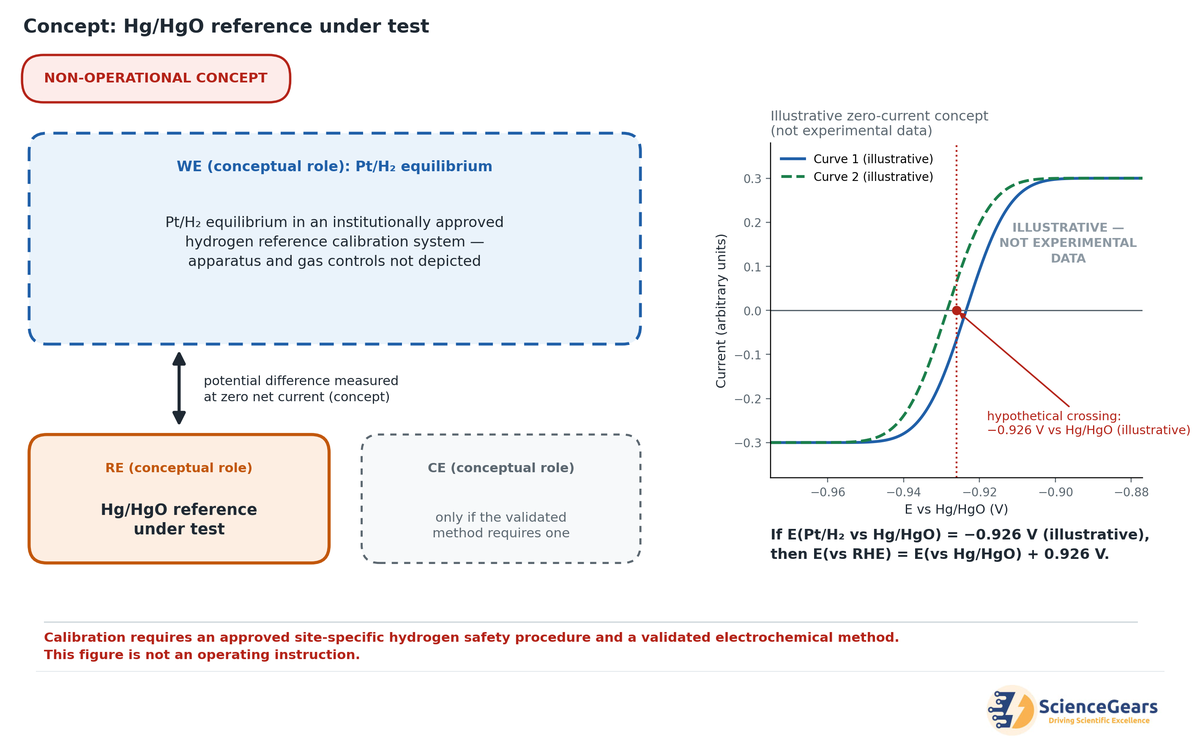
Calibration principle and laboratory safety (not a stand-alone operating procedure)
- Use the same electrolyte composition and temperature as the intended experiment. Where a hydrogen-based calibration is necessary, follow an institutionally approved hydrogen-handling SOP and the manufacturer’s validated calibration method. The setup must include an approved gas supply and flow control, suitable ventilation and exhaust, leak and ignition-source controls, and an appropriate chemical and gas safety assessment. Do not treat a fixed sparging time or an open-cell H₂ blanket as a universally safe or validated instruction.
- Under an approved hydrogen reference calibration procedure, the potential of the Pt/H₂ equilibrium may be measured against the reference electrode under test. The electrode geometry, Pt preparation, any counter electrode and the reference-tip placement should follow the validated method; a Luggin capillary assists positioning but is not a selective chemical barrier.
- Use the measurement technique, potential window, scan rate and equilibration criteria specified by the validated calibration protocol. A slow voltammogram may be suitable in some systems, but a universal 1 mV s⁻¹ scan rate or a single zero-current crossing is not sufficient evidence of equilibrium for every electrode.
- For an illustrative Pt/H₂ equilibrium observed at −0.926 V vs Hg/HgO, the reference-to-RHE conversion would be E(vs RHE) = E(vs Hg/HgO) + 0.926 V. If a CV is used, any averaging of forward and reverse zero-current crossings must be justified and repeatable under the laboratory method; report the measured calibration and its conditions.
- Compare the measured offset with a calculation that uses the appropriate reference fill, activity-based pH, temperature and estimated liquid-junction terms. Unexpected differences should prompt investigation of reference condition, electrolyte composition, contamination and calibration setup. Do not apply an automatic 10–30 mV pass range or diagnose electrode failure from a single difference alone.
- Recheck after replacement or servicing of the reference, a change of electrolyte or temperature, and at the interval specified by the laboratory’s documented method.
The Hg/HgO reference electrode page lists a 1 M KOH-filled, refillable option. For concentrated hydroxide electrolytes, obtain configuration-specific compatibility guidance rather than assuming that the 1 M KOH fill is interchangeable with the test solution. Where the approved measurement arrangement permits it, a suitable reversible hydrogen electrode avoids a separate Hg/HgO-to-RHE numerical conversion.
For substrate choices in the same alkaline cell, see Nickel foam vs nickel mesh vs nickel plate, and for reference placement and iR issues in two-compartment cells, see H-cell troubleshooting.
6. Hg/Hg₂SO₄ in sulfate and chloride-free acid
Mercury/mercurous sulfate potentials of approximately +0.616 V, +0.640 V, +0.650 V and +0.680 V versus SHE appear in different scientific or supplier references. They should not be treated as universally interchangeable values: standard-state conditions, sulfate fill, electrode design and junction effects must be distinguished.
Which number applies. The reaction is Hg₂SO₄(s) + 2e⁻ ⇌ 2Hg(l) + SO₄²⁻(aq). Its standard potential is approximately +0.616 V vs SHE at unit sulfate activity. Filled-electrode examples at 25 °C include around +0.640 V (reported by Gamry for a saturated K₂SO₄ design), +0.650 V (Gaskatel compilation, saturated K₂SO₄), and +0.680 to +0.682 V (Metrohm Autolab and Gaskatel, 0.5 M H₂SO₄). These source-specific values can differ by several to tens of millivolts; report the actual fill and verify the offset used. The linked ScienceGears product page lists sulfate-based fill options but does not replace manufacturer calibration information.
Temperature. Mercury/mercurous sulfate references can show temperature-dependent potentials and, in some designs, thermal hysteresis. The linked ScienceGears page advertises a 0–40 °C range for certain standard versions, but this is not a verified limit for every available model. Check the exact supplier datasheet and measure or validate the offset at the experimental temperature. Do not extrapolate a nominal −0.8 mV K⁻¹ coefficient to justify use outside a model’s rated conditions.
Chloride cuts both ways. Choose this electrode when chloride must be excluded from the cell. Equally, keep chloride out of the electrode: Hg₂Cl₂ is far less soluble than Hg₂SO₄, so chloride entering the paste converts it and shifts the potential. If the sample contains chloride, protect the Hg/Hg₂SO₄ reference from chloride ingress with a compatible, manufacturer-approved intermediate electrolyte bridge or double-junction arrangement. A Luggin capillary helps position the reference tip near the working electrode but does not, by itself, prevent ionic crossover. An appropriately specified Ag/AgCl reference may be preferable where chloride contamination is acceptable.
Applications. The main uses are lead-acid battery half-cell potentials, corrosion tests in sulfate or sulfuric-acid media, and acidic electrodeposition without chloride. The Hg/Hg₂SO₄ reference electrode is offered in different body and junction designs; geometry, refillability and dimensions should be checked for the selected model. It contains mercury, so follow institutional handling and disposal rules.
For the instrument side of a corrosion or battery measurement, see the potentiostat and galvanostat range.
7. Reporting, verifying and defending your potentials
Reviewer 2 writes: "Please state the reference electrode and how potentials were converted." If your methods section says only "Ag/AgCl", you now owe a revision.
Report five things. Electrode type, filling solution, temperature, the conversion applied, and the offset value used. For example: "Potentials were measured against Ag/AgCl (3 M KCl, +0.210 V vs SHE at 25 °C) at 25 ± 1 °C and converted to RHE using E(RHE) = E(Ag/AgCl) + 0.210 + 0.0592 × pH, with pH measured at 25 °C." For corrosion work, the current ASTM G3-14(2024) practice covers conventions for reporting and displaying electrochemical corrosion data; citing it does not constitute a claim of laboratory compliance.
Verify against a master. Keep one electrode of the same type and fill, stored sealed and never placed in a sample. Before each measurement campaign, place the reference electrode under test and the dedicated master reference electrode in a fresh, manufacturer-compatible comparison electrolyte at the same temperature, with their junctions close but not touching. Measure their potential difference using a high-input-impedance voltmeter or an electrochemical instrument in its documented reference-comparison configuration; allow the reading to stabilise and record the offset. Set and document an acceptance criterion for the reference-to-master potential difference and drift that reflects the required measurement accuracy, electrode model, junction, temperature and validated laboratory procedure. Do not equate a manufacturer’s potential-stability specification with a universal acceptance tolerance for an electrode comparison. For Hg/HgO, the RHE calibration in section 5 is the verification.
Place the reference sensibly. Position the reference sensing point near the working electrode to reduce uncompensated solution-resistance effects without disturbing current distribution. A Luggin capillary may aid placement, but an excessively narrow or blocked bridge can add impedance, and it is not inherently a chloride-blocking barrier. Keep the permitted junction/electrolyte path wetted and free from trapped gas according to the cell design.
Do not mix scales in one figure. If you overlay data from two references, convert both to a single scale first and say which one.
Reference electrodes in spectroelectrochemical and operando cells
Raman, UV-vis, IR and X-ray absorption cells put the working electrode behind a window, often in a thin-layer geometry, and that changes what a good reference looks like.
- Calibrate in situ and assign spectra on a stated scale. For operando Raman, UV–vis, IR or X-ray measurements, report the actual reference, electrolyte, temperature, potential conversion and calibration procedure alongside the spectra. Calibration against a suitable RHE may be useful in aqueous studies, but a single universal operando method should not be inferred from an unidentifiable preprint.
- Keep contaminating ions away from the active surface. Conventional Ag/AgCl references can introduce chloride through the junction, potentially influencing adsorbates or surface chemistry. When chloride is incompatible, consider a manufacturer-approved low-leakage or double-junction system with a compatible outer fill, or an appropriate sulfate or alkaline reference. No ordinary junction guarantees zero ion crossover.
- Keep the reference out of the optical beam path where practical. AgCl coatings may be light-sensitive, while optical access, heat and illumination can influence certain electrode constructions. Select and shield the reference according to the product documentation rather than assuming all Hg/HgO products have the same light sensitivity.
- Mind iR in thin-layer cells. A long, narrow or high-resistance ionic path between the working electrode and reference sensing point can produce uncompensated resistance and shift the applied interfacial potential. Position the reference without obstructing the beam or current distribution, validate the reference stability and instrument settings, and state the iR-correction method where used.
Related but outside scope
Three adjacent items are kept out of the main body. Quasi-reference electrodes such as a bare silver wire do not have a fixed potential; calibrate them against an internal standard, and see the silver wire pseudo reference electrode. Non-aqueous references use a different potential scale; the non-aqueous Ag/Ag⁺ reference electrode is typically reported against ferrocene/ferrocenium, as recommended by IUPAC (Gritzner and Kůta, Pure Appl. Chem., 1984). pH glass electrodes have their own conditioning rules and are not covered here.
8. Decision matrix: matching the reference to the experiment
Use this matrix when you need a reference quickly. Numerical offsets are illustrative 25 °C literature values (Table 1), not certificates for every product. Confirm fill, temperature and compatibility.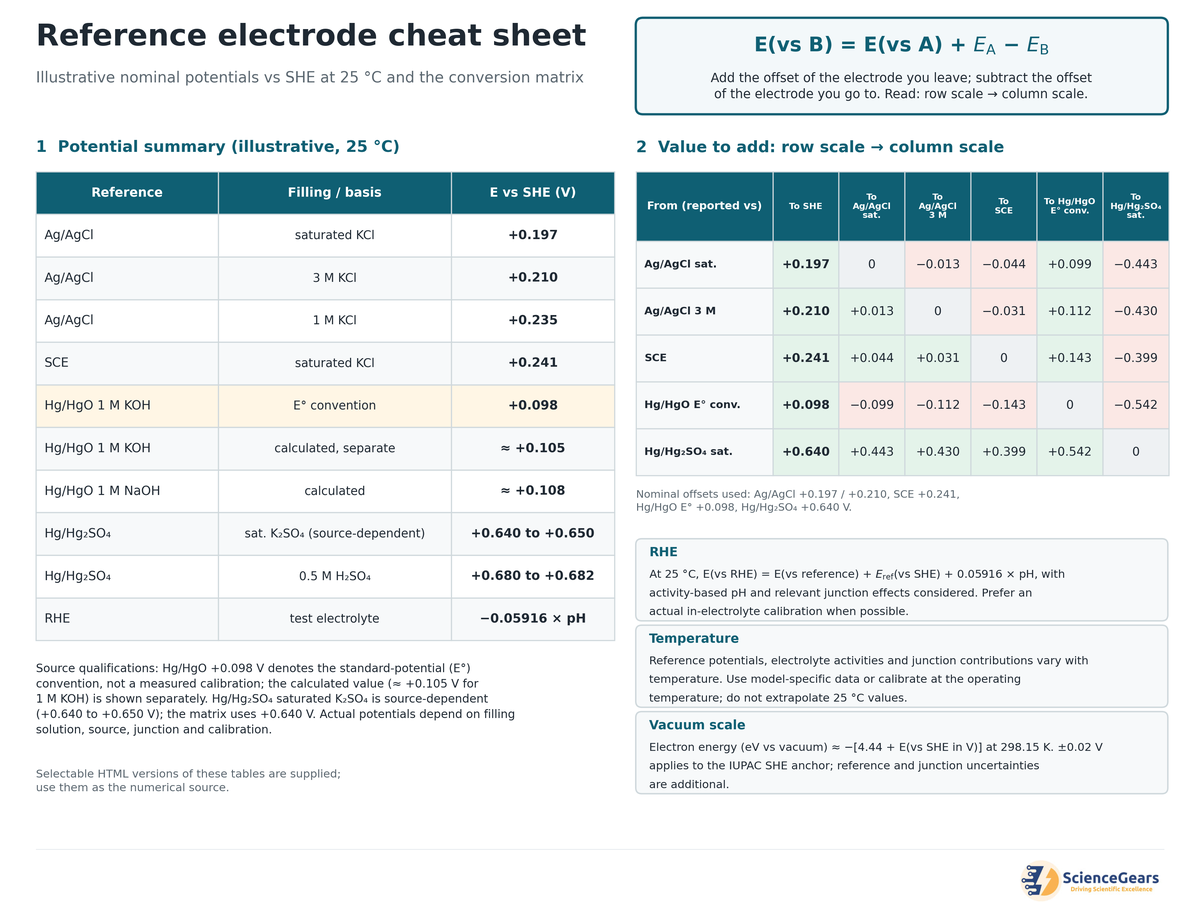
| Application | Recommended reference | Specific product | Key rationale | Key constraint |
|---|---|---|---|---|
| Routine aqueous CV and EIS | Ag/AgCl, saturated KCl | Ag/AgCl reference electrode | Common mercury-free aqueous reference; nominal +0.197 V vs SHE with saturated KCl | Chloride leakage; check model-specific storage and servicing instructions |
| Matching literature that used 3 M KCl | Ag/AgCl, 3 M KCl fill | Ag/AgCl reference electrode | Approx. +0.210 V vs SHE in this worked example (13 mV above +0.197 V) | State the fill; confirm fill at order |
| Corrosion potentials in chloride media | Ag/AgCl with Luggin capillary | Ag/AgCl reference electrode with J-type fritted Luggin capillary | Chloride tolerant, tip close to the working electrode | A Luggin positions the sensing tip; keep the ionic path wet and assess added impedance |
| Comparing with older SCE-referenced data | SCE, saturated KCl | Saturated calomel electrode | +0.241 V vs SHE, matches legacy literature | Mercury; verify model limit (many general SCEs are not rated above 50 °C) |
| Chloride-sensitive aqueous work, mercury permitted | Double salt bridge SCE | Double salt bridge saturated calomel electrode | Compatible outer bridge can reduce, not eliminate, chloride transfer | Mercury; added liquid junction and fill-compatibility requirements |
| Lead-acid half-cell potentials | Hg/Hg₂SO₄, matched fill | Hg/Hg₂SO₄ reference electrode | Approx. +0.680 to +0.682 V vs SHE for cited 0.5 M H₂SO₄ fills; no added chloride fill | Mercury; verify supplier-specific fill and temperature range |
| Corrosion in sulfate or sulfuric acid | Hg/Hg₂SO₄, saturated K₂SO₄ | Hg/Hg₂SO₄ reference electrode | Approx. +0.640 to +0.650 V vs SHE in cited saturated K₂SO₄ sources | No chloride-containing fill; prevent external chloride ingress |
| Acidic electrodeposition without chloride | Hg/Hg₂SO₄ | Hg/Hg₂SO₄ reference electrode | Avoids chloride interference with deposition | Hold temperature steady; thermal hysteresis |
| Alkaline OER and HER in KOH | Hg/HgO, matched fill | Hg/HgO reference electrode | +0.098 V is an E° convention; ~+0.105 V is an activity-based estimate for 1 M KOH | Validate in-electrolyte Hg/HgO-to-RHE offset; model and light conditions matter |
| Alkaline battery electrode studies | Hg/HgO | Hg/HgO reference electrode | Alkaline-compatible reference when the stated fill and junction are suitable | Mercury handling and disposal |
| Alkaline fuel cell half-cells | Hg/HgO | Hg/HgO reference electrode | Hydroxide-based half-reaction matches the medium | Match fill to electrolyte concentration |
| pH-swept electrocatalysis without conversions | RHE, H₂-saturated Pt | Reversible hydrogen electrode | 0 V vs RHE at every pH | Requires suitable H₂ reference system and approved safety controls |
| Organic electrolytes (outside this table's scale) | Ag/Ag⁺ | Non-aqueous Ag/Ag⁺ reference electrode | Avoids an aqueous junction | Report against ferrocene/ferrocenium |
| Microcells and screen-printed formats | Silver wire quasi-reference | Silver wire pseudo reference electrode | Compact, no filling solution | Not a true reference; calibrate internally |
| Checking a reference electrode for drift | Dedicated master reference, matched type and fill | Ag/AgCl reference electrode | Compare reference under test with an independent master under controlled conditions | Use validated acceptance criteria; do not assume a universal 5 mV threshold |
9. Frequently asked questions
How do I convert an Ag/AgCl potential to SHE?
For a nominal 25 °C conversion, add the documented Ag/AgCl-to-SHE offset: approximately +0.197 V for saturated KCl, +0.210 V for some 3 M KCl references, or +0.235 to +0.237 V for 1 M KCl, depending on the source and product. For example, +0.350 V vs Ag/AgCl (saturated KCl, using +0.197 V) gives +0.547 V vs SHE. Check the actual electrode fill and temperature; do not mix offsets from different reference designs.
Is the SCE potential +0.241 V or +0.244 V, and is it valid only at 25 °C?
Both +0.241 V and approximately +0.244 V vs SHE at 25 °C are reported for saturated-KCl SCEs in recognised compilations. This article consistently uses +0.241 V in its worked examples. Temperature changes the actual potential; do not apply an unverified constant coefficient to a different electrode or temperature. Follow the model-specific operating limit (Metrohm Autolab advises against general SCE use above 50 °C).
Which reference electrode should I use for alkaline OER and HER?
In strong aqueous alkali, a compatible Hg/HgO reference with a verified fill and in-electrolyte RHE calibration is a common choice; a suitable RHE is another option. Conventional Ag/AgCl references may be affected by strongly alkaline conditions, but suitability depends on the exact construction and junction. If mercury use is not permitted, select an approved mercury-free reference configuration and verify its stability rather than assuming a double junction automatically solves every compatibility problem.
How do I convert Hg/HgO potentials to RHE, and why does the offset change with electrolyte concentration?
At 25 °C, the nominal equation is E(vs RHE) = E(vs Hg/HgO) + E(Hg/HgO vs SHE) + 0.05916 × pH, with appropriately defined pH and junction effects. The frequently used +0.098 V is a standard-potential convention; activity-based estimates near +0.105 V for 1 M KOH are not universal measured offsets. For an illustrative +0.620 V reading, pH = 14 and +0.098 V give about +1.547 V vs RHE, or +0.318 V above the 1.229 V OER equilibrium potential before any experiment-specific corrections. A directly calibrated RHE offset is preferable for quantitative comparison. The offset changes with hydroxide composition, activities, temperature and junction conditions (Kawashima et al., 2023; Das et al., 2025).
How do I convert an electrode potential to the vacuum energy scale for band-edge or work-function comparisons?
Convert the electrode potential to SHE using the explicitly stated reference offset, then estimate electron electrochemical energy relative to vacuum using E(electron, eV) ≈ −[4.44 + E(vs SHE in V)]. The IUPAC-recommended absolute SHE reference is 4.44 ± 0.02 V at 298.15 K, and the experiment adds its own reference/junction uncertainties. For example, −0.300 V vs Ag/AgCl (saturated KCl) gives −0.103 V vs SHE and an estimated −4.34 eV vs vacuum. This arithmetic does not by itself identify a semiconductor band edge or validate a Mott–Schottky flat-band measurement.
Can I use Hg/Hg₂SO₄ instead of Ag/AgCl in sulfuric acid?
Yes, an appropriately specified Hg/Hg₂SO₄ reference is useful when chloride from a conventional Ag/AgCl filling solution would interfere. For 0.5 M H₂SO₄, approximately +0.680 to +0.682 V vs SHE at 25 °C is reported; for saturated K₂SO₄, published product and reference values include about +0.640 and +0.650 V. These are examples for particular fills and source conventions, not a universal 40 mV difference. Protect the reference from chloride ingress, verify its actual filling solution, and use only within the selected model’s temperature rating.
10. Expert support: how ScienceGears works alongside your research
A reference that reads 20 mV off rarely announces itself, and by the time a reviewer flags the discrepancy, the data are already in the paper. Dr. Siva Arumugam, who trained in electrochemistry to PhD level and has more than 20 years of international experience in electrochemistry, and the ScienceGears technical team work through these problems at the level of your electrolyte, fill and temperature.
Reference selection before you order
If you are choosing between Ag/AgCl, SCE, Hg/HgO and Hg/Hg₂SO₄ for a new electrolyte, the technical team can review your chemistry, temperature range and mercury policy before you buy, so the electrode and its fill match the experiment from the start. Talk to our technical team →
Offset calibration and conversion checks
Send the electrode type, fill, electrolyte and temperature along with the potentials you need to compare, and the team will check the conversion path and suggest a calibration routine, including RHE calibration for Hg/HgO in your own hydroxide solution.
Complete system supply
- Ag/AgCl reference electrode
- Hg/HgO reference electrode
- Hg/Hg₂SO₄ reference electrode
- Saturated calomel electrode
- Double salt bridge saturated calomel electrode
- Reversible hydrogen electrode
- J-type fritted Luggin capillary
- Reference electrodes: full range
AU/NZ availability: confirm stock and dispatch timing
ScienceGears provides technical support across Australia and New Zealand. Confirm local stock, availability and dispatch timing for the exact electrode or accessory when requesting a quotation.
"A potential is only a number until you say what it was measured against, in which solution, and at what temperature." — ScienceGears Technical Team
11. Further reading
Related guides
- How to choose the right reference electrodes: selection by aqueous, alkaline and non-aqueous system
- Reference electrode storage, refilling and maintenance: drift checks, KCl fills and junction care
- Nickel foam vs nickel mesh vs nickel plate: substrates for alkaline HER and OER
- H-cell troubleshooting: reference placement, crossover and iR drop
- How to choose the right working electrode: glassy carbon, gold, platinum and carbon formats
Related product pages: reference electrodes, potentiostats and galvanostats, corrosion test electrochemical cell, and H-cell.
Selected scientific references
(for verification; the electrode-specific datasheet takes precedence)
- Trasatti, S., "The absolute electrode potential: an explanatory note (Recommendations 1986)", Pure Appl. Chem., 1986, 58, 955–966.
- "Accurate potentials of Hg/HgO electrodes: practical parameters for reporting alkaline water electrolysis overpotentials", ACS Catalysis, 2023, DOI 10.1021/acscatal.2c05655.
- "How to reliably report the overpotential of an electrocatalyst", ACS Energy Letters, 2020, DOI 10.1021/acsenergylett.0c00321.
- Corti, H. and Fernández-Prini, R., "Behaviour of the mercury, mercuric oxide electrode in alkaline solutions in the temperature range 298–363 K", J. Chem. Soc., Faraday Trans. 1, 1982, 78, 545–554.
- Hankin, A. et al., "Flat band potential determination: avoiding the pitfalls", J. Mater. Chem. A, 2019, DOI 10.1039/C9TA09569A.
- Gritzner, G. and Kůta, J., "Recommendations on reporting electrode potentials in nonaqueous solvents", Pure Appl. Chem., 1984, 56, 461–466.
- Reference compilations: Ives, D. J. G. and Janz, G. J., Reference Electrodes: Theory and Practice, Academic Press, 1961; Sawyer, D. T., Sobkowiak, A. and Roberts, J. L., Electrochemistry for Chemists, 2nd ed., Wiley, 1995; Bard, A. J. and Faulkner, L. R., Electrochemical Methods.
Additional directly checked sources (25 October 2026): Metrohm Autolab, “Reference Electrodes and Their Usage”, AN-EC-002 (https://www.metrohm.com/content/dam/metrohm/shared/documents/application-notes/an-e/AN-EC-002.pdf); Gaskatel, “Reference Electrodes Second Kind” (https://gaskatel.com/guides/electrochemical-potential-measurement/reference-electrodes-second-kind/); Das, K., Hausmann, J. N. and Driess, M., “Toward Reliable Reference Electrode Calibration In Alkaline Solution”, ACS Energy Lett. (2025), DOI 10.1021/acsenergylett.5c01269; ASTM G3-14(2024), Standard Practice for Conventions Applicable to Electrochemical Measurements in Corrosion Testing (https://store.astm.org/g0003-14r24.html).
The values given in this guide are literature and supplier-specific reference examples. Their apparent agreement or disagreement depends on fill, temperature, and the electrode/junction arrangement. Use the original supplier/model information and an in-use calibration where needed for quantitative conclusions.
12. Get in touch
Have a set of potentials from three papers and one reviewer comment? Talk to our technical team for a conversion check, or request a quote for the reference electrode, fill, and Luggin capillary that match your electrolyte. We support researchers across Australia and New Zealand and ship internationally on request.