

Contents
- Why reference electrodes drift, and how to tell which fault you have
- Storage and refilling: what the filling solution must do
- Junction clogging, salt creep and contamination
- Double junctions: when and how to maintain them
- Non-aqueous systems: storage, refilling and calibration
- Decision matrix: matching electrode, fill and maintenance to the experiment
- Frequently asked questions
- Expert support — how ScienceGears works alongside your research
- Further reading and get in touch
1. Why reference electrodes drift, and how to tell which fault you have
Your voltammogram has the right shape, but the redox couple sits 35 mV away from where it was last month, and nothing in the cell has changed except the reference electrode that someone left on the bench over the break. Before blaming the working electrode, it helps to know that reference-electrode problems have several possible causes, and their symptoms often overlap.
What actually sets the potential. For the Ag/AgCl couple, the potential is set by the activity of chloride in the filling solution through the Nernst relationship: E = E° − 0.059 log a(Cl⁻) at 25 °C, with E° of +0.222 V vs SHE. For a saturated-KCl Ag/AgCl reference at 25 °C, a commonly quoted nominal potential is approximately +0.197 V versus SHE; the exact value depends on chloride activity, temperature and the particular reference construction. A tenfold change in chloride activity therefore moves the potential by about 59 mV. This is why a filling solution that has been diluted by back-diffusion, topped up at the wrong concentration, or concentrated by evaporation is the first thing to suspect.
The six faults worth knowing. These are common possibilities, not ranked by measured prevalence:
- Changed chloride activity. The filling solution has been diluted, has evaporated, or has been refilled with a different concentration. Expect a stable but offset reading.
- Partly blocked junction. Silver chloride, silver sulfide, salt crystals or organic films restrict the flow through the frit. Expect noise, slow response and an unstable liquid junction potential.
- Bubble or dry frit. An air gap breaks the ionic path, either completely (the signal disappears or jumps) or partially (noise that changes when you tap the electrode).
- Contaminated half-cell. Sulfide or other species that react with silver have reached the Ag/AgCl element. Expect a steady creep that does not recover after refilling.
- Worn or light-damaged AgCl layer. The chloride coating has thinned or been photochemically reduced. ScienceGears advises keeping Ag/AgCl electrodes away from light for this reason. Expect an offset that survives a fresh fill.
- Temperature. The electrode has a genuine temperature coefficient, and in a saturated electrode the solubility of KCl adds a second, indirect term. Both saturated and unsaturated fills have temperature-dependent potentials, and measured values may also contain temperature-dependent junction contributions. The response depends on the electrode construction and electrolyte composition. Published coefficient values vary with electrode design, so measure it in your own setup if your work needs sub-millivolt accuracy.
An initial comparison check at the bench. Keep one electrode of the same type and fill as a master: stored sealed in its filling solution, used only for checking other electrodes, and never placed in a sample. Then:
- Pour fresh KCl at the same concentration as the electrode's fill into a clean beaker. Use a 3 M fill for a 3 M electrode and a saturated solution for a saturated one.
- Place the suspect electrode and the master in the beaker with the junctions close together and not touching.
- Measure the potential difference with a suitable high-input-impedance voltmeter. If using a potentiostat, follow the manufacturer’s documented open-circuit measurement and lead-connection procedure for comparing two reference electrodes.
- After allowing the electrode potentials to stabilise, record the difference and repeat the reading to assess drift; a 5- and 10-minute check is illustrative, not a universal equilibration requirement.
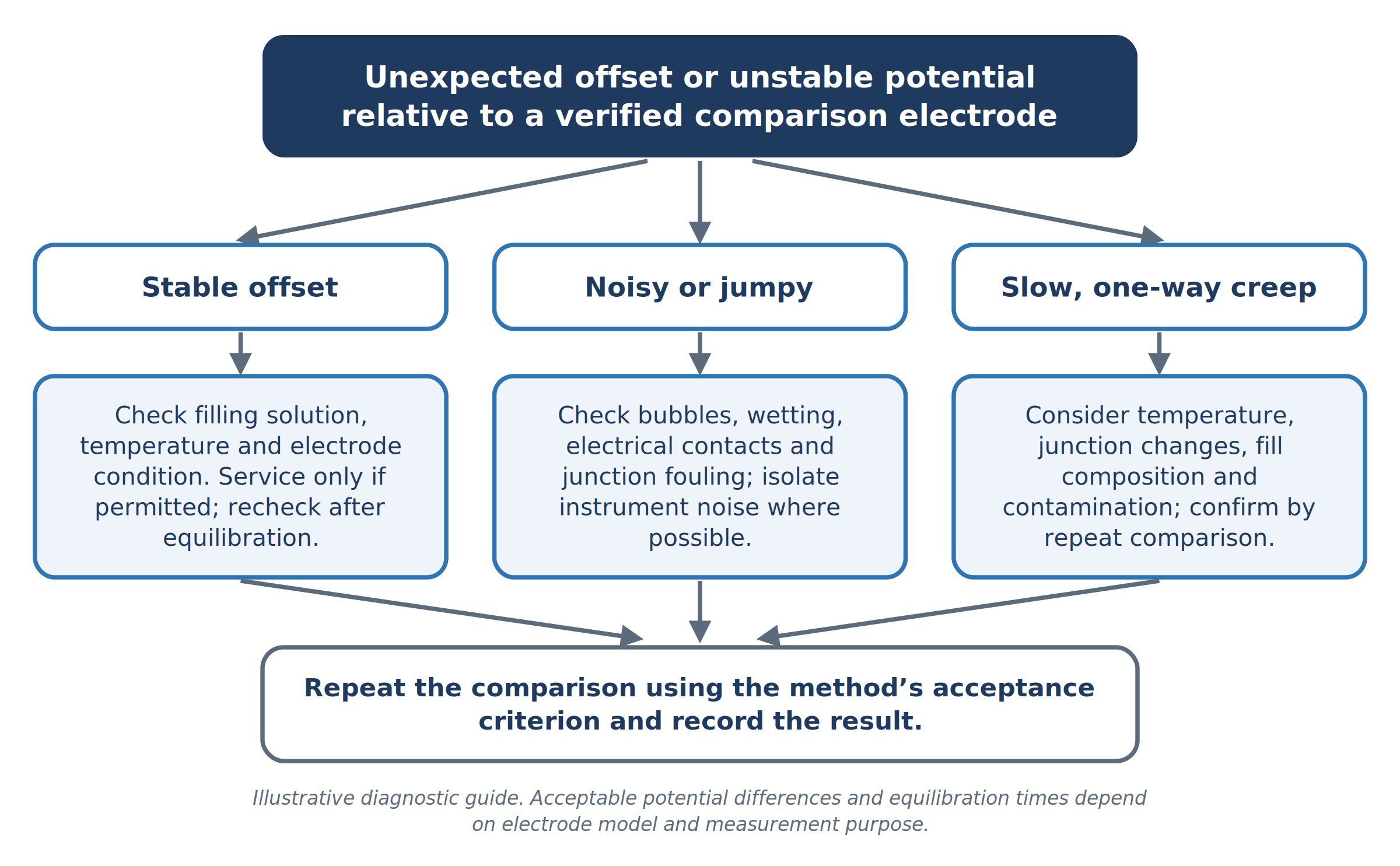
Compare the potential difference and its stability with an acceptance criterion appropriate to the electrode model, temperature, test conditions and required measurement accuracy. A persistent or changing offset warrants further investigation. The patterns below are diagnostic clues, not definitive fault identifications:
- Stable, constant offset. Suspect the fill concentration (fault 1) or the AgCl layer (fault 5). If the electrode is refillable, use the specified filling solution, allow it to equilibrate, and recheck. Otherwise seek the manufacturer’s replacement guidance.
- Noisy or jumping reading, sensitive to tapping. Suspect a bubble or a partly blocked junction (faults 2 and 3).
- Slow, one-directional creep. Suspect contamination or ongoing dilution (faults 1 and 4).
- Offset that changes when you stir or move the electrode. Changes in liquid-junction conditions or contamination may be involved; investigate bubbles, junction condition and measurement geometry.
Junction potentials are part of the story. At the frit, the filling solution meets the sample, and a diffusion potential develops because ions move at different speeds. Saturated or near-saturated KCl is the standard bridge for aqueous work because the K⁺ and Cl⁻ ions move at nearly the same speed, which keeps this potential small. A blocked or fouled junction makes it larger and less stable. A changing liquid-junction potential is one possible contributor to apparent drift and should be considered alongside changes in the reference half-cell, temperature and experimental setup.
The ScienceGears Ag/AgCl reference electrode is a refillable, fritted-junction design, and its product page advises regular verification against a standard electrode. That advice is exactly the master-electrode check above. A second Ag/AgCl electrode with the same fill, kept for no other purpose, costs far less than a week of unreliable data. For a wider comparison of electrode types before you decide what to keep as a master, see How to choose the right reference electrodes.
2. Storage and refilling: what the filling solution must do
A reference electrode that spent the summer shutdown dry in a drawer is the classic "dead" electrode of a shared laboratory, and the problem may be recoverable, but this depends on the electrode design and the cause of failure. A dried junction, evaporated electrolyte or internal damage requires different actions.
What the filling solution has to do. For refillable Ag/AgCl designs, the key considerations are the correct chloride activity, compatibility with the silver/silver-chloride element and the intended junction behaviour.
- Fix the chloride activity. The concentration you choose sets the electrode potential. At 25 °C, an Ag/AgCl electrode with saturated KCl is commonly tabulated at approximately +0.197 V versus SHE. Other KCl filling concentrations produce different reference potentials: check the electrode manufacturer’s value for the exact composition, and distinguish mol/L from mol/kg in tabulated data. The ScienceGears Ag/AgCl page confirms compatibility with saturated, 3 M and 1 M KCl. Use only a filling solution approved for the exact electrode model, record its composition and temperature, and report the corresponding reference scale. Do not change the fill to match a literature value unless the manufacturer supports that configuration and the electrode is requalified.
- Protect the Ag/AgCl equilibrium. Silver-containing chloride complexes can form in concentrated chloride electrolytes, but different reference-electrode designs specify different internal filling solutions. Use AgCl-containing KCl only where prescribed for the exact model; do not assume that every Ag/AgCl reference requires manually adding AgCl to the refill.
- Maintain the prescribed KCl concentration. Some saturated-KCl electrodes are designed with a solid KCl reservoir to help maintain saturation, but other reference bodies and junctions are not intended to contain crystals. If the solid KCl reservoir is depleted, saturation may no longer be maintained as temperature, evaporation or solution composition changes; inspect and service the electrode as directed by its manufacturer.
A practical note on the choice between saturated and unsaturated fills: an unsaturated KCl fill can reduce crystallisation risk relative to a saturated fill, but sufficiently concentrated solutions may still crystallise on cooling, and the reference potential remains temperature-dependent. Both saturated and unsaturated fills have temperature-dependent behaviour; the appropriate choice depends on the reference design, operating temperature and desired potential scale. For temperature-cycled or sub-ambient experiments, use a reference design and filling solution approved for the expected temperature range; a lower-concentration fill may be needed.
Storage rules that prevent most "dead" electrodes
- Never store the electrode dry. The ScienceGears Ag/AgCl page states it plainly: "Do not store the electrode dry." For the ScienceGears aqueous Ag/AgCl product, use the recommended KCl storage solution. Confirm the model-specific storage concentration and cap arrangement: some manufacturers recommend a slightly less concentrated external storage solution to limit frit crystallisation.
- For short-term storage, keep the junction wet in the specified storage cap or solution and limit evaporation; use the manufacturer’s guidance for external storage concentration.
- For long-term storage, use the manufacturer-approved cap, solution, port setting and temperature range. Protect light-sensitive Ag/AgCl elements from unnecessary strong illumination.
- Do not store it in deionised water or in the sample electrolyte. Chloride leaches out of the junction while sample ions diffuse in, and the electrode will wander for hours when you return it to service.
- For refillable designs requiring outward junction flow, use the fill-port setting and internal electrolyte height specified by the manufacturer. Some sealed or low-flow reference electrodes operate differently.
- Keep it out of strong light. Silver chloride is photosensitive, and ScienceGears advises avoiding exposure for this reason.
Refilling step by step
These are general checkpoints for user-refillable aqueous Ag/AgCl electrodes, not a universal manufacturer procedure. If the exact electrode model, filling solution and serviceable components have not been confirmed, do not open or refill it; consult its supplier first.
- Rinse the outside of the electrode with deionised water and blot it dry, keeping water away from the fill port.
- Remove the fill-port cap and draw out the old solution with a clean pipette or syringe with a long tip. Do not tip the solution out through the junction.
- If the model permits chamber flushing, rinse as directed by its service procedure using the correct replacement electrolyte and discard the rinses safely.
- Refill with the manufacturer-specified KCl or KCl/AgCl solution, to the permitted level for that reference design. The ScienceGears product guidance is that the internal level must stay above the level of the test electrolyte to avoid back-diffusion.
- For a saturated-KCl electrode designed to contain excess solid salt, inspect and replenish its KCl reservoir as directed by the manufacturer. Do not introduce crystals into a design that does not permit them.
- Tap gently to release bubbles, check that the element is fully immersed, and confirm that the junction wets.
- Allow the reference and junction to equilibrate in the recommended solution for the period specified by its manufacturer, then verify a stable potential against a suitable laboratory reference. A dried, damaged or contaminated frit may not recover and may require replacement.
- Check against the master electrode as described in section 1.
Never top up with a different concentration. Replace the solution fully, so you know what is inside.
When refilling is not enough. If the offset persists after a fresh fill and a proper soak, suspect the AgCl layer. For sealed commercial electrodes, replacement is the practical answer. Re-chloriding a silver element is a specialised refurbishment procedure that should be undertaken only if the electrode manufacturer permits user servicing and provides a validated protocol. Otherwise, replace the element or electrode and verify the replacement before use. Do not polish an Ag/AgCl-coated element unless the manufacturer explicitly permits refurbishment; polishing can remove its active AgCl layer.
Saturated calomel electrodes require their own mercury-compatible service procedures, rather than the Ag/AgCl refurbishment steps above. The ScienceGears saturated calomel electrode uses saturated KCl and is described as refillable. Some refillable SCE designs maintain an excess KCl reservoir, while storage and junction-cleaning instructions depend on the model. Follow the actual supplier service guidance before opening the device, adding crystals or attempting maintenance. The electrode contains mercury, so handle and dispose of it according to local hazardous waste regulations.
Reference electrodes reward the same habits as working electrodes: consistent cleaning, honest records and a quick check before each campaign. If you maintain your own working electrodes, the discipline is described in How to polish and maintain glassy carbon, gold and platinum electrodes. Add the reference electrode check to the same routine.
3. Junction clogging, salt creep and contamination
The trace has gone noisy, the potentiostat is warning about compliance on a perfectly healthy cell, and the tip of the reference electrode has turned grey. These are the classic symptoms of a junction that is no longer doing its job.
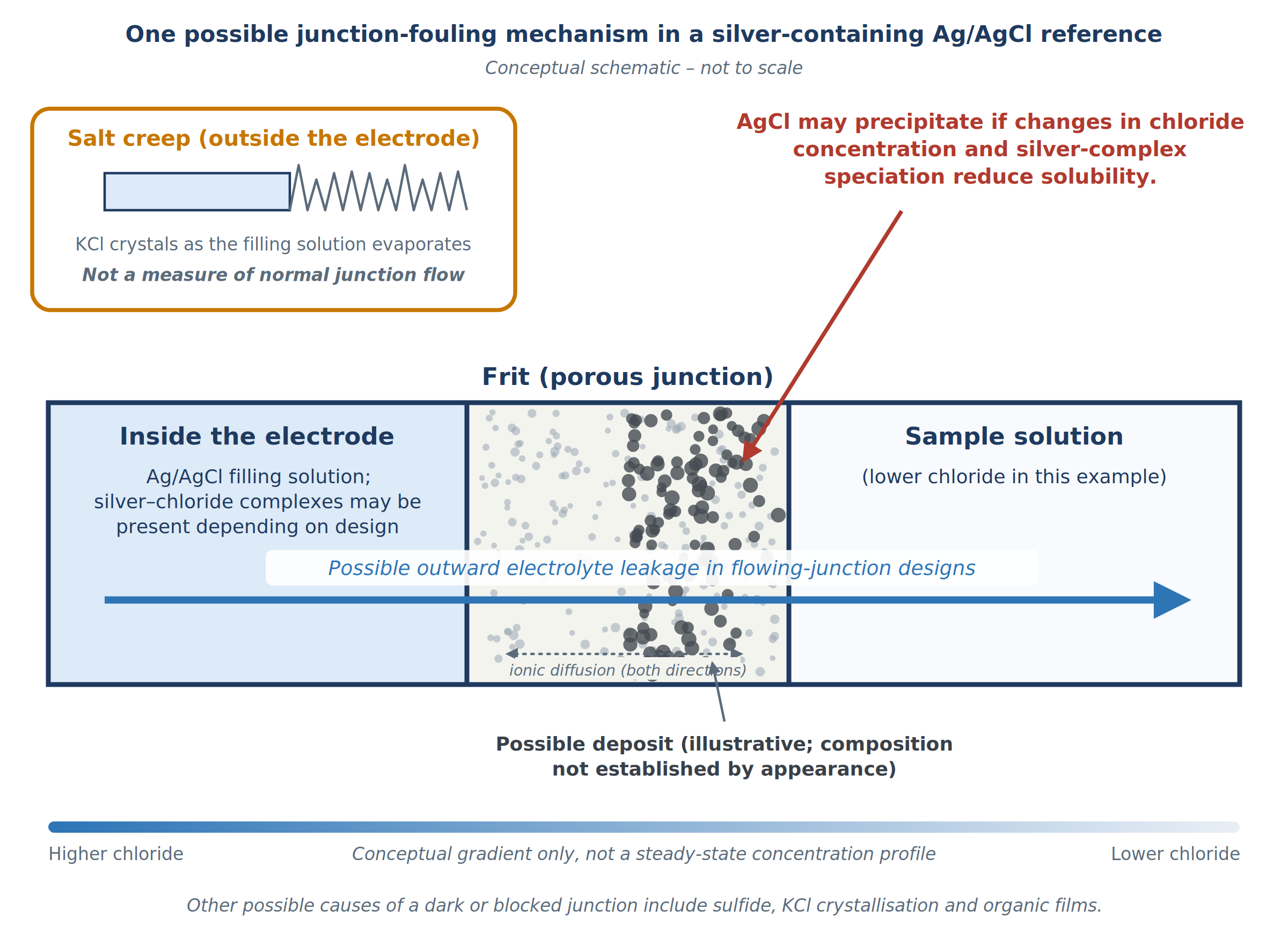
Why junctions clog. The junction is a deliberate leak. It lets ions move between the filling solution and the sample, and a slow outward flow keeps the sample from creeping into the electrode. Published technical literature describes the weak point of the Ag/AgCl design: some Ag/AgCl filling solutions contain dissolved silver–chloride complexes. When these encounter a lower-chloride environment, altered speciation and solubility can favour AgCl precipitation under suitable conditions. This is one possible mechanism of fouling, not an inevitable outcome of dilution; sulfides, salt crystallisation and organic films are other possible causes. A dark or discoloured frit does not, by itself, identify the deposit. Junction blockage may increase impedance and destabilise measurements.
Salt creep is a different problem. Salt creep is KCl crystallising on the outside of the electrode as the saturated solution evaporates through the junction. External crystals may simply reflect evaporation of leaked electrolyte, but their appearance does not confirm a normal junction flow rate. Check the fill level and inspect for obstruction. It becomes a fault when crystals block the fill port, bridge across to the outer surface and create a stray conducting path, or form inside the junction when the laboratory cools. A saturated fill left in a cold room is the usual culprit.
Work out what you have before you treat it
- Look at it. Check for bubbles near the frit, a grey or black deposit on the junction (silver salts), white crystals on the outside (salt creep), and a cloudy or discoloured fill.
- Check the impedance. If your instrument supports reference-electrode impedance diagnostics, follow its documented electrode wiring, electrolyte, measurement settings and interpretation method. An elevated result can indicate increased junction resistance but may also include solution or bridge resistance; compare against an appropriate baseline. The ScienceGears double salt bridge SCE guidance says: "Replace frits or clean the junction when impedance rises."
- Check the flow. If the design allows it, monitor the junction drop rate. A fall in flow is an early sign of clogging, and ScienceGears recommends this check for the double salt bridge SCE.
Treatments, from gentlest to most drastic
- Bubble. Remove the electrode from the cell, tap the body gently, and re-immerse it in its filling solution until the frit wets. Do not poke the frit with wire.
- Salt crystals. Rinse the outside with deionised water. If crystals appear to obstruct the junction, follow the manufacturer-approved rehydration or cleaning method for the particular frit and electrode. Confirm the permitted cleaning solution, temperature and equilibration period before returning it to service.
- Silver chloride deposit. For a suspected AgCl deposit, follow the manufacturer-approved cleaning or frit-replacement procedure; chloride-dependent silver complexation does not justify a universal soaking time or solution. Do not use ammonia or other reactive cleaning agents on a silver-containing reference-electrode junction unless the electrode manufacturer explicitly approves the procedure and the laboratory has completed an appropriate chemical risk assessment. If the recommended electrolyte soak does not restore performance, follow the manufacturer-approved frit-cleaning or replacement procedure.
- Organic film. Use an electrode-compatible solvent-cleaning method only where the manufacturer permits it, followed by the specified rinsing, conditioning and performance check.
- Replace the frit if the design allows it. The ScienceGears double salt bridge SCE is described as having easily serviceable frits. For sealed electrodes, replacing the electrode is cheaper than weeks of unreliable measurements.
After any treatment, re-equilibrate and run the master check from section 1 before using the electrode.
Contamination runs in both directions. A leaking Ag/AgCl electrode puts chloride and, through soluble silver chloro-complexes, silver into your cell. Published teaching literature notes that these complexes can reach the analyte over time and deposit silver on the working electrode. If you see unexplained extra waves, or a working electrode that behaves differently after a long run, check what has leaked from the reference. The ScienceGears Ag/AgCl page itself points out that these electrodes are unsuitable for chloride-sensitive systems, such as certain plating baths or chloride-free redox mediators. Section 4 covers the fix.
Prevention beats treatment
- Keep the filling solution level above the sample level so the net flow is outward.
- Rinse the junction with deionised water before and after each measurement. The ScienceGears reference electrode guidance puts it this way: "Keep frits clean to avoid clogging; replace salt bridges periodically."
- Do not leave an electrode standing in sample between runs.
- For repeated fouling or ion-contamination concerns, consider an appropriate double-junction or isolation-bridge design after checking its chemical compatibility and added impedance.
A word on Luggin capillaries. ScienceGears lists a J-type fritted Luggin capillary for reference electrode placement. Placing the tip close to the working electrode reduces the uncompensated resistance in the measurement, while the reference-electrode body can remain outside the bulk sample; the solutions remain ionically connected and some crossover may still occur. The trade-off is that the capillary and its frit are a second junction you must keep wet, bubble-free and filled. Treat it as a maintenance item, not a fitting.
Cell geometry affects all of this, because the placement of the reference, the volume of the cell and the way gas is handled all influence how fast a junction fouls. For a systematic view of cell formats, see the Electrochemical cell selection guide.
4. Double junctions: when and how to maintain them
You are running a reaction that cannot tolerate chloride, perhaps a silver-containing electrolyte, a halide-free redox mediator or a plating bath, and a conventional Ag/AgCl electrode keeps seeding the cell with chloride however carefully you rinse it. Or you are running a long experiment in a fouling-prone electrolyte, and the junction has blocked again. This is what double junctions are for.
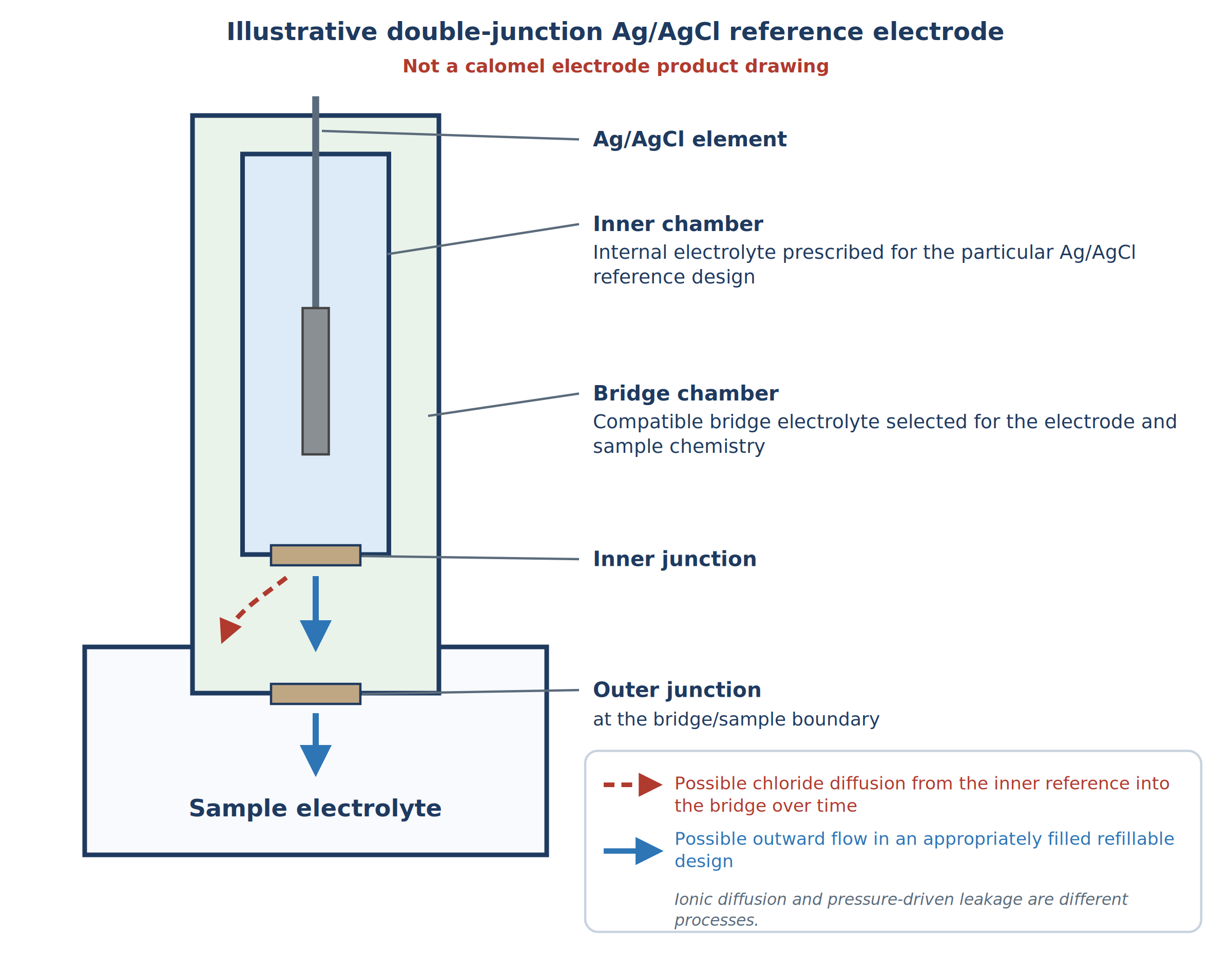
How a double junction works. The reference half-cell sits in its own chamber behind an inner junction. Outside that is a second chamber, the bridge, filled with an electrolyte you choose, and an outer junction connects the bridge to the sample. Chloride and silver have to cross two barriers, and the sample has to cross two barriers in the other direction, so contamination in both directions is reduced.
Choosing the bridge electrolyte. The bridge solution must be compatible with your chemistry and should have cations and anions that move at similar speeds, so the junction potential stays small. Compatible bridge electrolytes, including KNO₃ in some systems, are selected according to the sample chemistry and electrode design. Their concentration must follow a validated procedure; sulfate-based bridges are suitable only when the sample and reference system are compatible. In some systems, using a compatible supporting electrolyte as the bridge can limit the introduction of additional ions, but junction potential, conductivity and reference compatibility still require evaluation. Whatever you choose, record it in your methods section.
The trade-off. Two junctions mean two liquid junction potentials and a higher impedance. The ScienceGears double salt bridge SCE page says so explicitly, noting that the design introduces a second junction potential in return for reduced contamination. Do not choose a double junction by reflex. Choose it when contamination or fouling is a measurable problem.
Maintaining the bridge
- Refresh it regularly. Chloride diffuses outward through the inner junction into the bridge over time, so the bridge is slowly contaminated. Replace or refresh the bridge on a schedule appropriate to its design, contamination risk and laboratory method.
- Test it for chloride. Where chloride ingress must be monitored, use an appropriate validated assay for the bridge-electrolyte matrix or replace the bridge at a defined maintenance interval. Silver nitrate turbidity alone cannot establish chloride contamination in an unknown matrix. Renew the bridge if contamination is confirmed or if performance indicates deterioration.
- Keep both chambers filled. The ScienceGears guidance for its double salt bridge SCE is to keep both bridges filled with the recommended electrolytes.
- Know what you can refill. In some commercial designs the inner chamber is sealed and cannot be refilled. Supplier literature for such designs notes that irreversible changes at the inner junction cause a slow drift, and recommends periodic comparison with a laboratory master, especially where repeatability requirements are stringent. Check your electrode's design before assuming you can restore it.
- Maintain the outer junction. Treat it exactly like the single junction in section 3.
Building your own double junction. If you already own a single-junction electrode and need a short-term chloride barrier, a properly designed and compatible isolation bridge may reduce direct crossover. Fill the tube with your chosen bridge electrolyte, make sure the tip of the isolation tube is wetted and bubble-free, and treat the isolation tube as a maintained part. A suitably configured fritted bridge may also position the sensing point near the working electrode; a simple open-tip Luggin capillary alone does not provide equivalent isolation.
Contamination from the other side of the cell. The reference electrode is not the only source of contamination in a cell. A counter electrode that dissolves or deposits can foul a reference junction, and a separate compartment is often the better answer. The H-cell range is one option, and the guide to selecting a counter electrode explains how counter electrode choice affects contamination.
Where ScienceGears fits. The double salt bridge saturated calomel electrode is a double-junction design whose second salt bridge limits ion crossover. ScienceGears lists a nominal SCE potential of approximately +0.244 V versus NHE at 25 °C for this product; the exact potential and referencing conditions should be checked against its supplier documentation, and describes it as suited to low-chloride and fouling-prone systems. As with any SCE, it contains mercury and needs appropriate handling and disposal. For a mercury-free route, the ScienceGears Ag/AgCl page points to a double-junction version of Ag/AgCl for chloride-sensitive work. Ask the technical team about double-junction Ag/AgCl configurations when you request a quote, so the bridge chamber and fill match your electrolyte.
5. Non-aqueous systems: storage, refilling and calibration
A reference potential that creeps during a single acetonitrile experiment, a frit that whitens with precipitate, or a half-wave potential you cannot reproduce next week: all three are signs that an aqueous electrode has been pushed into an environment it was not designed for.
Why aqueous references struggle in organic solvents. Published supplier literature and teaching sources make the same points. Direct contact between an aqueous reference junction and an organic electrolyte can introduce water and ions, cause precipitation where salts are poorly soluble, and produce significant or poorly reproducible liquid-junction potentials. A carefully designed salt bridge can sometimes be used, but the junction and reference-scale limitations must be reported. Comparisons across solvents require an appropriate common redox reference rather than an unqualified conversion.
What a non-aqueous Ag/Ag⁺ electrode is. A silver element sits in a solution of Ag⁺, usually silver nitrate, dissolved in the same solvent as the cell, with a supporting electrolyte for conductivity. The ScienceGears non-aqueous Ag/Ag⁺ reference electrode is an Ag/AgNO₃ design for organic electrochemistry. Its product page describes typical filling-solution practice: AgNO₃ at 0.01–0.1 mol/L, with a supporting electrolyte such as tetrabutylammonium hexafluorophosphate at around 0.1 mol/L, chosen to suit the electrolyte in your cell. The Ag/Ag⁺ equilibrium potential depends on silver-ion activity in the chosen solvent and electrolyte; the supporting electrolyte contributes conductivity, while junction stability depends on the complete electrode/solution configuration.
Preparing and refilling
- Match the solvent and supporting electrolyte to those in your cell. Control water content to the level required by the experiment; use dry solvent for moisture-sensitive systems and confirm compatibility with the reference assembly.
- Prepare or obtain only the manufacturer-specified silver-ion filling solution (AgNO₃ or another approved salt, concentration, solvent and supporting electrolyte). Protect photosensitive silver-containing solutions from unnecessary light exposure and follow laboratory chemical-safety procedures.
- Clean the silver wire. Where the manufacturer permits access to the Ag/Ag⁺ element, follow its specified surface preparation and rinsing procedure. Do not polish sealed or non-serviceable electrodes.
- Rinse or condition the body and junction only with manufacturer-approved compatible solvents, then fill or assemble as instructed. Confirm a continuous ionic path without trapped bubbles.
- Allow the reference potential and junction to stabilise according to the manufacturer’s protocol and verify the chosen potential reference before measurement.
Storage
- Use the approved storage vessel, solvent and fill condition for the specific non-aqueous reference; protect photosensitive solutions from light and minimise solvent evaporation.
- Never store it in aqueous KCl or any aqueous solution, and never move an electrode that has been in water into a non-aqueous cell.
- Do not change solvents without checking the approved wettability, seal and frit compatibility; if solvent conversion is supported, follow the manufacturer’s validated rinse, refill and re-equilibration sequence.
- Replace the filling solution on a routine schedule, and sooner if it discolours, becomes cloudy, or if the potential relative to ferrocene wanders. Published work on non-aqueous references notes that water ingress shifts the potential, and the ScienceGears page lists slight drift from moisture as a limitation. Where water contamination is critical, a compatible double-junction or isolation-bridge arrangement may reduce transfer, but does not guarantee complete isolation.
Reference non-aqueous electrode potentials to an appropriate internal or external redox standard, commonly Fc/Fc⁺, under stated electrolyte conditions. The Ag/Ag⁺ potential depends on solvent, silver-ion activity and supporting electrolyte composition. Add ferrocene directly to the measurement solution only when it will not interfere with the analyte or reaction; otherwise use a separate compatible measurement. IUPAC recommended the ferrocene/ferrocenium couple (Fc/Fc⁺) for this purpose in 1984, and the ScienceGears product page recommends reporting against it for "inter-laboratory comparability". A practical routine:
- After obtaining the principal experimental data, determine the Fc/Fc⁺ potential using a compatible solution under matched conditions. Depending on analyte stability and interference, this may use a separate electrolyte solution or an aliquot; choose the concentration and supporting electrolyte from a validated method.
- Record a cyclic voltammogram of Fc/Fc⁺ using a suitable scan rate and potential window, and evaluate whether the response is sufficiently reversible and well resolved for potential referencing.
- For a well-resolved, sufficiently reversible Fc/Fc⁺ response, estimate the midpoint as E½ ≈ (Epa + Epc)/2. If the peaks are distorted by kinetics, uncompensated resistance or other processes, use an appropriate validated referencing approach.
- Report every potential as E vs Fc/Fc⁺ = E vs Ag/Ag⁺ − E½(Fc/Fc⁺), using an internal standard or a validated external measurement under matched conditions; document the reference assembly, electrolyte and standard procedure.
If you have two Ag/Ag⁺ electrodes with identical fills, comparing them in a fresh portion of cell electrolyte is the non-aqueous equivalent of the master check in section 1. A persistent offset or unstable difference warrants checking reference construction, silver-ion activity, junction condition and the measurement method; acceptance limits depend on the experiment.
Choosing between a true Ag/Ag⁺ electrode and a wire. If you are sceptical about maintaining a filled electrode, remember that a bare silver wire is often used as a quasi-reference electrode with ferrocene as the internal standard. The quasi-reference potential is not intrinsically well defined, so a suitable redox standard and stability checks are important. A dedicated Ag/Ag⁺ reference can be advantageous when its solvent, junction chemistry and stability are compatible with the experiment, but it is not automatically superior in every system.
Where to go for the choice itself. The guide to choosing the right reference electrodes covers when non-aqueous Ag/Ag⁺ is the right option and how it compares with the other types.
Related but outside scope
Three adjacent items are deliberately left out of the main body of this guide. Quasi-reference electrodes such as a bare silver or platinum wire are not true references, because their potential is not buffered by a fixed redox equilibrium. ScienceGears lists a silver wire pseudo reference electrode for such work. The reversible hydrogen electrode has no filling solution and a different maintenance profile, and it is listed on the reversible hydrogen electrode page. pH glass electrodes have their own storage and conditioning rules and are not covered here.
6. Decision matrix: matching electrode, fill and maintenance to the experiment
Use this matrix when you need to choose an electrode and a maintenance routine quickly. Where the constraint column says "master check", it refers to the procedure in section 1.
| Application | Recommended electrode and fill | Specific product | Key rationale | Key constraint |
|---|---|---|---|---|
| Routine aqueous voltammetry and teaching laboratories | Single-junction Ag/AgCl with manufacturer-prescribed KCl filling solution | Ag/AgCl reference electrode | Mercury-free, refillable, approximately +0.197 V vs SHE in saturated KCl | Leaks chloride; keep fill level above the sample and store wet |
| Corrosion potential measurements in chloride-containing media | Ag/AgCl, saturated or 3 M KCl, with a Luggin capillary | Ag/AgCl reference electrode with J-type fritted Luggin capillary | Chloride-tolerant, and the capillary places the tip close to the working electrode | Maintain the additional Luggin electrolyte path; check for trapped gas |
| Reproducing literature that used 3 M or 1 M KCl | Ag/AgCl with a manufacturer-approved fill and a verified reference scale | Ag/AgCl reference electrode | The product page lists 3 M and 1 M fills; the potential differs by several millivolts from saturated | Report filling solution and temperature; use documented potential conversion when necessary |
| Temperature-cycled or sub-ambient experiments | Ag/AgCl with a fill approved for the lowest intended temperature | Ag/AgCl reference electrode | Lower crystallisation risk than saturated KCl at some temperatures; verify the fill and working-temperature range | Potential differs from saturated; calibrate at working temperature |
| Chloride-sensitive electrolytes (silver-containing, halide-free mediators, some plating baths) | Double-junction Ag/AgCl with an application-compatible bridge electrolyte | Ag/AgCl reference electrode, double-junction configuration to be confirmed with the technical team | A compatible bridge reduces, but does not eliminate, chloride crossover into the cell | Extra junction potential; check whether the inner chamber is refillable |
| Chloride-sensitive or fouling-prone aqueous media where mercury use is permitted | Double salt bridge SCE | Double salt bridge saturated calomel electrode | Second bridge can reduce ion crossover and some fouling risks; serviceability depends on model | Contains mercury; extra junction potential |
| Comparing with historical SCE-referenced data | SCE with saturated KCl | Saturated calomel electrode | Classic reference at approximately +0.24 V vs SHE | Mercury handling and disposal; keep solid KCl present |
| Non-aqueous voltammetry in acetonitrile or propylene carbonate | Ag/Ag⁺ with approved silver-ion fill, solvent and compatible supporting electrolyte | Non-aqueous Ag/Ag⁺ reference electrode | Compatible non-aqueous solutions avoid an aqueous/organic interface, although a liquid-junction potential may still arise | Verify reference scale against a suitable standard under matched conditions |
| Battery electrode studies in organic electrolytes | Chemistry-specific reference electrode, selected and checked for the actual cell | Reference-electrode range — selection depends on battery chemistry | For lithium-ion cells, the required Li/Li⁺ potential scale and reference stability must be assessed; other batteries need their own appropriate scale | Check electrolyte and separator compatibility, reference stability and relevant electrochemical scale |
| Nonaqueous experiments requiring control of water content | Ag/Ag⁺ in dry solvent, sealed storage | Non-aqueous Ag/Ag⁺ reference electrode | Appropriate dry-electrolyte handling can reduce moisture-related potential shifts | Replace the fill when it discolours or drifts |
| Checking Ag/AgCl electrodes for drift | A dedicated master Ag/AgCl with the same fill, kept in storage solution | Ag/AgCl reference electrode | Provides a like-for-like comparison of potential stability | Never use the master in samples; master check |
7. Frequently asked questions
How should I store an Ag/AgCl reference electrode, and for how long can it sit unused?
Keep the junction submerged in KCl of the same concentration as the internal fill, with the fill port closed, in the dark, at a steady temperature. Never store it dry, in deionised water, or in sample. Storage life, filling-solution replacement and reconditioning depend on the electrode model, container seal and laboratory conditions. Inspect the electrode after extended storage and verify potential stability before use; refill or replace it according to manufacturer guidance.
How do I know whether my reference electrode has drifted, and how much drift is acceptable?
Compare it with a dedicated master electrode of the same type and fill in a fresh beaker of KCl at the same concentration, and record the difference after 5 and 10 minutes. Assess both the offset and its stability against the electrode manufacturer’s guidance or a validated laboratory acceptance criterion appropriate to the required potential accuracy. Investigate persistent or changing differences before relying on the electrode for quantitative work.
Can I unclog a blocked reference electrode frit?
Often, yes. Some blocked frits can be recovered, but the correct cleaning solution, temperature and solvent compatibility depend on their construction. Use the manufacturer-approved method, then recondition and compare with a verified reference; replace a damaged or persistently high-impedance frit when serviceable. For repeat fouling, consider a compatible double-junction system.
What is a double-junction reference electrode, and what should I use as the bridge electrolyte?
It has two chambers and two junctions: the reference half-cell sits behind an inner junction, and a bridge electrolyte sits between that and the sample. Contamination in both directions is reduced. Choose a bridge electrolyte whose ions move at similar speeds and do not interfere with your chemistry. KNO₃ or other bridge salts can be suitable in specific systems, but the choice must consider sample reactions, the reference element, solubility, junction potential and conductivity. Where chloride monitoring is required, use a matrix-appropriate analytical check rather than identifying chloride from a silver-nitrate precipitate alone.
Can I use an aqueous Ag/AgCl electrode in acetonitrile or another organic solvent?
Direct immersion of an aqueous Ag/AgCl junction into an organic electrolyte can introduce water or chloride and produce problematic liquid-junction potentials; some salt-bridge arrangements are feasible when validated. A compatible non-aqueous reference system and reporting relative to a suitable redox standard such as Fc/Fc⁺ generally improve comparability. Do not transfer electrodes between solvent systems without confirming that their construction and service instructions permit it.
How often should I replace the filling solution?
There is no single interval, because it depends on use. Follow the maintenance interval for the specific reference electrode and use frequency, electrolyte exposure and performance checks to decide when to replenish or replace its filling solution. Refill sooner if the electrolyte is contaminated or the reference potential becomes unstable, using a compatible approved solution. Record the date of every refill on the electrode body, because a "when was this last filled?" question usually answers itself.
8. Expert support: how ScienceGears works alongside your research
Reference electrode faults rarely announce themselves clearly, and the cheapest fix is usually found by someone who has already seen the same symptom. Dr. Siva Arumugam, who trained in electrochemistry to PhD level, and the ScienceGears technical team can talk through your drift, noise or contamination problem in the context of your cell, your electrolyte and your potentiostat, rather than in the abstract.
Electrode selection before you order
If you are choosing between a single junction, a double junction and a non-aqueous design, the technical team can review your electrolyte, solvent, temperature range and tolerance for chloride before you buy, so the electrode and its maintenance routine match the experiment from day one.Talk to our technical team →
Drift and contamination diagnosis
If you have inherited an electrode that no longer behaves, describe the symptom, the fill and the history, and the team can help you work out whether it needs a fresh fill, a junction clean, a new bridge solution or replacement, using the same triage as section 1.
Complete system supply
- Ag/AgCl reference electrode
- Double salt bridge saturated calomel electrode
- Saturated calomel electrode
- Non-aqueous Ag/Ag⁺ reference electrode
- J-type fritted Luggin capillary
- Silver wire pseudo reference electrode
- Reference electrodes: full range
AU/NZ availability — confirm stock and dispatch timing
ScienceGears provides technical support across Australia and New Zealand. Confirm local stock, availability and dispatch timing for the exact electrode or accessory when requesting a quotation.
A reference electrode is only as good as its last refill and its last check, so build both into the routine before the data depends on them.
9. Further reading and get in touch
If you want to go further, these ScienceGears guides cover the neighbouring decisions:
- How to choose the right reference electrodes
- How to polish and maintain glassy carbon, gold and platinum electrodes
- How to select a counter electrode: platinum wire, mesh, gauze, graphite rod and carbon cloth
- Electrochemical cell selection guide
Related product pages: the reference electrodes range, electrochemistry accessories, the H-cell range and the corrosion test electrochemical cell range.
Selected scientific and technical references (for verification; electrode-specific service manuals take precedence)
- Gritzner, G. & Kůta, J. (1984). Recommendations on reporting electrode potentials in nonaqueous solvents. Pure and Applied Chemistry 56, 461–466. https://doi.org/10.1351/pac198456040461
- Cengiz, E. C. et al. (2021). Reference electrodes in Li-ion and next-generation batteries: Correct potential assessment, applications and practices. Journal of The Electrochemical Society 168, 120539. https://doi.org/10.1149/1945-7111/ac429b
- Chen, C. et al. (2025). Silver electrodeposition from Ag/AgCl electrodes: Implications for nanoscience. Nano Letters 25, 9427–9432. https://doi.org/10.1021/acs.nanolett.5c01929
Get in touch. If you would like a second opinion on a failing electrode, or a quote for a replacement or a complete reference electrode kit, contact the technical team or request a quote.